Priest's office
CastleEberschwang
Eberschwang Castle
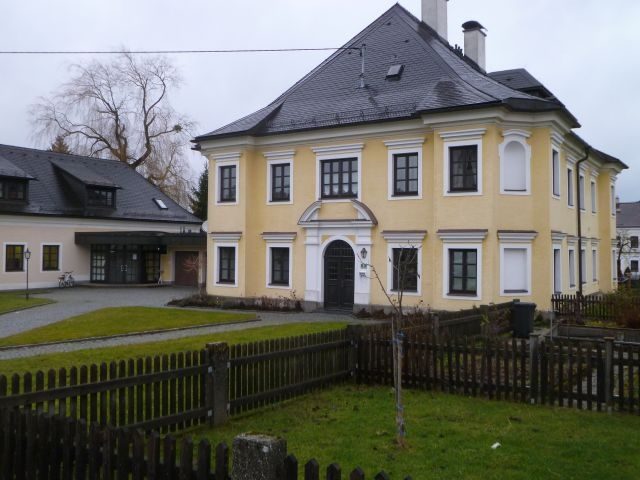
In the municipality of Eberschwang in Upper Austria, Eberschwang Castle, once a moated castle, now serves as the rectory.
History+
The origins of Eberschwang Castle likely date back to the 13th century, when it was owned by the Kirchsteiger family. After their extinction at the end of the 14th century, it became the ancestral seat of the knightly family of Pewntner, documented from 1447. Georg Peuntner, the last of his line, died in 1527. His widow and daughters sold the property between 1503 and 1530 to Hanns Marschalk. Under Hans Caspar Marschalk, a new building was constructed in 1542, and the family was elevated to the nobility in 1557. After the Marschalk line died out, Eberschwang passed to the related Barons of Tattenbach, who were enfeoffed with it around 1600. Count Gottfried Wilhelm von Tattenbach-Reinstein had the wooden predecessor building replaced by the current stone castle around 1668. In 1684, it was made available to the pilgrimage church as a benefice house. During the War of the Spanish Succession, Eberschwang was plundered by Austrian hussars in 1704. Maximilian Franz, Imperial Count of Tattenbach-Rheinstein, united it with his domain of Aurolzmünster in 1735. Following the Treaty of Teschen in 1779, Eberschwang, along with the Innviertel region, became part of Austria. The benefice was abolished in 1785. After the death of Heinrich, Count of Rheinstein-Tattenbach, in 1821, it was long owned by the Counts Arco-Valley, until Pastor Johann Schuster acquired the estate in 1858 and converted it into a rectory. Today, it is owned by the Diocese of Linz.
Source: Wikipedia · Licence: CC BY-SA 4.0 · Image: http://commons.wikimedia.org/wiki/File:Schloss_Eberschwang_mit_Pfarrbibliothek.jpg?uselang=de
This description draws on the facts documented in the linked Wikipedia article; Wikipedia content is licensed under CC BY-SA 4.0. Wording and editing: Mobile History.
Location: 48.1555, 13.5621