CastleEckental-Eckenhaid

Eckenhaid Castle
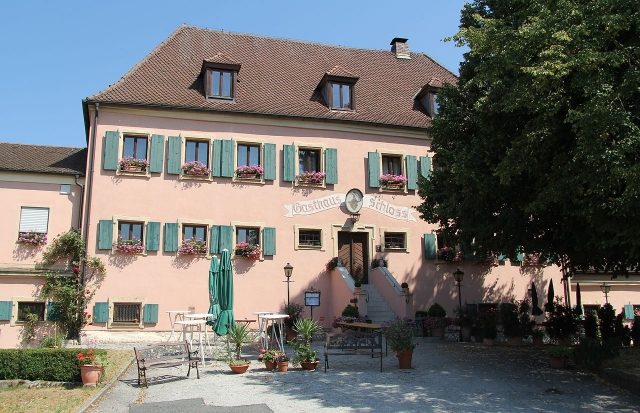
Eckenhaid Castle

Restaurant

Eckenhaid Castle is a massive, symmetrical hip-roofed building, constructed around 1790 using older walls within a former castle complex, of which only minor remnants survive today.

The place first appears as "Eckinhaide" in 1278. As imperial property, it was pledged by King Rudolf I to the "strenuo viro" Brandario (Ruger von Brand) for 100 pounds of Nuremberg Heller. Therefore, a Brander is also found as the owner of the imperial village of Eckenhaid in the so-called Nuremberg Imperial Salbuch of about 1300. However, there is no mention of a castle here. The pledging continued for a long time: in 1304, with the consent of King Albrecht, the Nuremberg Imperial Schultheiß Konrad Eseler took over the pledge after he had redeemed it at his own expense. It was not until 1339 that Emperor Ludwig the Bavarian could again dispose of the property and pledged it to Friedrich and Johann Fischbecken for their services rendered to him in Italy and Germany. In 1376, Niklas von Wendelstein, King Wenzel's master chef, had taken over the pledge. Ulrich von Wolfsberg redeemed it for the king in 1383 and took it into his own possession as a pledge. In 1387, the Nuremberg patrician Ulrich Muffel acquired the imperial pledge and established a longer-lasting tradition of ownership for the first time. In 1414, Niklas II. Muffel was enfeoffed with the imperial fief of Eckenhaid by the king, followed in 1426 by his son Niklas III. Muffel as a vassal.

While the Muffel family had significantly influenced the fortunes of the imperial city since the 13th century, its reputation reached a low point in 1469 when the owner of Eckenhaid, Niklas III, was accused of embezzling city funds and sentenced to death. After these dramatic events, the Eckenhaid estate fell to his sons Gabriel, Hieronymus, and Heinrich, who agreed in 1475 to transfer Eckenhaid to Gabriel. From him, Jakob Muffel inherited it in 1498, whose portrait was so masterfully preserved for posterity by Albrecht Dürer.

When a fortified residence was built on the imperial fief remains unclear to this day. A report from the Schnaittach district court to the Bavarian State Directorate Amberg from 1806 remained somewhat enigmatic and without further description. At that time, superiors were informed that in Eckenhaid, not only the "Castrum in the village" left by the Muffels was to be found, but also outside the village the meager remains of a castle, which was called "old castle or Marienburg" here. However, no further information about this second, older castle has been found so far.

The Muffel castle met its end in the Second Margrave War when it was burned down by the margravial troops on June 2, 1553. Gustav Voit and other authors report that the residence was no longer restored. According to Wilhelm Schwemmer and Gustav Voit, the castle site was not rebuilt until 1711. Doubts are appropriate here. When Carl Sigmund Muffel died around 1710, he bequeathed the administration of the castle and estate, by then part of the family foundation, to his cousins Georg Tobias and Christoph Jacob Muffel. The heirs merely stated in 1711 that the testator had neglected much of the Eckenhaid buildings and, above all, had allowed the Voithaus to fall into ruin. Finally, the brothers expressly applied for the construction of a new staff residence. Georg Tobias Muffel argued for years later with the Sebaldi Forest Office about permission to rebuild the two-story administrator's house. He explicitly referred to the "narrowness of the castle in Eckenhait," meaning a then habitable castle, but one that was too small to accommodate the servants.

Even before the foreseeable extinction of the Muffel of Eschenau in 1784 and the then inevitable reversion of the fief, a fierce struggle apparently began between the imperial city and Electoral Bavaria, which claimed state sovereignty, over the fiefdom. The electoral government was of the opinion that Eckenhaid and Marquardsburg were landed estates in the Duchy of Upper Palatinate, therefore the emperor absolutely had to enfeoff a "local nobleman" and not a Muffel heir. Electoral Bavaria ultimately prevailed and in 1789/90 presented the electoral fief provost and Sulzbach government official Karl Theodor Graf von Bettschart, whose father had been born a commoner and had had a brilliant career as an official. The Count defended himself against later accusations by referring to the poor condition of the estate and the numerous debts he had taken over from the widow Muffel.

The castle building was so damaged in 1790 that the new owner, according to his own statement, had large parts of the building, which largely consisted of half-timbered walls, demolished because "the repairs would not have lasted long anyway." The castle building was expressly "almost completely rebuilt, and solidly so," using older solid parts. The new castle was designed with three stories; the two new residential floors rest on the "large cellar," a high basement divided into several barrel vaults. Around 1790, five rooms and a hall were set up on the upper floor for the lord's stays. On the ground floor, there were three parlors and chambers each, and a prison for the Bettschart lower court. A large vaulted kitchen with an adjacent pantry was probably housed in a single-story annex at that time.

In 1806, the castle was occupied by French troops and severely damaged in its furnishings. The valuable wallpapers hung in the rooms are said to have been torn down. With the death of Count von Bettschart on February 4, 1820, in Munich, the fief reverted to the Bavarian state, which took over the knight's estate under its own administration. The count's administrator, Karl Alois Münzer, was taken over by the state and was allowed to retain his office and his official residence on the upper floor of the castle. However, due to years of neglected building maintenance, which the administrator personally blamed on the Count, the castle building was considerably dilapidated in 1820. In 1823, the Bavarian state therefore carried out extensive repairs.

Eckenhaid Castle was administered by the state for only a few years and was soon sold again. Under private owners, a guesthouse was established in the castle, which led to some changes in the internal wall structure of the lower residential floor. The remaining castle facilities have been gradually reduced since the 19th century; only a few remnants of the fortifications, a small square tower, and a remnant of a roundel built from large ashlar stones have been preserved. It was probably built in the late 15th or early 16th century as a bastion at a corner of the defensive wall.

Take Mobile History with you

You are reading this text for free. Premium adds what matters on the road: descriptions read aloud, sites found through your camera, whole regions taken offline.

  • Every description, including the ~17,700 Premium sites
  • Audio guide: have descriptions read to you on location
  • AR finder: see sites through your camera, with distance and bearing
  • Unlimited saved sites

14 days free, then from €2.99 a month. Cancel anytime.

Source: Wikipedia · Licence: CC BY-SA 4.0 · Image: http://commons.wikimedia.org/wiki/File:D-5-72-121-42_Eckenhaid_Schloss_Hauptgeb%C3%A4ude.jpg?uselang=de

This description draws on the facts documented in the linked Wikipedia article; Wikipedia content is licensed under CC BY-SA 4.0. Wording and editing: Mobile History.

Location: 49.5790, 11.2265