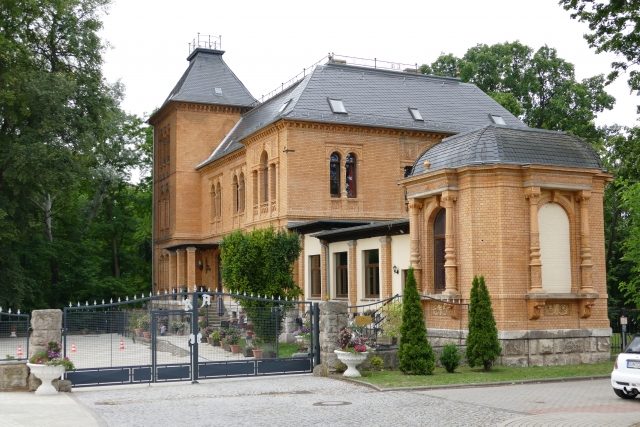
CastleEckstedt

Eckstedt Castle

Eckstedt Castle

To be privately owned

In 1191, the community was first mentioned in a document. In 1279, a Berthold II. Vitzthum von Eckstedt is verifiable in documents. In the 13th century, there was already a castle, which was destroyed again. In 1342, the Archbishop bought back the Vitzthum office. In 1440, a new castle was built. In 1492, a connecting ditch was built between Eckstedt and Schwansee for its irrigation. In 1525, the Peasants' War had an impact on the surroundings of Erfurt. In 1556, the noble family Vitzthum von Eckstedt had the Eckstedt Castle rebuilt.

During the Thirty Years' War, Eckstedt suffered greatly. In 1635, 121 people died of the plague. In 1640, robbery and devastation occurred by soldiers of the imperial army. In 1641, a large fire raged in the village, only 6 houses remained standing. After the reconstruction, a fire of the rectory and school building occurred in 1697, and a fire of the mill in 1719. From 1740 to 1744, the current church "St. Stephanus" was built. Before 1780, the castle burned out, and in 1860, it was demolished. In 1882/83, a new large, castle-like villa with classical elements was built. The castle and estate frequently changed owners, and in 1927, they were acquired by Rudolf Harnisch.

From the mid-17th century, the noble town belonged to the Amt Großrudestedt, which became part of the Duchy of Saxe-Eisenach in 1672 and came to Saxe-Weimar-Eisenach in 1741. In 1850, the noble jurisdiction was abolished, and the town has since belonged to the administrative district of Weimar of the Grand Duchy of Saxe-Weimar-Eisenach. In 1862, the construction of the new school building began. In 1884, the construction of the Weimar-Großrudestedt railway line followed. In 1905, the construction of the first water supply pipeline began, partly still in operation today, and the following year, the electrical power supply.

During the Second World War, 68 women and men from Poland, France, Yugoslavia, and Italy had to perform forced labor in agriculture.

Eckstedt was occupied by US troops in April 1945, and by the Red Army in early July. In 1945, the estate owner Rudolf Harnisch was dispossessed in accordance with the laws of land reform in East Germany. The castle was to be blown up, but this was prevented by the community at the last moment. The MAS/MTS moved into the area of the farm buildings, then until 1990 the Erfurt agricultural machinery repair company, and the administration and apprentices moved into the castle. In 1952, in the course of an administrative reform, Eckstedt became part of the district of Erfurt in the newly formed district of Erfurt.

Take Mobile History with you

You are reading this text for free. Premium adds what matters on the road: descriptions read aloud, sites found through your camera, whole regions taken offline.

  • Every description, including the ~17,700 Premium sites
  • Audio guide: have descriptions read to you on location
  • AR finder: see sites through your camera, with distance and bearing
  • Unlimited saved sites

14 days free, then from €2.99 a month. Cancel anytime.

Source: Wikipedia · Licence: CC BY-SA 4.0 · Image: Mobile Geschichte

This description draws on the facts documented in the linked Wikipedia article; Wikipedia content is licensed under CC BY-SA 4.0. Wording and editing: Mobile History.

Location: 51.0699, 11.1438