CastleBad St. Leonhard im Lavanttal

Ehrenfels Castle
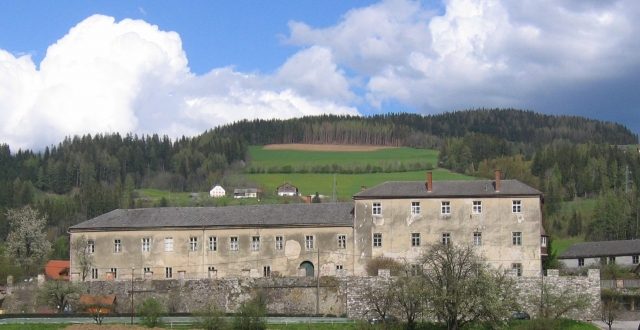
Ehrenfels Castle

To be privately owned

Ehrenfels Castle in Bad St. Leonhard is a castle in Bad St. Leonhard im Lavanttal, a market town in the district of Wolfsberg in Carinthia, Austria.

While the old Gomarn Castle, also known as Veste St. Leonhard, was always the property of the Prince-Bishopric of Bamberg, Ehrenfels Castle remained in private ownership until 1635. It takes its name from the Lords of Ehrenfels, who immigrated to Carinthia from Switzerland. Their ancestral seat was Ehrenfels Castle near Sils in Graubünden. A 14th-century armorial roll shows that the Ehrenfels family had three fish in their coat of arms.

Friedrich von Ehrenfels (around 1200) is mentioned as the first in Carinthia. From 1356–1362, Wulfing von Ehrenfels was a Bamberg administrator and visdom. The von Ehrenfels family owned properties in Styria, such as Kammern and St. Radegund. Wulfing bought a house in St. Leonhard, which his four sons fortified.

At the beginning of the 15th century, the family was at the height of its glory, as simultaneously one of two brothers was the governor of Carinthia, and the other was Bishop of Lavant. With Otto's son Johann II, the von Ehrenfels family died out in the male line. In 1591, Ehrenfels Castle was acquired by Count Georg Nogarol, who, with the permission of the Prince-Bishopric, had a mighty bastion erected around it in 1593. His coat of arms can still be seen several times in the stone bulge of the high wall. Count Nogarol came from old Tuscan nobility and served Ferdinand I (HRR)|Emperor Ferdinand I. After the death of Hans von Salamanca, Count of Ortenburg, he was appointed governor of Carinthia in 1602. He died on December 18, 1619, and was buried in Judenburg. Thereafter, Ehrenfels Castle passed into the possession of his cousin Count von Balmeran, whose wife was a born Porcia. From him, it passed after a few years to Johann Maximilian von Herberstein, who sold it in 1635 to Franz, Bishop of Bamberg and Würzburg. In the same year, this bishop granted the town of St. Leonhard an annual fair before and after St. Leonhard's Day.

In 1759, Ehrenfels, along with the lordship of St. Leonhard, passed into imperial possession. In 1826, the Rosthorn brothers, an industrialist family with smelting and mining operations, acquired the property. In 1846, Count Henckel von Donnersmark took over the Lavanttal operational shares of the Rosthorn brothers and thus also Ehrenfels Castle in Bad St. Leonhard. In 1933, the Swiss forestry company Hespa-Domäne (Hespa = Holzeinkaufsstelle Schweizerischer Papier- und Papierstoff-Fabrikanten), which in turn sold it to its chief forester Franz Eberhard, bought the castle along with the takeover of the Wiesenau lordship. Since 2010, Eberhard's heirs share the castle with the merchant Richard Stückler from Bad St. Leonhard.

After several fires (1762 and 1808), the castle underwent repeated structural changes. Most recently, it was severely damaged by aerial bombs in World War II and repaired in 1949. Worth seeing is the arcaded inner courtyard from the 16th or 17th century, as well as the Gothic entrance gate.

Take Mobile History with you

You are reading this text for free. Premium adds what matters on the road: descriptions read aloud, sites found through your camera, whole regions taken offline.

  • Every description, including the ~17,700 Premium sites
  • Audio guide: have descriptions read to you on location
  • AR finder: see sites through your camera, with distance and bearing
  • Unlimited saved sites

14 days free, then from €2.99 a month. Cancel anytime.

Source: Wikipedia · Licence: CC BY-SA 4.0 · Image: http://commons.wikimedia.org/wiki/File:Schloss_Ehrenfels.jpg

This description draws on the facts documented in the linked Wikipedia article; Wikipedia content is licensed under CC BY-SA 4.0. Wording and editing: Mobile History.

Location: 46.9650, 14.7899