School
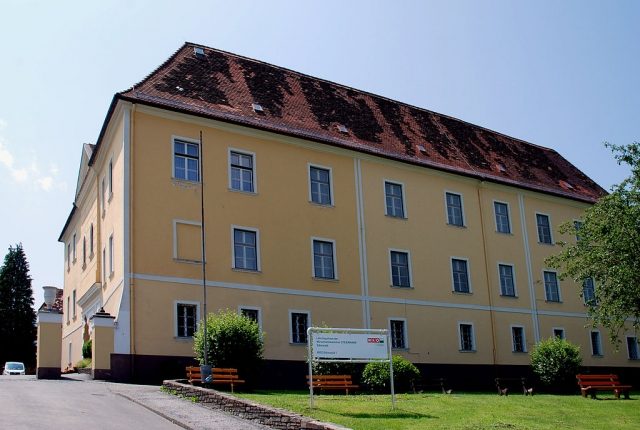
Eibiswald Castle

Eibiswald Castle is a castle in the market town of Eibiswald in Styria. Its history dates back to the second half of the 12th century. Since 1953, it has belonged to the Styrian Chamber of Commerce, which maintains a provincial vocational school there.
At the site of the present castle, there was formerly a castle presumably built around 1170, which was originally probably owned by the Lords of Mureck and secured the road to the Radlpass. It is considered the successor to the "Turmbauerkogel" complex south of Eibiswald, whose beginnings are also dated to the 11th and 12th centuries. At the end of the 15th century, the masonry of the Turmbauerkogel complex was used for the expansion of Eibiswald Castle. When the administrative focus shifted from the Turmbauerkogel complex to Eibiswald Castle cannot be precisely determined; the change is associated with the redesign of the town of Eibiswald during the time of King Ottokar II Přemysl, who was also ruler of Styria from 1261. After the extinction of the Mureck family, the castle came into princely possession. The first documentary mention of the seat dates from 1255, when it was granted, along with the associated regional court, to Herbort von Füllenstein. In the 13th century, the castle was called "Ybanswalde," which can be traced back to a Lord Iwein. In 1294, the estate came as a fief to Hartnid von Wildon. The Wildoners appointed servants who managed the estate for them and, although not related, called themselves after Eibiswald.
The Wildoners were succeeded in possession in 1332 by the Lords of Wilthausen. However, to settle various inheritance claims, they had to pledge the castle to Haug von Tybein in 1345. In 1401, Eibiswald came to Rudolf von Wallsee. During the Walsee Feud, the castle was stormed by mercenaries of Duke Ernst. Only after the peace treaty with the Duke did Eibiswald return to the possession of the Lords of Walsee, who, however, had to briefly pledge it to Leutold von Stubenberg in 1456. Wolfgang von Wallsee sold the lordship in 1464 to Emperor Frederick III, who leased it a few years later to Wilhelm Grassl. After Grassl fell in battle against the Turks, Andree Spangsteiner took over the lease in 1475. In 1479, there was an occupation by the Hungarians. Emperor Maximilian I sold the estate in 1500 to Siegmund von Eibiswald. The Turks invading via the Radlpass devastated the farms belonging to the Eibiswald lordship in 1532, but spared the castle.
In 1572, a fire destroyed the castle. Wilhelm von Eibiswald had the burnt ruin rebuilt into a Renaissance castle. After his death in 1576, the lordship of Eibiswald reverted to the territorial princes. Wilhelm's brothers, Christof and Georg, could not buy it back, but only lease it. Archduke Karl of Inner Austria sold the castle in 1579 to Hans Leyb, who further expanded it. In 1622, the estate came into the possession of Julius Neidhart von Mörsperg, who acquired it as a free allodial property in 1624. Between 1639 and 1674, the Barons of Eibiswald again resided on the estate. After 1674, the castle came into the possession of Otto Wilhelm Graf Schrottenbach and his family. From 1775, Ignaz Ernst Purgay was administrator, from 1784 tenant, and from 1800 owner of the Eibiswald lordship. Since Purgay had debts due to failed speculations, the estate was confiscated in 1820 and sold in 1829 to Friedrich Georg Hansa. The Hansa family remained in possession of the castle until 1883. In 1890, the Vinzenzverein for voluntary poor relief bought the castle and established a boys' boarding school there, which existed until 1938. Since 1953, the building has belonged to the Styrian Chamber of Commerce, which maintains the Provincial Vocational School for Electrical Installation Technology and Radio Mechanics there. The last restoration of the castle took place in 1985.
Description+
The castle is a four-winged, two-story complex around a narrow, rectangular inner courtyard. On three sides of the courtyard are three-story column arcades, which are glazed on the upper floors. The entrance facade in the east has a central risalit from the beginning of the 19th century. The rusticated twin portal from the late 17th century serves as the entrance portal to the castle. The triangular gable above the twin portal dates from the early 19th century and was erected in place of a 17th-century clock tower. Next to the portal is a fresco depicting the castle in the late 17th century. The rooms on the ground floor are spanned by massive cross-rib vaults. On the second upper floor, some heavy wooden beam ceilings can be found. Furthermore, some stucco ceilings from the second half of the 17th century are preserved.
Only a few remnants of the former fortifications remain. Previously, the castle was surrounded by a wall with battlements, which was reinforced in the south by two projecting square towers. Access was via a round gate tower. In front of the castle moat was a round tower to protect the access. The moat was filled in towards the end of the 17th century. In the 20th century, buildings for school operations were erected on the site of the fortifications.
Take Mobile History with you
You are reading this text for free. Premium adds what matters on the road: descriptions read aloud, sites found through your camera, whole regions taken offline.
- Every description, including the ~17,700 Premium sites
- Audio guide: have descriptions read to you on location
- AR finder: see sites through your camera, with distance and bearing
- Unlimited saved sites
14 days free, then from €2.99 a month. Cancel anytime.
Source: Wikipedia · Licence: CC BY-SA 4.0 · Image: http://commons.wikimedia.org/wiki/File:Eibiswald_Schloss.jpg
This description draws on the facts documented in the linked Wikipedia article; Wikipedia content is licensed under CC BY-SA 4.0. Wording and editing: Mobile History.
Location: 46.6841, 15.2437