To be privately owned
Eichenbarleben Castle

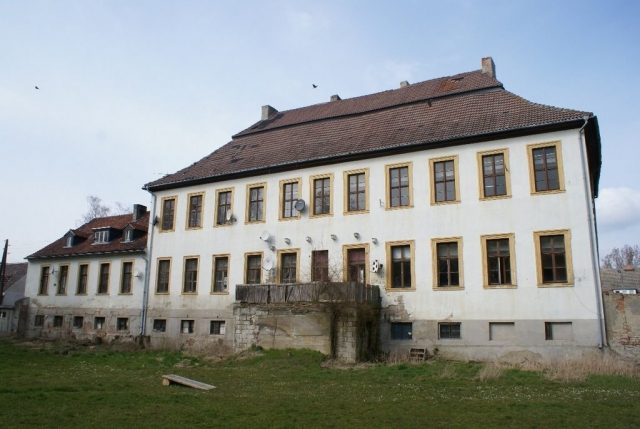
Eichenbarleben Castle is located in the municipality of Eichenbarleben on the road from Magdeburg to Braunschweig, in the middle of the fertile Magdeburg Börde. It was owned by the von Alvensleben family from 1453 to 1858.
Acquired together with Hundisburg Castle, it was elevated to an independent lordship from 1565 by Joachim I von Alvensleben from Erxleben and expanded into a spacious castle complex with round corner towers for his youngest son. Here too, Joachim founded a Latin school, which, however, did not survive the Thirty Years' War.
His successor, Gebhard Johann I von Alvensleben, established an observatory. The residential buildings and corner towers of the castle had to be restored in 1654–1655 after wartime destruction. In 1703, the palace on the north side of the castle courtyard, newly built only in 1654, was abandoned in favor of the manor house built opposite it in 1701–1703, which still exists. Some interiors received stucco decorations in Rococo forms. Details suggest that the Brunswick court architect Hermann Korb, as in nearby Hundisburg, was also active in Eichenbarleben shortly thereafter.
Helene von der Schulenburg, the builder's widow and sister of the lady of Hundisburg, had the corner tower next to the gate and the adjacent building redesigned for herself as the most charming part of the whole. Since 1700, Eichenbarleben had been the main seat of a widely branched line, in which higher military talent repeatedly emerged. The Prussian generals Gustav and Constantin von Alvensleben were born here. Purchased in 1813 by the House of Erxleben II, the castle property passed by inheritance to the Lords von Krosigk in 1858, who held it until 1945. In 1945, the owners were expropriated by the communists.
The reconstruction corresponds to a state that existed from the beginning of the 18th century until 1870. At that time, the main gate was relocated, the moat was largely filled in, and the formal garden was extended to the house as an English park. The castle, destroyed in the Thirty Years' War, must have had a keep and a manor house with Renaissance gables. The church visible in the background, built by Margaretha v. d. Asseburg, Joachim's widow, and renovated in Baroque style by Helene v. d. Schulenburg, is adorned with interesting tombs from the 16th–18th centuries. They convey a good impression of the castle's importance at that time.
Personalities+
- Andreas I von Alvensleben (1495–1565) was lord of Calvörde Castle and lord of Eichenbarleben Castle and Randau Castle.
Take Mobile History with you
You are reading this text for free. Premium adds what matters on the road: descriptions read aloud, sites found through your camera, whole regions taken offline.
- Every description, including the ~17,700 Premium sites
- Audio guide: have descriptions read to you on location
- AR finder: see sites through your camera, with distance and bearing
- Unlimited saved sites
14 days free, then from €2.99 a month. Cancel anytime.
Source: Wikipedia · Licence: CC BY-SA 4.0 · Image: Roland Neubert, Halle (Saale)
This description draws on the facts documented in the linked Wikipedia article; Wikipedia content is licensed under CC BY-SA 4.0. Wording and editing: Mobile History.
Location: 52.1648, 11.3986