School
Elsterwerda Castle
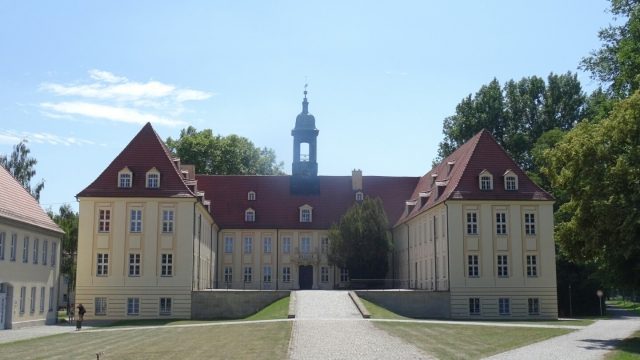
The listed Elsterwerda Castle is a castle complex built in Elsterwerda (Brandenburg) in the 17th century. It was built in place of a previously existing castle, presumably from the 13th century.
Elsterwerda Castle seems to have been founded on the banks of the Black Elster at the end of the 12th or beginning of the 13th century. The exact date has not yet been determined. It served to secure the river crossing of the Dresden-Berlin trade route and as an advanced outpost of the old castle guards Boritz and Strehla in the area east of the middle Elbe. Its construction is probably closely related to the castles of Frauenhain, Saathain, and Tiefenau built at that time.
Elsterwerda Castle was first mentioned in a document in 1288. From a document dated February 18, 1326 (Hauptstaatsarchiv Weimar), it can be concluded that Heinrich von Köckritz was the feudal lord of the Meissen Margrave's castle. In a document dated December 21, 1343, Conrad von Köckritz appears as the owner of the complex, named as "Lord of Elsterwerda". The family remained owners of the complex until the 16th century. Until 1367, the castle and town of Elsterwerda belonged to the Diocese of Naumburg. The castle included the manor, which covered an area of 53 hides and was divided into 2594 tax shocks.
In 1509, Duke Georg of Saxony appeared in Elsterwerda to put an end to the rule of the Köckritz family, after the brothers von Köckritz had attacked and abducted the Hohenleipisch pastor in his house in a robber-knight manner after a dispute. It seemed that other nobles wanted to join the Köckritz family's breach of the peace. In 1512, Otto von Köckritz was the hereditary lord of Elsterwerda, and in the same year, Elsterwerda was sold by the brothers Hanß and Georg von Köckritz to Duke Georg of Saxony for 10,000 thalers. However, they were forced to do so. The Duke, who was without heirs, sold Elsterwerda in 1539 to Christoph von Maltitz. Before he came to Elsterwerda, he was a Saxon councilor and governor of Merseburg. He died in 1546 and converted to Protestantism shortly before his death.
From 1547 to 1567, Haubold von Maltitz, who also acquired the manors of Oelsnitz and Kotschka, and for some time his brother Georg von Maltitz, were lords of Elsterwerda. In 1586, Sigmund von Maltitz (Electoral Saxon stable master and chief forester in Annaburg) came into possession of Elsterwerda. After Sigmund's death, the von Rohr family acquired the property from the brothers Haubold and Georg von Maltitz on March 5, 1612. Under their influence, major construction projects took place in Elsterwerda.
By 1616, after the demolition of the old buildings, a multi-winged complex was erected. An inscription tablet with this year commemorates the builder Bernhart von Rohr and his wife with their names for this construction project. Around 1700, there was a four-winged complex with a surrounding moat. Only on the east side was this interrupted by a ramp leading to the inner courtyard. Presumably, there was also a bridge construction.
Around 1708, Baron Woldemar von Löwendal (1660–1740), Royal Polish Grand Marshal, Privy Councilor and Cabinet Minister, as well as Director of the Chief Mining Council, and also a grandson of Frederick III (Denmark and Norway), acquired the property. In 1716, the Mückenberg manor also came under his rule, which he later bequeathed to his wife Benedicta Margareta von Löwendal. He had large parts of the four-winged complex in Elsterwerda demolished, and an open three-winged complex with short side wings facing east was created. This construction project financially ruined von Loewendahl, and on March 20, 1727, he had to sell the property, including Krauschütz and Kotschka, to King August the Strong for 10,500 thalers.
The new builder, who made the property a chamber estate, immediately began the reconstruction according to the plans of his court architect Matthäus Daniel Pöppelmann. From 1730, Johann Christoph Knöffel with his student Samuel Locke was responsible for the construction. Thus, with the extension of the side wings, the building that essentially still exists today was created. The costs amounted to 21,257 thalers.
August the Strong gifted the lordship on June 4, 1727, to his daughter-in-law and wife of the Crown Prince, Maria Josepha of Austria. In 1728, a lime tree avenue was laid out for the castle's driveway, and after the ascension to the throne of Maria Josepha's husband, King August III of Poland, the castle acquired the character of a hunting and pleasure palace. A pheasantry and a shooting lodge were added west of the castle. The construction work on the grand staircase from the lowest floor to the pleasure garden and the castle tower with a striking clock were completed in 1737. Later, the castle was left to Duke Karl of Courland as a residence, who used it as a summer residence until his death in 1796.
From 1796, the castle remained under the administration of the Saxon Electors until 1814. In 1781, the officer's house was built close to the castle. In 1791, guests at the castle included King Frederick William II, the Crown Prince of Prussia, and the Count of Artois, later King Charles X of France.
Other guests at the castle in 1813 are said to have included Gebhard Leberecht von Blücher, when 30,000 men of his corps camped in Elsterwerda and Kotschka from September 28 to 30 during the Wars of Liberation, and in the same year, Emperor Napoleon.
After the division of Saxony, Elsterwerda came under Prussian rule in 1815. In October 1851, the Prussian Provincial School Board commissioned the Ministry of Culture to establish a seminary in Elsterwerda Castle. Consent was given on April 6, 1852, but the building permit was not granted until 1856. In the autumn of 1857, the renovation work was completed, and on January 6, 1858, it was handed over to the seminary administration. Excluded was the officer's house, which had been sold to the municipalities of Elsterwerda and Krauschütz in 1849. On November 13, 1857, the Royal Prussian Teacher's Seminary was opened with 19 pupils. From 1926, the teacher's seminary was closed, and in its place came the Elsterschloss Oberrealschule, a state secondary school.
In 1938, this school was converted into a high school, which also included the former private school. In 1995, the entire castle complex was extensively renovated and now houses the Elsterschloss-Gymnasium, which is considered one of the most beautiful schools in Germany.
Regular events in and around Elsterwerda Castle+
- February: "Open Day" at Elsterschloss-Gymnasium
- May: Elsterwerda Garden Days
Take Mobile History with you
You are reading this text for free. Premium adds what matters on the road: descriptions read aloud, sites found through your camera, whole regions taken offline.
- Every description, including the ~17,700 Premium sites
- Audio guide: have descriptions read to you on location
- AR finder: see sites through your camera, with distance and bearing
- Unlimited saved sites
14 days free, then from €2.99 a month. Cancel anytime.
Source: Wikipedia · Licence: CC BY-SA 4.0 · Image: Jörg Heldt
This description draws on the facts documented in the linked Wikipedia article; Wikipedia content is licensed under CC BY-SA 4.0. Wording and editing: Mobile History.
Location: 51.4542, 13.5235