To be privately owned
Ennsegg Castle

Ennsegg Castle is located in the city of Enns (Schlossstraße 4) in the district of Linz-Land in Upper Austria.
The prehistory of Ennsegg Castle is related to the former princely Ennsburg. This first princely castle on Georgenberg had become so dilapidated by the end of the 15th century that Emperor Frederick III. in 1483 ordered the judge and council of the city of Enns to construct a new building. For this purpose, four burgher houses were demolished on Ennsberg, and in their place, the princely castle was erected. Just a hundred years later, this new imperial residence was in such a desolate state that a new construction was again considered.
In doing so, the equally dilapidated old castle on Georgenberg was revisited. This was the weakest point in the city's defensive ring, so a reconstruction of the castle and city wall had to be considered. The city council of Enns therefore requested the transfer of the old castle in three letters to the Emperor (1565). It was argued that – if a nobleman were to receive the old castle – the owner and his people would be exempt from the city's jurisdiction, that the costs for the new construction would be very high, and that the city needed an armory for storing military equipment. Emperor Maximilian II nevertheless decided in favor of his deserving Imperial Councillor Georg Gienger. Thus, in 1565, the old castle passed from princely possession to the Vice-Chancellor of the Court, Dr. Georg Gienger (* 1500). Gienger came from a patrician family in Ulm and held numerous positions (Vice-Chancellor of the Court, Imperial Councillor, Landvogt in Swabia, and Burgvogt of Enns). The Emperor allowed his Imperial Councillor to expand the old castle into the current Ennsegg Castle on the condition that he restore the "dilapidated and partly collapsed castle of many years ago" to a good structural condition. The new castle was built between 1565 and 1570. Gienger, in turn, received the right that he would "not be hindered" by the Enns bailiffs for the reconstruction of the castle. This noble free seat then developed into the associated free lordship of Enns. However, the building commissioned by Gienger was significantly smaller than it is today; the so-called "Old Castle" was located at the northeast end of the high terrace and consisted of a two-story arcaded courtyard, the stair tower, and a connecting wing to the city wall.
After Gienger's death († 1577), the property passed to his daughter Ursula, who was married to Ferdinand Helfried von Meggau. His successor was then David Ungnad. His son Andreas Ungnad referred to himself as Lord of Ennsegg in 1601. Since this Ungnad was a Protestant and had participated in the uprising of the Protestant estates against the sovereign, he lost his property in 1623. The castle was confiscated and passed to the Bavarian Councillor Ott Josef von Kirchberg in 1623. After his death, his son of the same name took over the property and bequeathed it to his widow Regina, née Baroness von Hoyos. David Ungnad von Weissenwolff, who had converted back to Catholicism and was elevated to Count by Emperor Ferdinand III, was able to buy back Ennsegg in 1656. The expansion of the castle by the two wings enclosing the large courtyard dates back to him.
In 1722, Ennsegg, along with Roith Castle and Köppach Castle, came as a dowry of Maria Anna Josepha von Weissenwolff to her husband, Prince Johann Wilhelm Trautson. Again as a dowry from their daughter Maria Josepha, Prince Karl Josef von Auersperg received the castle in 1744. In 1794, Vinzenz Prince Auersperg followed him, and in 1838, Ennsegg passed to his son of the same name, Vinzenz.
Due to its convenient location, Ennsegg Castle often hosted illustrious guests: Emperor Franz of Lorraine, husband of Maria Theresia, used Ennsegg as an overnight stop in the spring of 1764 with two archdukes on their journey to Frankfurt am Main. To accommodate the imperial guest appropriately, the Upper Austrian provincial government instructed the city of Enns to bring various furniture and furnishings from Vienna and from the Provost of St. Florian to Ennsegg. Marie Antoinette, daughter of Empress Maria Theresia, stayed in the border town of Enns in 1770. She had been married to the Dauphin of France at the Augustinians in Vienna and now began her journey to her new French homeland with a large entourage (57 carriages) and a carriage drawn by six horses. After the Battle of Ebelsberg (May 3, 1809), Napoleon took up his quarters in Ennsegg Castle. In 1810, Archduchess Maria Luise stayed with her father Emperor Franz I at Ennsegg; she was then on her way to her husband Napoleon. On November 7, 1816, Karoline Auguste of Bavaria, the wife of Emperor Franz of Austria, arrived in Ennsegg. The Austrian heir to the throne, Archduke Franz Ferdinand, was a frequent guest at the castle as a young dragoon officer in the years 1884-1888. The imperial daughter Archduchess Marie Valerie spent the summer months at Ennsegg with her family from 1900 to 1902.
In 1841, Vinzenz Prince Auersperg had the castle park laid out as an English garden and the interiors newly adapted. The park was already intended as a public recreation area at that time. In 1888, Mathilde Princess of Auersperg, together with her sister Caroline, widowed Landgravine Fürstenberg, were the owners. Two years later, Caroline Fürstenberg and Eduard Egon Landgrave Fürstenberg appear as owners, and in 1904, Landgrave Eduard Egon von Fürstenberg alone was in possession. In 1928, Ennsegg came by donation to Marie Caroline Johanna Countess Walderdorff-Fürstenberg. From 1940, her daughters Marie Julie Countess Colloredo-Mannsfeld and Therese Countess Walderdorff were the owners. They were followed by Franz Eugen Walderdorff.
In 2000, the real estate company Dr. Georg Spiegelfeld-Schneeburg & Co KG took over Ennsegg Castle and initiated the renovation of the complex. The city of Enns bought the castle park.
Ennsegg Today+
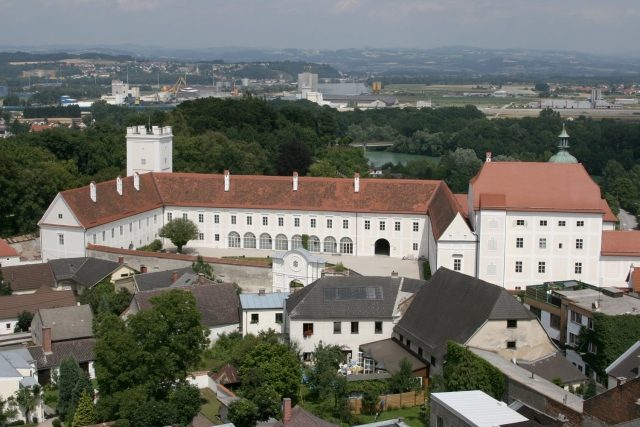
Ennsegg Castle was part of the city fortifications of Enns. The northeast wing rests on a high wall and seals off the city to the north and east. At the northeast corner, a square tower projects from the wall, clearly indicating its function as flank protection for the city fortifications. Instead of a roof, it is covered by a crenellated battle platform.
The castle has two inner courtyards, the larger of which is an arcaded courtyard, and the smaller a cloister courtyard. These courtyards are separated by a longitudinal wing. The larger courtyard is open to the southwest, the smaller to the southeast. The so-called Chapel Tower with a baroque onion dome is attached to the west side of the arcaded wing. Roman finds from Lauriacum (Lorch) are displayed in the arcade. Above the east and west entrances are the coats of arms of the Auerspergs.
The castle chapel, with an octagonal central room and a dome, dates from the second half of the 17th century. It was built into a defensive tower originating from the city fortifications. It is richly decorated with stucco. The frescoes in the wall panels are likely by Carpoforo Tencalla; they depict a cycle of the Life of Mary, a testament to David Ungnad von Weissenwolff's commitment to the Counter-Reformation. The four fully plastic stucco figures represent the Evangelists. The altar was installed around 1800. However, the altarpiece was stolen by American occupation troops in 1945.
The interior of Ennsegg Castle suffered greatly during World War II and the post-war period. Until 1956, the demarcation line, behind which the Russian occupation zone of Austria began, ran directly below the castle.
Today, the castle has been restored. Noteworthy in the eastern part is the Rococo picture gallery, which is now used as a wedding hall. The pictures located there are recessed into the wall. In another hall, there is a magnificent Renaissance-style ceramic stove with the Jörger coat of arms, which comes from Köppach Castle.
Since 2001, the Enns State Music School has been housed in the wing tracts. The castle also serves as a cultural center and registry office. Parts of the building are divided into apartments and office spaces. Various events are held to revitalize the castle, such as Advent events or weddings in the picture gallery or the castle chapel; the castle can also be rented for private events through the municipality of Enns. Guided tours of Ennsegg Castle are possible by telephone appointment.
Take Mobile History with you
You are reading this text for free. Premium adds what matters on the road: descriptions read aloud, sites found through your camera, whole regions taken offline.
- Every description, including the ~17,700 Premium sites
- Audio guide: have descriptions read to you on location
- AR finder: see sites through your camera, with distance and bearing
- Unlimited saved sites
14 days free, then from €2.99 a month. Cancel anytime.
Source: Wikipedia · Licence: CC BY-SA 4.0 · Image: http://commons.wikimedia.org/wiki/File:Enns_03.jpg
This description draws on the facts documented in the linked Wikipedia article; Wikipedia content is licensed under CC BY-SA 4.0. Wording and editing: Mobile History.
Location: 48.2154, 14.4814