CastleRemagen

Ernich Castle

Ernich Castle

To be privately owned

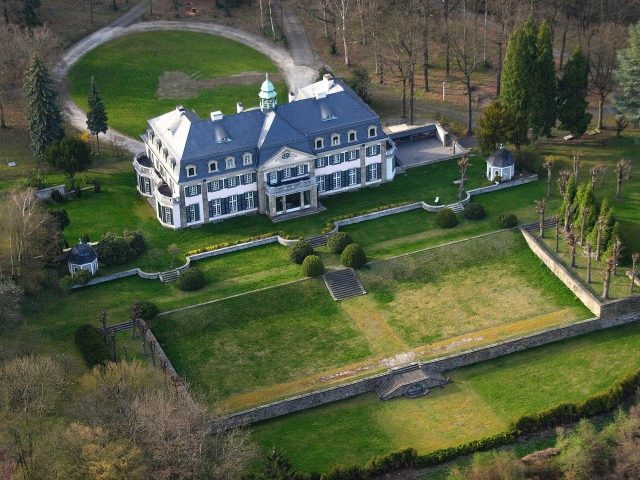
Schloss Ernich (also Haus Ernich) is a Neo-Baroque manor house in Remagen, a city in the Rhineland-Palatinate district of Ahrweiler, completed in 1908. It is located between the city center of Remagen and Oberwinter, high above Federal Highway 9 and the Cologne-Koblenz railway line on the left bank of the Rhine, opposite the city of Unkel. The castle, including its park, is protected as a cultural monument. From 1949 to 1955, it served as the residence of the French High Commissioner, and subsequently until 1999, as the residence of the French Ambassador to the Federal Republic of Germany.

Location+

Schloss Ernich is situated at 134 m above sea level, approximately 85 m above the Rhine, on a plateau-like terrain sloping from west to east, offering views in a southeasterly direction. It is accessible via a private, winding access road from district road 40, which runs parallel to the Rhine and the B 9. A forest path also ends in front of the castle area. As Haus Ernich, it forms a residential area within the Remagen district of the eponymous city.

The house was built from 1906 to 1908 in the Neo-Baroque style for the client Arnold von Guilleaume (1868–1939), a Cologne industrialist, according to a design by the architect and court master builder Ernst von Ihne. It was named after the "Im Ernich" field where the property was located. The groundbreaking ceremony took place on August 12, 1906, and the topping-out ceremony in 1907. On April 18, 1908, the Guilleaume family moved into the estate. Later, several outbuildings were erected on the grounds: a coachman's residence, a bowling alley, and an engine house. In 1910, a large outdoor staircase was built.

Until 1930, Schloss Ernich served as the country and summer residence of Arnold and his wife Elisabeth "Ella" von Guilleaume, née Deichmann. After the end of the First World War, it was taken over by the American occupation forces with 30 soldiers for two years starting in 1919. In 1933/34, the Richardsen family established a hotel restaurant there, particularly popular with Cologne society, for which a new kitchen wing was specially built. The then Reich Chancellor Adolf Hitler is said to have stayed at Schloss Ernich several times during this period, including on April 12, 1937. The hotel ceased operations during the Second World War. Until 1945, the castle was a military hospital. It was again confiscated by occupation troops, this time French, who used the property as an orphanage. Subsequently, it served as a guesthouse for the International Film-Union's temporary employees.

In the autumn of 1949, the French Republic established the residence of its High Commissioner at the seat of government in Bonn at Schloss Ernich. The High Commissioner exercised the Allied control rights over the Federal Republic of Germany for his country and had his office in Bad Godesberg. The castle, with its 40 rooms at the time, was furnished with valuable paintings and Louis XVI furniture, initially at the expense of the state of Rhineland-Palatinate. Accommodation barracks for the French Gendarmerie were built at the beginning of the access road. André François-Poncet, who maintained close ties with the city of Remagen, held the position of High Commissioner. On January 15, 1950, French Foreign Minister Robert Schuman held negotiations with Federal Chancellor Konrad Adenauer at Schloss Ernich regarding the sovereignty of occupied Germany. When this was achieved in 1955 and the Allied High Commission dissolved, the French High Commission was converted into a regular embassy. The castle now served – released from confiscation and rented by France – as the residence of the embassy, the official and residential seat of the French Ambassador; some of the valuable furnishings were replaced. Several French state guests stayed at Schloss Ernich since the founding of the Federal Republic. In 1959, the property, which until then still belonged to the Guilleaume family, also became the property of France.

See also: Embassy of the French Republic (Bonn)

In the course of the relocation of the seat of government, the French Embassy moved to Berlin in 1999 (→ French Embassy in Berlin). The former residence of the embassy now stood empty but continued to belong to the French Republic. Interim considerations by Federal Chancellor Helmut Kohl to use the house as a German-French cultural center after the move failed. In December 2006, the German film producer Ulrich Felsberg acquired the castle from the French Ministry of Finance and began renovations in 2007. The work was largely completed in 2011.

Architecture+

The castle is built in rectangular forms, two to three stories high, features short side wings, and has a mansard roof. The garden front is designed as a representative show facade and faces the Rhine. It comprises eleven axes, three of which are accounted for by a projecting central risalit. This incorporates a single-story entrance portal that supports a balcony and is topped by a triangular gable in classical forms. The facades of the side wings are designed differently: the western one with two semicircular bay-like projections, the eastern one with a single continuous one. The house is adorned with a roof turret.

Southeast of the castle, there is a three-tiered, stepped garden area that extends to the mountain-side edge of the steep slope leading down to the Rhine bank. An observation pavilion is located on the northeastern edge of the castle complex, and a tennis court on the southern edge.

Take Mobile History with you

You are reading this text for free. Premium adds what matters on the road: descriptions read aloud, sites found through your camera, whole regions taken offline.

  • Every description, including the ~17,700 Premium sites
  • Audio guide: have descriptions read to you on location
  • AR finder: see sites through your camera, with distance and bearing
  • Unlimited saved sites

14 days free, then from €2.99 a month. Cancel anytime.

Source: Wikipedia · Licence: CC BY-SA 4.0 · Image: http://de.wikipedia.org/wiki/Datei:Schloss-Ernich-005.jpg

This description draws on the facts documented in the linked Wikipedia article; Wikipedia content is licensed under CC BY-SA 4.0. Wording and editing: Mobile History.

Location: 50.5964, 7.2048