Local government
Ettenheim Castle
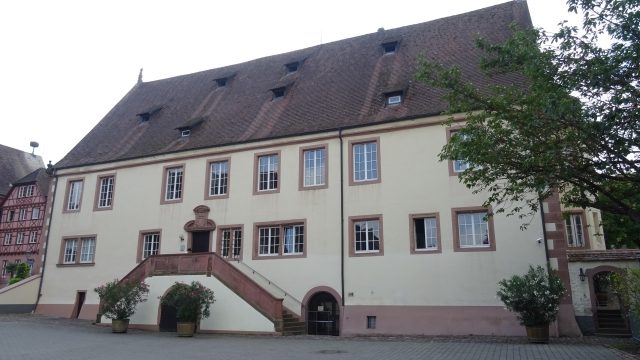
Ettenheim Castle was the last residence of the last Prince-Bishop of Strasbourg, Louis René Edouard de Rohan-Guémené. It is therefore also known as Palais Rohan ('last castle'). Today it serves as the city administration of Ettenheim.
The city of Ettenheim belonged to the secular possessions of the Prince-Bishopric of Strasbourg since the 11th century. In 1560, Bishop Erasmus Schenk von Limpurg erected the building as an official residence in the Renaissance style. The three-story building with a high, also three-story gable roof was built on a much older cellar foundation. Due to its hillside location, the cellar floor is visible from the courtyard. The only architectural decorations are the gable finials, a stone frieze under the gable, and the stone coat of arms above the entrance, which is accessed by a double-flight staircase. The keystone on the eastern gable peak of the bay window facing the market square shows the coat of arms of the builder Bishop Erasmus and the year 1560.
In the 18th century, Ettenheim was expanded in the Baroque style as a secondary residence alongside Strasbourg and Saverne. In 1790, Cardinal Louis de Rohan had to flee from his possessions on the left bank of the Rhine. He initially moved to Ettenheimmünster Monastery until the official residence was transformed into a princely-episcopal residence. In 1791, Ettenheim became the official residence of the Prince-Bishop and the Cathedral Chapter. However, they repeatedly had to flee from the revolutionary troops. It was not until 1801 that the Cardinal could finally return, where he died in 1803. His estate was auctioned off. Only one tapestry of his uncle Armand Gaston de Rohan-Soubise has been preserved and is displayed in the meeting room on the upper floor. There is also a Torah curtain (Parochet) from the former synagogue in Ettenheim. The other tapestries later adorned Mannheim Palace, where some of them can be displayed again.
Behind the official residence was the Vogt's house. Later, the Winter School was built here, which was used as a higher secondary school and an agricultural school. Today, assisted living apartments are located here, and the vaulted cellar is used by a local cultural initiative.
Take Mobile History with you
You are reading this text for free. Premium adds what matters on the road: descriptions read aloud, sites found through your camera, whole regions taken offline.
- Every description, including the ~17,700 Premium sites
- Audio guide: have descriptions read to you on location
- AR finder: see sites through your camera, with distance and bearing
- Unlimited saved sites
14 days free, then from €2.99 a month. Cancel anytime.
Source: Wikipedia · Licence: CC BY-SA 4.0 · Image: Jörg Heldt
This description draws on the facts documented in the linked Wikipedia article; Wikipedia content is licensed under CC BY-SA 4.0. Wording and editing: Mobile History.
Location: 48.2537, 7.8115