CastleEttlingen

Ettlingen Castle

Ettlingen Castle

Museum

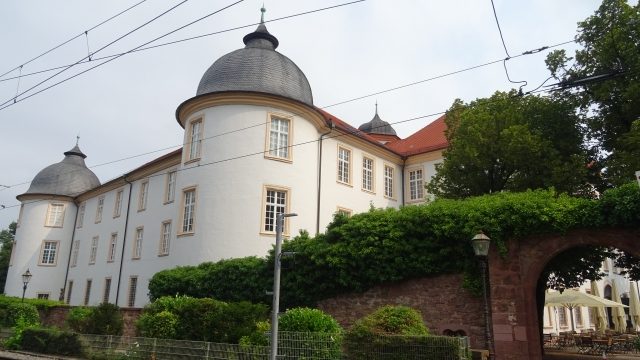
Ettlingen Palace is a Baroque palace in the center of the Baden-Württemberg city of Ettlingen.

The current palace had two predecessor buildings. After Ettlingen was elevated to a city in 1192 by Emperor Henry VI, a medieval castle complex was built in the 13th century to protect the city. Remains of the castle tower, in natural stonework, can still be seen in the current palace courtyard from this complex. The keep, which is still preserved today, dates from the period of further expansion of the castle, undertaken by the Margraves of Baden after they came into possession of the city in 1219.

In the 16th century, a magnificent Renaissance palace followed. Two round corner towers were added to the south wing, and the keep received an upper floor made of half-timbering. The three-winged Renaissance complex around the old keep, completed in 1600, was destroyed in 1689 during the War of the Palatine Succession by French troops, along with the entire city.

Baroque Palace+

Construction History

Margravine Augusta Sibylla decided, after the death of her husband, Margrave Ludwig Wilhelm (Türkenlouis), to take up her widow's residence in Ettlingen. From 1727, she had a Baroque palace built from Lossburg sandstone as her retirement home, using the still existing ruins. The architect of the opulent four-winged palace, completed in 1733, was Johann Michael Ludwig Rohrer. With the death of the Margravine in 1733, a long period began during which the palace was used for various purposes: as a guesthouse, and from 1812 as a military hospital. In 1871, the Prussians housed a non-commissioned officer school here. In 1912, the palace finally came into the possession of the city of Ettlingen.

Palace Courtyard

In the clearly structured palace courtyard, the impressive trompe-l'œil architecture on the south wing is striking. This Baroque illusionistic painting, together with the impressively designed entrance, gives the palace courtyard, restored in 1978, a magnificent nuance. The Ettlingen Palace Festival takes place annually here in summer. The Dolphin Fountain from 1612, designed by the Renaissance master builder Johannes Schoch, is also located in the palace courtyard.

Asam Hall

Augusta Sibylla paid personal attention to the construction of the palace chapel, which was dedicated to the Bohemian saint John of Nepomuk. The painting of the palace chapel was carried out by Cosmas Damian Asam (1686–1739). It depicts the Passion of Saint Nepomuk in 30 frescoes. These are the only frescoes by Cosmas Damian Asam still preserved on the Upper Rhine. Today, the former chapel is the main hall of the palace; it is used particularly for concerts, such as the Schubertiade led by Thomas Seyboldt.

Knight's Hall

Next to the Asam Hall, the Knight's Hall, used by Margravine Augusta Sibylla as a ballroom, with wall paintings in the window niches, a gently curving gallery, and the mighty chandelier from Bohemia, remains one of the most representative rooms in the palace today.

Museum

Today, the palace is a museum and event center. The Albgaumuseum is housed in the building, with a collection on city history and archaeology, as well as a collection of regional art since 1900, especially by Karl Hofer, and also a painting gallery. In the Baroque ambiance of the state rooms, the museum displays East Asian handicrafts.

Take Mobile History with you

You are reading this text for free. Premium adds what matters on the road: descriptions read aloud, sites found through your camera, whole regions taken offline.

  • Every description, including the ~17,700 Premium sites
  • Audio guide: have descriptions read to you on location
  • AR finder: see sites through your camera, with distance and bearing
  • Unlimited saved sites

14 days free, then from €2.99 a month. Cancel anytime.

Location: 48.9403, 8.4058