Hotel
CastleEyba
Eyba Castle
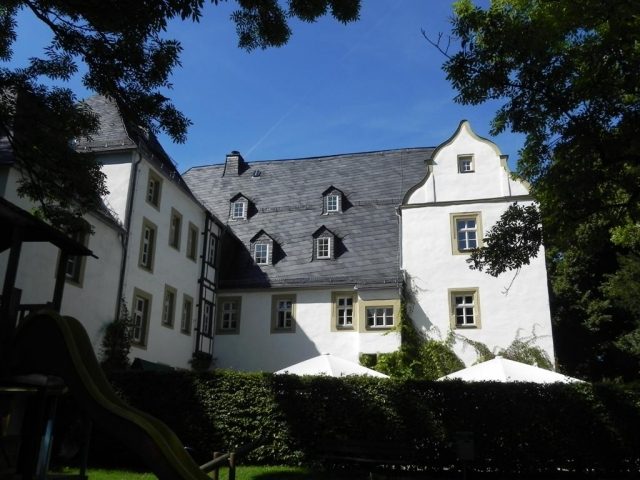
The true age of Eyba remains disputed to this day. Based on general settlement history, assumptions that a manor house already existed in the 9th or 10th century are rather to be denied.
However, the Lords of Könitz, whose ancestral seat was Könitz Castle, are likely to have been the founders of the settlement farm and the village of Eyba. Although members of this family frequently appear as participants or witnesses in documents from the 11th to 13th centuries, unfortunately, no conclusions can be drawn about their residences, especially concerning Eyba.
Eyba is first mentioned in a document in 1348: Albrecht von Könitz has a dispute with a Lord Rüdiger: "... that is the Vogtship in Ywe, the estate in Arnoldisgereute in Wicindorf in Volcmanstorf and what goes as a fief from the aforementioned Lord, which belonged to Heinrich von Beulwitz..."
The Lords of Könitz were vassals of the Counts of Schwarzburg. In Eyba, Heinrich von Könitz and his wife Käthe resided in 1414. The probably childless couple sold their property in 1420/21 to their relatives, the brothers Hartmann II and Jürgen von Könitz zu Kaulsdorf. In 1435, they divided their property, which included Lichtentanne in addition to Kaulsdorf and Eyba. At this time, Eyba was a wasteland. In 1442, Jürgen, also called Georg or Jörg, resided in "Ywe", which had fallen to him in the division. He now also owned the Wickersdorf outpost, which is mentioned for the first time in the "division note", but apparently also lay desolate. Jürgen is likely to have resettled Eyba and can thus be considered its second founder. After his death, his son Michel von Könitz was enfeoffed with Eyba in 1454, and he was succeeded in 1489 by his son Hartmann III. Due to his possessions in Saalfeld monastery villages, he was also a vassal of the Benedictine abbey of Saalfeld, where he held the office of chairman of the feudal court. In 1499, he bought the village of Knobelsdorf from Ulfrich zu Schweinbach, thereby gaining further serfs for his estate. Until 1915, the large speaking tube was kept in Eyba, with which the Knobelsdorf teamsters were once called to forced labor 2.5 kilometers across the Gißra valley from a window of the castle. The childless couple Hartmann III and Elisabeth founded a chapel at the Franciscan church in Saalfeld in 1513. When Hartmann III died, Peter I zu Lichtentanne inherited the property, and after his death, his son Peter II was enfeoffed with Eyba in 1552. His brother Hartmann IV was a co-feoffee.
From 1553–1555, they had a new castle built on the foundations of the old settlement farm in Eyba, which in its essential parts still exists today.
Peter II died in 1558. His inheritance fell to his brother Hartmann IV. Thus, the entire Könitz property was now in one hand. Around 1569, Hartmann IV moved to Eyba and gave up the Lichtentanne estate. In 1569, he established a parish in Eyba. Until then, the church had belonged as a filial to Hoheneiche.
The Eyba succession occurred in 1621, after the death of Veit Ulrich I, a son of Hartmann IV, whose son Hans Adam took over. The Thirty Years' War, one of the most terrible chapters in Eyba's history, falls within the period of his rule. While in peaceful times Eyba's location on the old trade route Leipzig-Nuremberg was a blessing, in times of war it became a curse for the village. Hardly any other place on the Saalfeld Heights suffered so much from looting, violence, murder, and devastating plague. Most of the troop movements between Saalfeld and Gräfenthal that have been handed down to us passed through Eyba. Friend and foe did not differ in their ruthless and brutal behavior.
A nephew of Bernhard Alexander, Johann Ernst von Könitz, inherited the property in 1681. He sold the Kaulsdorf real estate to his brother-in-law there and reacquired Knobelsdorf, which had fallen to his brother Hans Dietrich in an inheritance division. Under Johann Ernst, Eyba experienced a certain heyday. In 1686, albeit only after several requests from the comital authorities, he arranged for the establishment of a school, after Pastor Andreas Bock had already taught the children "of his own free will" in a winter school since 1665. The noble-minded man of God did this, although the 41 years of his pastorate were marked by a continuous struggle with his patron for an improvement in his salary.
Johann Ernst also initiated the church building in 1719/20 on the remains of a previous church. A new hereditary burial place was added on the northern side for the gentry, as the crypt under the church had long been overcrowded.
Two grandsons of Johann Ernst von Könitz divided the property in 1740. Johann Adam Friedrich took over the Saxon part, i.e., mainly Wickersdorf, his brother Anton Ludwig Carl received the Schwarzburg part, i.e., Eyba and Knobelsdorf.
Source: Wikipedia · Licence: CC BY-SA 4.0
This description draws on the facts documented in the linked Wikipedia article; Wikipedia content is licensed under CC BY-SA 4.0. Wording and editing: Mobile History.
Location: 50.6077, 11.3375