CastleBad Windsheim

Eyerlohe Castle

Eyerlohe Castle

The Castle can be visited

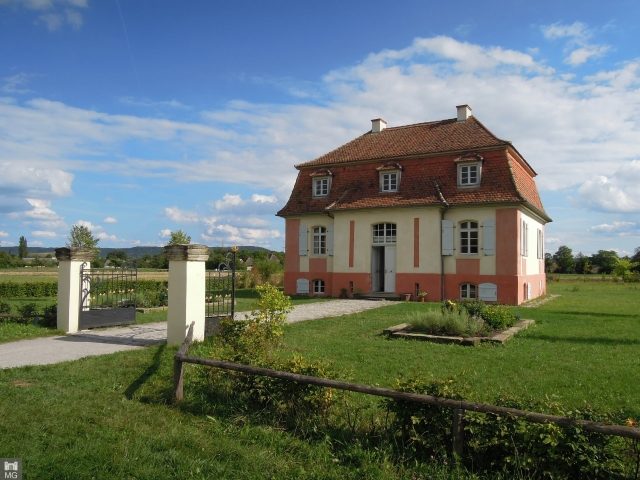
Since summer 2004, a Baroque manor house from Eyerlohe (municipality of Aurach) near Ansbach has been rebuilt in the Franconian Open-Air Museum Bad Windsheim. A permanent exhibition on hunting in the Margraviate of Brandenburg-Ansbach and on the life of nobility and peasants in the 18th century will convey its complex past to museum visitors. Through this exhibition, the manor house will then become the "Hunting Lodge". The opening of the castle and exhibition is planned for the end of 2009.

The builder of the manor house in 1778 was the margravial councilor Carl Friedrich Alexander von Eyb zu Eyerlohe. In the archival sources, the name "Sommerhaus" (summer house) appears for Eyerlohe. Since the estate did not include hunting rights, it cannot strictly be called a hunting lodge. The Barons von Eyb belong to an old Franconian noble family that still maintains possessions in Franconia today. At the time of the manor house's construction, this family belonged to a circle of old-established families who, as court cavaliers, were constantly connected to service in the principality and thus, with some other families, formed the leading stratum of senior state officials.

Barely 30 years after its construction, in 1806, an administrator inhabited the building, and in 1864 it came into peasant ownership. Before its acquisition by the Franconian Open-Air Museum Bad Windsheim (2003), it had been transformed by a modern "farmyard" and structurally pushed back so that it could not be preserved at its original location. Little is known so far about the former use and significance of the castle. Through its acquisition by the Franconian Open-Air Museum, this precious jewel of Baroque cultural and architectural history is preserved for posterity. In addition, it expands the existing museum landscape with its many rural-peasant buildings to include the aristocratic-seigniorial aspect, as once in Franconia, a small castle represented the local lordship in almost every village.

With external dimensions of only ten by twelve meters, the building hardly differs from a larger farmhouse. Its symmetrical facades, laid out in harmonious proportions, are reminiscent of those of the characteristic buildings of the margraviate of Brandenburg-Ansbach's master builder, Johann David Steingruber. The arrangement of the rooms in the floor plan, which is identical on all three floors, is based on 18th-century castle architecture. The color concept of the facade, as reconstructed after the rebuilding in the Franconian Open-Air Museum, is based on restoration investigations and corresponds to that of the construction period.

In the 18th century, hunting was a high privilege of the nobility. It was a status symbol and self-affirmation, staged as a gallant courtly festival for the amusement of guests and the sovereign himself. The aim was to present as much game as possible in an orderly manner for shooting, which ensured absolute hunting success. This was no longer hunting in the sense of stalking. Hunting had lost its original meaning. It now served to justify a single social class. Increasingly elaborate summer and hunting lodges were built, not for permanent residence, but solely for stays in the hunting grounds and serving as a backdrop for festivities.

The Margraves of Ansbach also passionately indulged in the princely privilege of hunting. Margrave Carl Wilhelm Friedrich passionately pursued falconry. This was considered the most distinguished of princely hunts. At his court in 1750, he maintained the largest falconer corps in Europe with 51 people. During his 26-year reign (1729-1757), he hunted 34,429 pieces of game. His son, Margrave Alexander, indulged in the parforce hunt, which he re-established in 1763. During this elaborate chase on horseback for a single piece of game, great damage occurred in forests and fields at the expense of the population. The high position of the builder of our manor house, Carl Friedrich Alexander von Eyb, at the margravial court suggests that he too participated in hunts at that time.

The reconstruction of the manor house in the Franconian Open-Air Museum is supported by the "Förderkreis Jagdschlösschen im Fränkischen Freilandmuseum e.V." (Friends of the Hunting Lodge in the Franconian Open-Air Museum), founded specifically in 2001.
Further income is generated, among other things, by the sale of hand-painted floor tiles, which are produced in the museum's own brickworks and, bearing the donor's name, are laid in a prominent position in the so-called "media room" of the manor house.

Take Mobile History with you

You are reading this text for free. Premium adds what matters on the road: descriptions read aloud, sites found through your camera, whole regions taken offline.

  • Every description, including the ~17,700 Premium sites
  • Audio guide: have descriptions read to you on location
  • AR finder: see sites through your camera, with distance and bearing
  • Unlimited saved sites

14 days free, then from €2.99 a month. Cancel anytime.

Source: Wikipedia · Licence: CC BY-SA 4.0 · Image: Mobile Geschichte

This description draws on the facts documented in the linked Wikipedia article; Wikipedia content is licensed under CC BY-SA 4.0. Wording and editing: Mobile History.

Location: 49.4955, 10.4203