The Castle can be visited
Museum
Fasanerie Castle (Eichenzell)
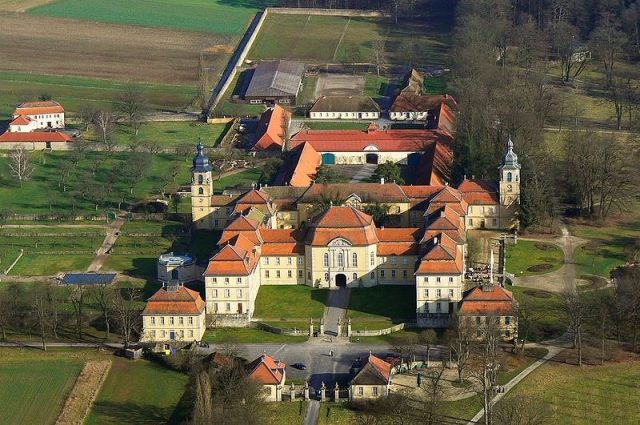
Schloss Fasanerie is a castle in Eichenzell near Fulda. Originally known as Schloss Adolphseck, the 18th-century building is described by the museum administration as Hesse's most beautiful Baroque castle and is accessible to visitors.
Around 1710, a modest country castle was built under Prince-Abbot Adalbert von Schleifras, presumably by Johann Dientzenhofer.
From 1730, the castle was expanded under Prince-Abbot Adolph von Dalberg. This construction, with its gate passage, still encloses the second castle courtyard to the east today. Until 1757, it was splendidly expanded under Prince-Bishop Amand von Buseck according to plans by the princely court architect Andrea Gallasini. The castle served as a summer residence until the mid-19th century. After the annexation of Electorate of Hesse by Prussia, the property was expropriated and finally returned to Landgrave Friedrich Wilhelm in 1878 as a private residence. His wife, Princess Anna of Prussia, resided in the complex until 1918. The castle suffered severe damage in World War II. In 1951, the first exhibition rooms could be opened, and the current museum was established in 1872.
The castle now belongs to the Hessian House Foundation, which exhibits a large part of the art collection of the House of Hesse there. This includes a significant collection of antiquities and an extensive porcelain collection. Since 2010, extensive renovation and restoration work has been taking place, as a result of which the castle is being repainted in its original white exterior color.
Structures+
The castle is a complex of several building wings around a sequence of courtyards. The original building is the old castle (the so-called "Schlösschen," built by the Fulda cathedral master builder Johann Dientzenhofer), which is located in the center of the complex and flanked by two towers to the north and south. To the east, two farmyards with a stud farm that is still in operation today adjoin it, while to the west follow the almost square inner courtyard, as well as the courtyard of honor, centrally bounded by the ballroom building, which dates back to the extensions under Gallasini.
The castle was once surrounded by a Baroque garden, which today can only be recognized in its basic structure. However, for example, the Japanese Teahouse still bears witness to the glorious splendor of the late Baroque era. The estate includes a large park with a variety of different tree species; the naturalist Carl von Linné contributed to its design. This park is surrounded by a natural stone wall up to six meters high.
Take Mobile History with you
You are reading this text for free. Premium adds what matters on the road: descriptions read aloud, sites found through your camera, whole regions taken offline.
- Every description, including the ~17,700 Premium sites
- Audio guide: have descriptions read to you on location
- AR finder: see sites through your camera, with distance and bearing
- Unlimited saved sites
14 days free, then from €2.99 a month. Cancel anytime.
Source: Wikipedia · Licence: CC BY-SA 4.0
This description draws on the facts documented in the linked Wikipedia article; Wikipedia content is licensed under CC BY-SA 4.0. Wording and editing: Mobile History.
Location: 50.5077, 9.7080