CastleUhingen

Filseck Castle

Filseck Castle

Restaurant

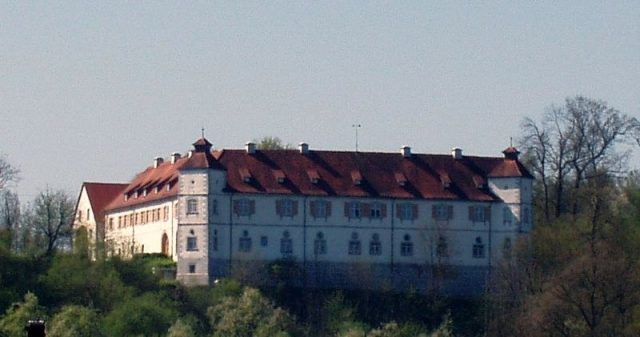
Filseck Castle is situated high above Federal Highway 10 between the towns of Faurndau and Uhingen, offering views of the Filstal valley and the Hohenstaufen mountain, nestled between the Buckelwiese meadow and the Filsecker Feld. The castle belongs to the town of Uhingen in Baden-Württemberg. It can be reached on foot or by bicycle from Uhingen, or by car via Faurndau towards Sparwiesen (a district of Uhingen).

Architecture+

Today, Filseck Castle is a closed four-winged building in the Renaissance style with a vaulted cellar dating back to the Staufer period. The floor plan of the predecessor castle during the Staufer era was – according to archaeological emergency excavations during the restoration in the 1990s – still quite simple, consisting of an inhabited north tower and defensive walls. In 1596/97, Burkhard von Berlichingen built the current north wing, incorporating the Staufer residential tower. In 1736, Karl Magnus Freiherr von Ertingen (or Ertringen) added the second floor to the Staufer east wing, creating a four-winged castle with the same ridge height. In 1850, a modern farm building was constructed. The castle wings received stucco ceilings, and the exterior walls were given new plaster.

The current castle originated from a fortress, presumably built around 1230 by Count Egino von Aichelberg. In 1268, the knight Ernst von Filseck is mentioned in documents. As he was a vassal of Aichelberg, it is likely that the castle was still in the possession of the Aichelbergs at that time. The family remained owners until 1318, when Diepold von Aichelberg, together with his sons, sold the castle to Eberhard I von Württemberg, from whom it passed around 1350 to the Reuss von Reussenstein family, in whose ownership it remained for about 200 years.

In 1568, the Reuss family sold the imperial immediate knightly estate to the Göppingen mayor Balthasar Moser, from whom Dietrich von Gemmingen acquired it only five years later. He sold the unprofitable estate in 1596 to Burkhardt von Berlichingen, who began in 1597/98 to replace the old castle complex with a more comfortable Renaissance-style castle. The current north wing and part of the east wing largely took on their present form. In 1608, Burkhardt left the new building to his five heiress daughters, particularly Anna Margaretha and her husband Colonel Otto von Vohenstein. In 1648, their son-in-law, Major Matthias Georg Fischer von Rob, took over the complex, which remained in the possession of his son Ludwig Friedrich and his wife Anna Elisabeth, née Neubronner von Eisenburg, until 1706.

In 1707, Filseck Castle came into the possession of Lieutenant Colonel Johann Ludwig Emigius von Zweiffel through Ludwig Friedrich's second wife, who sold it in 1710 to the Cistercian monastery of Schöntal/Jagst. Its abbot Benedikt Knittel had a castle chapel established shortly thereafter. Already in 1721, the monastery gave up possession of Filseck and sold the complex to Lieutenant General Baron Carl Magnus Leutrum von Ertingen. Under him, around 1733, the eastern wing extension, the Charlottenhof named after his wife, the castle park, and the avenues were created. In 1739, the castle was held as collateral by Count Christoph Martin II von Degenfeld-Schonburg in Eybach. Ten years later, the completely over-indebted property passed through bankruptcy to the main creditor, the Augsburg banker Christian I von Münch, whose family remained owners until their male line died out in 1920. Under them, the southern farm building was rebuilt in 1851.

When the last male descendant, Oskar von Münch, died in a Heilbronn sanatorium and nursing home in 1920, the castle passed through Oskar's only sister Gabriele to the Barons von Podewils. Like their predecessors, they did not inhabit or manage the estate themselves, but Filseck was leased to the Waggershauser family from 1906 to 1968. After Gabriele's death in 1953, Oskar's second wife Margarete, née von Rohr, inherited the estate. On May 8, 1971, the farm buildings forming the west and south wings burned down in a fire. Margarethe von Podewils then sold the complex to the Stuttgart company Dr. Manfred Beck. Since the fire, countless potential uses for the castle, whether by private individuals or public institutions, had been considered. Almost all failed, not least due to economic viability, although the complex had been included in the state's monument preservation priority program since 1979 with funding of 900,000 Euros. Although the roof was re-covered in 1975/76, the destruction by vandalism continued to advance. The Göppingen district acquired the castle in 1986 to include it in the state of Baden-Württemberg's monument utilization program. Thus, approximately 6.70 million Euros in additional funding were raised. In 1988, the external development could be carried out, and the supply and disposal facilities of the property could be established. The reconstruction and renovation work began in May 1989 and was completed in 1993. The inauguration was celebrated in June 1994. Ultimately, the renovation and new construction cost around 11.5 million Euros. Since January 1, 2002, the complex has been owned by the Schloss-Filseck-Stiftung of Kreissparkasse Göppingen.

Current Use+

Today, in addition to the restaurant and halls, as well as the associated apartments, the castle houses the Cultural Office of the Göppingen district with the district archive and district archaeology. The attic contains documentation on the castle's history from the "Förderkreis Schloss Filseck" (Friends of Filseck Castle).

The halls of Filseck Castle:

In the Dürnitz

This hall once served as a common room for the castle staff, as a chapel for the Schöntal/Jagst monastery at the beginning of the 18th century, and then as a coach house. Today, the hall serves as a room for the castle restaurant, featuring a Staufer-era wall in its floor, archaeological finds in a wall display case, and a battle painting by a Dutch artist.

The Berlichingen Hall

This hall, with its 36 seats, commemorates the builder of the castle. It is adorned with a cast-iron box stove from 1598, designed based on original remnants, with a tiled top.

The Münch Hall

This hall, with its 60 seats, commemorates the Augsburg patrician and banking family von Münch, who owned the castle from 1749 to 1920. The hall has been restored according to historical findings. Ornamental paintings, banded half-timbering and infills, as well as wall paneling characterize the Renaissance room.

District Rooms

The three rooms in the northwest corner of the upper floor are used by the district. They can be rented for events by the district administration. Their catering is only possible through the restaurant's tenant.

The Leutrum Hall

This hall (50 seats) with Rococo-era banded stucco commemorates Baron Carl Magnus Leutrum von Ertingen.

The Waggershauser Room

This room (12 seats) commemorates the family who leased the estate from 1906 to 1968. A painted Biedermeier cabinet and a landscape painting by Eugen Wolff (1873–1937), a painter born in Filseck, adorn the room.

The Moser Hall

This hall in the west wing (50–80 seats) is dedicated to the family who briefly owned Filseck in the 16th century. Its member Johann Jacob Moser was one of the most important European constitutional lawyers of the 18th century.

Take Mobile History with you

You are reading this text for free. Premium adds what matters on the road: descriptions read aloud, sites found through your camera, whole regions taken offline.

  • Every description, including the ~17,700 Premium sites
  • Audio guide: have descriptions read to you on location
  • AR finder: see sites through your camera, with distance and bearing
  • Unlimited saved sites

14 days free, then from €2.99 a month. Cancel anytime.

Source: Wikipedia · Licence: CC BY-SA 4.0 · Image: https://commons.wikimedia.org/wiki/File:Schlo%C3%9F_Filseck.jpg

This description draws on the facts documented in the linked Wikipedia article; Wikipedia content is licensed under CC BY-SA 4.0. Wording and editing: Mobile History.

Location: 48.7008, 9.6044