CastleBad Freienwalde

Freienwalde Castle
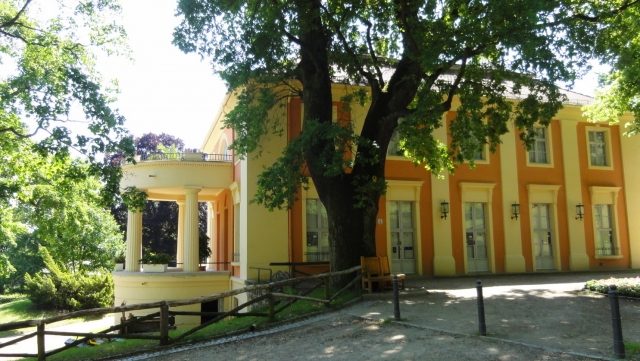
Freienwalde Castle

Cultural Events

Freienwalde Palace was built as the summer residence of the Prussian Queen Friederike Luise, wife of Frederick William II, in Freienwalde in Brandenburg. The more recent history of the building, constructed in the Neoclassical style, is closely linked to Walther Rathenau, who acquired the palace from the crown in 1909.

After the death of King Frederick William II, Queen Friederike Luise had plans for the construction of a summer palace in the south of the city on the so-called Apothekerberg drawn up by the local master builder Anton Hilke. She had already had the area landscaped in previous years and equipped with a tea house (1790). The design was revised in 1798 on behalf of Frederick William III by the Privy Senior Building Councillor David Gilly, who was able to report the successful completion of the construction work almost within the given cost framework of 20,500 thalers in the following year.

The building is a broad rectangular, two-story villa with five or four axes, whose only decoration originally consisted of a continuous string course at the lower edge of the upper floor. The flat roof was formerly only covered with sheet metal.

When the Queen died in 1805, the palace initially stood empty for a time. In 1822, the park was redesigned by the landscape architect Peter Joseph Lenné. In the late 1820s, the Polish Grand Duke Anton Heinrich Radziwill (1775-1833) spent several summers there. During this time, the palace seems to have been renovated, with the facade receiving a vertical articulation through cut pilasters. In 1834, the Grand Duke's daughter, Elisa Radziwill, who suffered from tuberculosis, died here during a cure to which King Frederick William III had invited her.

In 1909, the industrialist, writer, and politician Walther Rathenau acquired the palace and virtually awakened it from its slumber. According to plans by the architect Johannes Kraaz, he had the string course removed, the pilasters smoothed and fitted with capitals, among other things. A semicircular balcony was added to the northern narrow side of the house, and the rectangular window openings behind it were enlarged into an arched window. Rathenau took over larger parts of the largely preserved 18th-century interior furnishings from the Royal Court Chamber and had dilapidated wallpapers renewed. Apart from the merging of two rooms on the ground floor, he refrained from major interior alterations.

After the murder of Walther Rathenau in 1922, his heirs bequeathed the palace to the district of Oberbarnim in 1926, with the condition that Rathenau's intellectual legacy and memory be preserved at this location for all time. After 1945, however, the palace was plundered and almost all traces of remembrance were removed. In the GDR, it functioned as the "Pushkin House."

After the reunification, the palace was taken over again by the district of Bad Freienwalde in 1991, which established a Rathenau memorial there after extensive renovation. The bel étage now houses a permanent exhibition on the history of the building.

In the park of Freienwalde Palace, there is the former royal theater hall, a tea house, where concerts and theater performances have been held again since reunification, as well as film screenings and other artistic performances. In 1995, for example, Circus Krone held an event here.

Take Mobile History with you

You are reading this text for free. Premium adds what matters on the road: descriptions read aloud, sites found through your camera, whole regions taken offline.

  • Every description, including the ~17,700 Premium sites
  • Audio guide: have descriptions read to you on location
  • AR finder: see sites through your camera, with distance and bearing
  • Unlimited saved sites

14 days free, then from €2.99 a month. Cancel anytime.

Source: Wikipedia · Licence: CC BY-SA 4.0 · Image: Jörg Heldt

This description draws on the facts documented in the linked Wikipedia article; Wikipedia content is licensed under CC BY-SA 4.0. Wording and editing: Mobile History.

Location: 52.7840, 14.0315