CastleFrankenburg-Frein

Frein Castle

Frein Castle

Uninhabited

Frein Castle is located in the Frein district of the municipality of Frankenburg am Hausruck in the Vöcklabruck district of Upper Austria.

According to a document from Mattsee Abbey, Frein was owned by Chunrad der Schedinger in 1370. In 1444, Greiff Schöttinger, who lived in Mattsee, was the owner of Freyn. In 1485, Emperor Frederick III granted the deserted seat to Hans Gewmann. In 1560, Sebastian Huber became the owner, replacing the Zärtl von Geboltskirchen in possession. His son Ludwig bequeathed the castle to the Estates of Upper Austria in 1584. Christoph Geymann reacquired it from them in 1593, along with the estate. At that time, Frein was merely a "Holzwerch" (wooden structure). Christoph's namesake son was among the Protestant rebels against the Emperor and had to flee in 1620. The confiscated property was sold by Emperor Ferdinand II to Franz Christoph von Khevenhüller in 1626.

Between 1674 and 1684, the property belonged to Baron Veit von Gera, then it returned to the Khevenhüllers until 1810. The property, united with Kogl Castle, was bought by Dr. Pausinger. Franz Schaupp acquired the castle with the forest and estate of Frankenburg from the Pausinger-Frischberg family in 1849. Schaupp was one of the co-founders of the Zipf Brewery. The brewery dynasty remained the owner until 1942, when the last of the family, Emilie Schaupp, died childless. The former baronial family Limbeck von Lilienau, grandchildren of Wilhelm Schaupp, were appointed as heirs by the last namesake. Due to inheritance disputes, the castle was used by local Nazi officials until the end of World War II. Afterwards, ethnic German war refugees were quartered there for two years.

Today, the building houses a local history museum, the seat of the Frankenburg Forest and Estate Administration, and the archive of the Frankenburg Local History Association. The owner and lord of the castle is Christian Limbeck-Lilienau, who lives in Vienna and made headlines in 2007 when he provided free accommodation in the building to the refugee family Zogaj.

Currently, however, the castle is empty, as a sale to the municipality did not materialize.

Description+

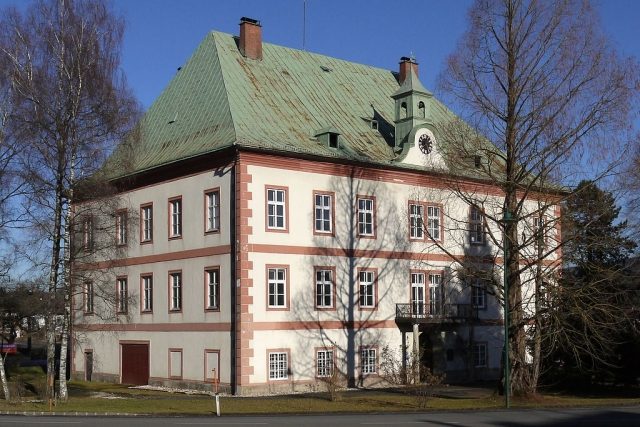
Frein Castle is a three-story building erected on a rectangular footprint with a high hip roof. Originally, Frein was a moated castle, but its moat was filled in on the access and street sides. The current building dates from the 16th and 17th centuries. A water-filled moat is still preserved at the rear. Access to the interior of the castle is provided by a round-arched granite portal. Above the portal is a balcony resting on two columns, from which a double door leads inside. The wrought-iron balcony railing is artfully crafted. Above the gate axis is a round gable with a clock and a superimposed turret. The facade is structured with reddish fascias, and the windows are also framed in the same color. The castle was renovated in 1950.

Take Mobile History with you

You are reading this text for free. Premium adds what matters on the road: descriptions read aloud, sites found through your camera, whole regions taken offline.

  • Every description, including the ~17,700 Premium sites
  • Audio guide: have descriptions read to you on location
  • AR finder: see sites through your camera, with distance and bearing
  • Unlimited saved sites

14 days free, then from €2.99 a month. Cancel anytime.

Source: Wikipedia · Licence: CC BY-SA 4.0 · Image: http://commons.wikimedia.org/wiki/File:Frankenburg_Schloss_Frein_2.JPG

This description draws on the facts documented in the linked Wikipedia article; Wikipedia content is licensed under CC BY-SA 4.0. Wording and editing: Mobile History.

Location: 48.0672, 13.4827