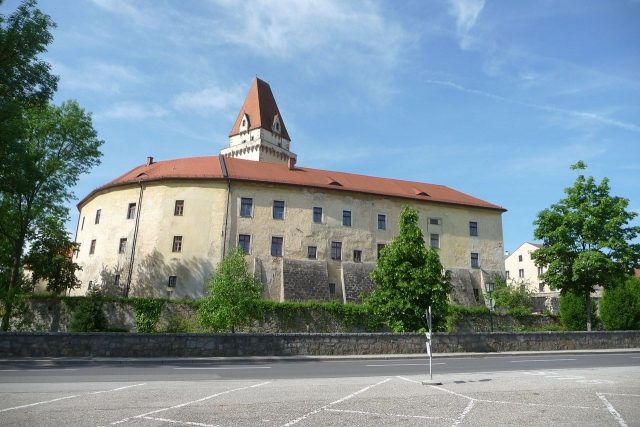
CastleFreistadt

Freistadt Castle

Freistadt Castle

Museum


Freistadt Castle in the Upper Austrian Mühlviertel was built between 1363 and 1398, including its keep, and served to strengthen the fortifications of the city of Freistadt. Today, the castle houses the tax office and the Mühlviertler Schlossmuseum.

The castle was built as a reinforcement of the fortifications starting in 1363. Duke Rudolf IV, the Founder, commissioned the construction of the castle. Until its completion, all possessions in the Freistadt regional court were subject to a tax: farm, hube, fief, and homestead. After Rudolf's death (1365), his brothers Leopold and Albrecht continued the construction, and in 1397/98 the new castle, including the keep, was completed. Until 1440, some repairs were carried out, and at the end of the 15th century, the keep was probably also raised.

The castle replaced the old castle in Salzgasse, the Altenhof (today: Salzhof). From then on, the new castle served the sovereign as the administrative building of the Freistadt dominion with its administrative seat in Freistadt (which included, among others, Leopoldschlag, Neumarkt, Schenkenfelden, and Rainbach) and as accommodation for the administrators of the dominion. The second administrative seat of the Freistadt dominion was Schloss Haus (from the 18th century). With the simultaneous expansion of the other fortifications, the castle strengthened the city's defensive power. Nevertheless, the castle was the weakest link in the chain of defense lines.

Then as now, the castle could be reached by two paths: on the one hand, through a gate on the main square, and on the other hand, through a gate at the end of Schlossgasse, coming from Böhmergasse, into the outer castle courtyard. The castle itself was additionally separated from the city by a moat and a drawbridge. Even the adjacent bourgeois houses were not allowed to have an exit into the outer castle courtyard at that time. The castle was additionally secured against the city and possible attacks from that side.

During the Hussite Wars and the many border feuds of the 15th century, the castle proved to be a strong bulwark alongside the city. In the 16th century, much was rebuilt; the plans for the reconstruction of the south wing (1588) came from master builders Antonio Cerisora, Ambrosio Solari, and Mert Pogner. Around 1594, the castle served as a refuge for the surrounding population during the Turkish Wars. Only once was the castle plundered by besiegers, in 1626, when the rebellious peasants conquered the city and the castle. The administrator at the time and three Capuchin friars present were locked in the castle chapel and mistreated. The liturgical vessels were stolen, all cupboards and chests were broken open and plundered.

Over time, there were also conflicts between the city and the castle. One point of contention was a "back door" that led from the castle into the Zwinger and over the city moat out of the city, which had already been planned during construction. This allowed the castle residents to leave the city unrecognized, but the gate also posed a security risk, which is why this door was bricked up in the 15th century. In 1584, Hans Christoph von Gera demanded the opening of the door, referring to the lack of escape routes during the two city fires of 1507 and 1516. Ultimately, the sovereign decided in favor of the city, to leave the door bricked up.

Changes of Ownership Over Time

When the Habsburgs needed money, the castle was pledged, so its inhabitants and "owners" changed frequently. The castle was part of the sovereign dominion of Freistadt and was granted as a pledged dominion. Each new owner had their own ideas and wishes, and so the castle - albeit only with the consent of the Habsburgs - was constantly rebuilt and altered. Little written evidence remains of the changes of ownership before 1620. From 1290 to the 14th century, the Wallsee family held the pledged dominion; in 1445, a Reinprecht III von Wallsee is attested as a pledge holder. From 1493 to 1500, the Zelkingers were the pledge holders, before Laßla von Prag held the pledge until 1509. From 1509 to 1620, the Landauer family owned the dominion and the castle. What remained constant was that they did not live in the castle and therefore entrusted administrators with its management, such as Bernhard Jörg zu Roith in 1519 or Hanns Christoph von Gera in 1604. In 1620, Emperor Ferdinand sold the dominion, including the castle, to Count Leonhard Helfried von Meggau, a Catholic ally during the Counter-Reformation. After the extinction of the Meggau family (1646), the property reverted to the Emperor. The pledge holder of the castle until 1700 was Johann Ulrich von Slavata, a son of Wilhelm Slavata and Otilie von Neuhaus, who was married to Maria Franziska Theresia von Meggau (1609–1676). In 1700, Emperor Leopold sold the dominion to Count Ferdinand Bonaventura von Harrach as a free property. His great-granddaughter Rosa married Prince Joseph Kinsky in 1777, and thus the dominion of Freistadt passed to the Kinsky family (princely line). In 1798, the city of Freistadt acquired the castle for 5000 guilders. Princess Rosa moved to the former Capuchin monastery outside the city, which had been dissolved in 1785 and was now converted into a princely castle. The administrative seat of the Freistadt dominion was also moved to the new castle until the abolition of manorialism in 1848.

Known administrators who managed the dominion for the owners and lived in the castle include: Until 1455, Ulrich von Starhemberg, in 1463, a Count von Bierstein, in 1475, Bernhard von Starhemberg, and in 1507, Georg von Lobenstein.

Property of the Municipality of Freistadt

After numerous renovations, the city used the castle as a transit barracks from 1801 (until 1924). The new quarters for passing troops allowed two houses in the city, which had previously served this purpose, to be sold back to citizens. Between 1829 and 1831, a infirmary was also housed there. From 1834 to 1848, the building stood empty, with only a few people living in it. To maintain a permanent garrison, the city donated the entire castle to the imperial treasury in 1853, and it has been state property ever since. Between 1879 and 1937, a garrison was stationed in the "Schlosskaserne" (Castle Barracks). A fire broke out here on May 2, 1880, severely damaging the entire castle and the northern part of the city, including the Böhmer Gate (38 buildings). Since 1924, various offices have been located in the former castle; today, it is the tax office.

After the fire of 1880, Emperor Franz Josef rejected the plan of some circles to demolish the damaged castle tower and had the tower repaired.

Since 1918, the castle has belonged to the Republic of Austria as the successor to the monarchy.

Current Appearance+

In front of the castle is the outer castle courtyard, which can be reached from the main square and from Böhmergasse via Schlossgasse. The former granary with stables (today: youth center) near the keep is located near the passage from the main square. Opposite are the former stables for horses (today: confectionery). The northern end of the square is bordered by the city wall, offering a beautiful view of the Liebfrauenkirche. Between the keep and the youth center, the newest access to the city (footpath) was built a few years ago, leading to the Finster Promenade (former city moat). The outer castle courtyard also serves as a parking lot for cars.

Through a gatehouse, one enters the inner castle courtyard. When the building served for defense, two drawbridges existed - one for a door and one for the entrance gate - whose rollers are still visible. Above the gatehouse is the former castle chapel. In the inner castle courtyard, there are two staircases and a covered walkway on the upper floor ("Gaden") through which one reaches the tax office and the castle museum. In the summer months, concerts and theater performances were often held before the Salzhof cultural center was inaugurated in 2003. The annual Freistadt Christmas market takes place in the outer and inner castle courtyards (usually on the 1st weekend in December).

The most imposing part of the castle is the castle tower - the keep, which is unique in its kind in Austria. The 50-meter-high tower is largely windowless and has a walkway on corbels at a height of 40 meters. A very steep wedge roof with four dormer windows on corbels forms the top of the tower. The Gothic keep is a landmark of the city and can be seen in many illustrations.

Castle Chapel+

The castle chapel was consecrated to the Holy Trinity in 1497. The chapel is located above the passage from the outer to the inner castle courtyard and can only be entered from the inner castle courtyard via several steps. From the outside, the chapel is a square building with two tall pointed-arch windows and one round tracery window. Inside the Gothic chapel, the cross-rib vault is well preserved, and the three-sided choir is conventionally closed. An altar is no longer preserved. Of the usual ecclesiastical furnishings, only the stone sacrament niche on the right side of the choir apse and a basin (baptismal font?) on the left side remain.

The chapel was spared from the fire of May 2, 1880, which broke out in the castle. During the time when the castle was a barracks, the chapel was used as a uniform magazine and was equipped with a wooden floor. Today, the former chapel is part of the castle museum and houses a remarkable collection of reverse glass paintings.

Granary+

The former, listed granary stands southwest of the castle in the outer castle courtyard. The three-story cube was built around 1552 under Georg von Landau. The window arches date from the time of construction (window reveals). On the east front, there is a stepped structure as a supposed merlon of the former battlements of the city wall. Inside, there is a round-arched cellar gate and a rectangular portal with an inverted lintel, marked with the year 1583. The cellar has a barrel vault. In 1982/83, a renovation took place, and today the building is used as a youth center and youth hostel.

Take Mobile History with you

You are reading this text for free. Premium adds what matters on the road: descriptions read aloud, sites found through your camera, whole regions taken offline.

  • Every description, including the ~17,700 Premium sites
  • Audio guide: have descriptions read to you on location
  • AR finder: see sites through your camera, with distance and bearing
  • Unlimited saved sites

14 days free, then from €2.99 a month. Cancel anytime.

Source: Wikipedia · Licence: CC BY-SA 4.0 · Image: http://commons.wikimedia.org/wiki/File:Schloss_Freistadt_3.jpg?uselang=de

This description draws on the facts documented in the linked Wikipedia article; Wikipedia content is licensed under CC BY-SA 4.0. Wording and editing: Mobile History.

Location: 48.5125, 14.5064