Museum
CastleFriedberg
Friedberg Castle
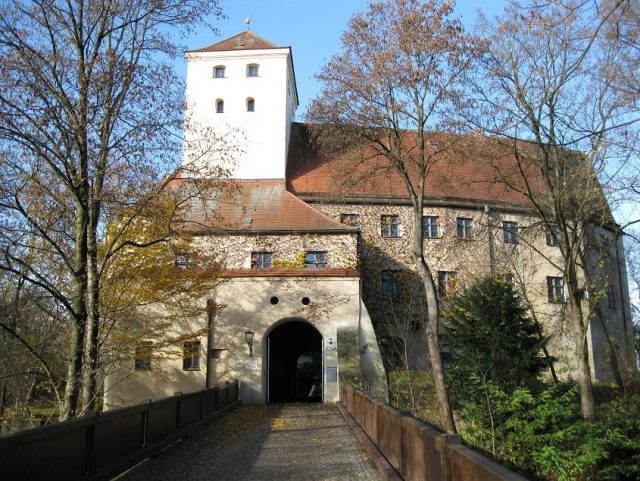
Friedberg Castle or Wittelsbach Castle is a Renaissance complex in the north of the town of Friedberg in the district of Aichach-Friedberg in Old Bavaria, today part of Swabia. The well-preserved monument dates back to a high medieval castle complex of the Dukes of Bavaria and today houses the municipal museum and event rooms.
History+
The unusually deep neck ditch in front of the castle is possibly an indication of an early medieval predecessor complex, perhaps a Hungarian-era defensive castle. Several fortifications from this period are located on the Lechrain between Thierhaupten and Mering, so such a rampart in front of the gates of Augsburg seems quite plausible. Many such rampart castles date back to prehistoric and early historical settlements. In older literature, a Roman watch station or settlement on the castle hill was also considered. The high medieval castle was built in 1257 under Duke Ludwig II the Strict to protect the Bavarian customs station on the border with the imperial city of Augsburg. At this time, the Bishop of Augsburg also tried to expand his prince-bishopric across the Lech. In 1264, the planned layout of the city of Friedberg followed, whose fortifications were connected to the defensive complex.
In 1409, the fortress was rebuilt and expanded under Duke Ludwig the Bearded. In 1541, a fire devastated the complex, which subsequently had to be largely renewed. The design for the new building in simple Renaissance forms came from Jörg Stern. However, the executing construction manager was Narziß Krebs. The medieval castle was expanded with the west wing on this occasion. In 1567, the new castle was assigned to Duchess Christina of Lorraine as a widow's residence, through whose presence until 1575 Friedberg briefly became a center of court life in Bavaria. During the Thirty Years' War, damage occurred, which was repaired by Marx Schinnagel from 1652 to 1656. From 1754 to 1768, a faience manufactory was set up in the rooms. From 1789, the castle served as the seat of the forest administration, later (from 1803) the Rentamt was housed here. Already in 1886, a (art) historical museum was opened in the complex, which is now managed by an academic art historian. In 1982, there was a major redesign of the museum, which was then housed in 14 exhibition rooms on the north and west sides of the castle. From 1977, the Wittelsbach Castle was extensively renovated and converted for use in the south wing by the Surveying Office, which had been located here since 1915. In 2007, the surveying offices of Aichach and Friedberg were merged as part of the Bavarian administrative reform. The seat of the new office is Aichach. The office rooms in Friedberg thus became vacant. At the same time, the city acquired the castle from the Free State and began redesigning the grounds in winter. As a first step, the green belt around the complex was thinned out to better integrate the overgrown ensemble into the cityscape again. The extensive three-year renovation of the building for 23 million euros was completed in 2018. During this, the building was gutted and uniformly redesigned. The castle has since been a center for cultural events; rooms can also be rented for private events. In 2019, Mayor Roland Eichmann and building officer Carlo Haupt received the Bavarian Monument Protection Medal on behalf of the city of Friedberg for the renovation of the castle. In the course of the renovation, the museum in Wittelsbach Castle was moved to the south side and reopened with a new concept and new design in May 2019.
Source: Wikipedia · Licence: CC BY-SA 4.0 · Image: Hubi1802
This description is a machine translation of an excerpt from the linked Wikipedia article. The source text was written by its authors, the translation is by Mobile History; like the original it is licensed under CC BY-SA 4.0.
Location: 48.3578, 10.9792