Museum
Friedrichstein Castle (Bad Wildungen)

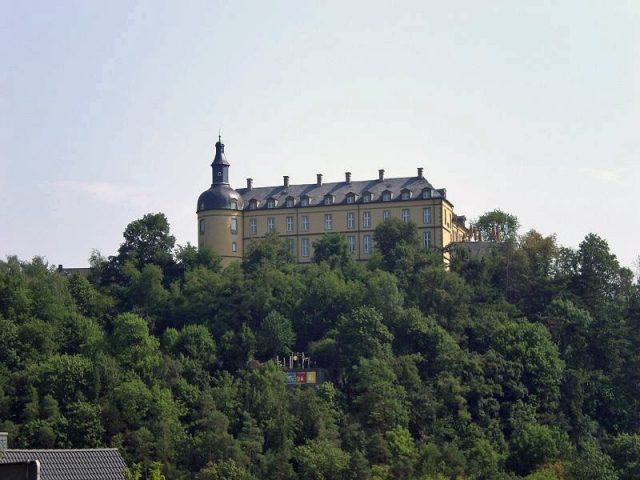
Friedrichstein Castle is a Baroque castle on the Schlossberg in the Altwildungen district of Bad Wildungen in North Hesse. First a Gothic castle, then a Baroque palace, later a youth hostel and hotel, it now serves as a museum and restaurant.
History and Construction History+
In 1200, Count Friedrich of Thuringia, who had become Count of Wildungen through his marriage to Lukardis of Ziegenhain, erected a Gothic castle on the 303 m above sea level mountain. It was the seat of the office, jurisdiction, and administration. In 1260, the Counts of Waldeck became owners of the castle and county of Wildungen.
Count Josias II of Waldeck began the Baroque conversion of the castle in 1663, following a symmetrical, French-Baroque model. His design envisioned a large triangular building complex with two long, sharply converging wings and a small connecting wing. A monumental domed structure was planned at the intersection of the two long wings. By the death of Josias II, who fell as a Venetian general in battle against the Ottomans in Crete in 1669, the western long wing and the main building were completed by the Mengeringhausen master builder Emanuel Brand.
In 1665, the sculptor Rudolf Kippenhahn erected a rusticated portal with a broken pediment and coat of arms. He also designed the Baroque staircase. The widow of Count Josias II had an older wing of the castle, which was still standing, demolished in 1678 and a new one, probably the gate wing, built. However, the Gothic round tower of the medieval castle with its dome and lantern remained.
Count Friedrich Anton Ulrich of Waldeck had the castle renovated between 1707 and 1714. In doing so, he incorporated impressions from his extensive travels and the experiences he had previously gained during the construction of the castles in Bad Arolsen and Bad Pyrmont. He completed the design begun by Josias II by erecting the south wing with the terrace in front of it. He also had the two smaller side wings built. Count Friedrich Anton Ulrich of Waldeck became the namesake of Friedrichstein Castle.
From 1715 to 1719, the stucco work in the Great Ballroom in the south wing was created by the Italian master Andrea Gallasini and the ceiling paintings by his compatriot Carlo Ludovico Castelli. The ceiling painting shows the apotheosis of the House of Waldeck. The castle was thereafter only an occasional residence for Friedrich Anton Ulrich of Waldeck, who was elevated to Prince in 1711. In 1751 and 1757, Markus Christoph Krau created the Rococo decorations in the castle. Some supraports, wall areas above the doors of the late 18th century decorated with relief ornaments or paintings, are by Johann Valentin Tischbein.
During the Franco-Prussian War of 1870/1871, a hospital was set up in the lower rooms of the castle. Subsequently, the castle served as the residence of Prince Heinrich of Waldeck, who, however, moved to Landau Castle near Bad Arolsen in 1897. A forester's residence was then set up in the north wing. In 1906, the premises were renovated and thereafter served as a summer residence for the Waldeck princely family.
After the First World War, due to the settlement agreement with the Waldeck princely house on August 26, 1920, the castle came into the possession of the Waldeck municipal association of the Free State of Waldeck. The castle was leased for residential purposes. In addition, a hotel settled there. In the spring of 1921, the Hessian Mountain Club set up a youth hostel in the lower rooms. In the 1930s, an NSDAP training center was established at the castle. During this time, Hermann Göring was a guest at Friedrichstein Castle several times.
After the Second World War, ownership of the castle passed to the State of Hesse. Today it is an external branch of the Hessian State Museum Kassel. The Hunting Museum exhibits the "Turkish booty" of the Hessian Landgrave Karl. Since 2006, the sculpture trail "Paradisical Experiences" leads around the castle.
Take Mobile History with you
You are reading this text for free. Premium adds what matters on the road: descriptions read aloud, sites found through your camera, whole regions taken offline.
- Every description, including the ~17,700 Premium sites
- Audio guide: have descriptions read to you on location
- AR finder: see sites through your camera, with distance and bearing
- Unlimited saved sites
14 days free, then from €2.99 a month. Cancel anytime.
Source: Wikipedia · Licence: CC BY-SA 4.0
This description draws on the facts documented in the linked Wikipedia article; Wikipedia content is licensed under CC BY-SA 4.0. Wording and editing: Mobile History.
Location: 51.1242, 9.1281