The Castle can be visited
CastleFrýdlant v Čechách (Friedland in Böhmen)
Frýdlant Castle
More pictures
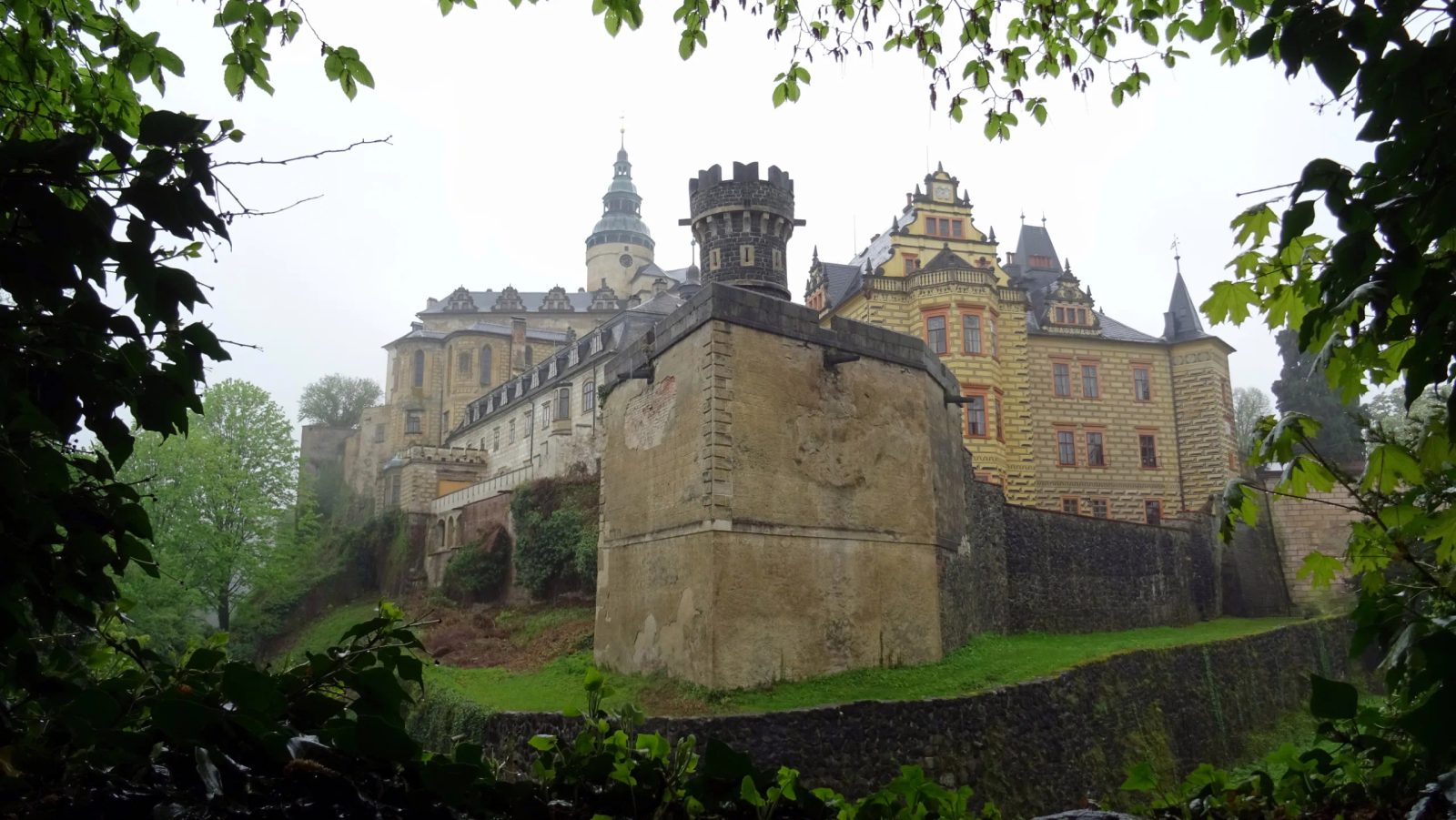
Frýdlant Castle (German Friedland) is located on the edge of the town of Frýdlant v Čechách in the Liberec District, Czech Republic. From 1621 to 1634, the castle was owned by Wallenstein.
History+
The early Gothic castle was built by the Ronow family. The core of the round tower, which still dominates the building today, also dates from this period. In 1278, the castle passed into the possession of the Lords of Bieberstein, who added further objects to it. On April 1, 1558, Friedrich von Rödern acquired Friedland Castle and Lordship for 40,000 thalers from Emperor Ferdinand I. He was followed by his sons, of whom only Field Marshal Melchior von Redern (1555–1600) remained from 1591. According to plans by the Italian architect Marco Spazio, around 1600 the complex in the outer bailey below the castle was expanded into a castle by a three-story wing with sgraffito decorations on the facade. A new castle chapel with a late Renaissance high altar was also built during this construction phase. His son, Christoph von Redern, fought in 1620 as a dragoon officer in the service of the Bohemian rebels (and their Winter King Frederick I) against Habsburg rule in the Battle of White Mountain. After the cause of the rebels was lost, he returned to Friedland Castle, where he shortly after granted refuge to his cousin Joachim Andreas von Schlick, who had fled from Bautzen as a leader of the rebels. Schlick was arrested here on March 18, 1621, by invading Saxon troops and taken to Dresden, Redern escaped to Silesia and Poland, his property was confiscated. On the day of the execution of Schlick, who had been extradited by the Saxon Elector to the imperial special court in Prague, on June 21, 1621, the lordships of Friedland and Reichenberg were pledged to the imperial colonel Albrecht von Wallenstein, who acquired them a year later for 150,000 Bohemian guilders (though de Witte's inflation guilders). Through arrondissements, he combined them with his simultaneously acquired lordship of Gitschin, located further south in Bohemia. Due to the possession of the lordship, Wallenstein was elevated to Duke of Friedland in 1625. After his assassination in 1634, his property was also confiscated and the lordship sold to his adversary Matthias Gallas, the commander-in-chief of the imperial army. From 1757 to 1945, it belonged to the Counts Gallas and later Clam-Gallas. After castle fires at the end of the 17th century, early Baroque alterations were added. 50 rooms in the castle are open to the public. The interior consists of furniture from the last four centuries. Numerous room creations from the 19th century in the Historicism style are completely preserved and were used as living quarters by the owner family until 1945 (especially in the Renaissance wing from around 1600). The original mobile furnishings from this period are also preserved here in rare completeness. Ceramics and porcelain, as well as an armory and a pipe exhibition, can also be visited. The castle kitchen with a collection of copper and pewter dishes dates from the beginning of the 20th century. Both ovens and the grill are still functional. In February 1922, during a recuperation stay in nearby Spindlermühle, Franz Kafka began writing his novel The Castle. In his autobiographical writings, there are few references to the genesis of the castle novel. However, it is considered possible that Friedland Castle could have provided initial inspiration for the material. Later, Kafka stayed in the High Tatras not far from Orava Castle, where Murnau's film Nosferatu had been shot in 1921. Both castles could have served as sources of inspiration for him. A newer trace to the Amber Room leads to Friedland Castle. In February 1945, numerous crates are said to have been transported there and walled up in the castle cellar.
Take Mobile History with you
You are reading this text for free. Premium adds what matters on the road: descriptions read aloud, sites found through your camera, whole regions taken offline.
- Every description, including the ~17,700 Premium sites
- Audio guide: have descriptions read to you on location
- AR finder: see sites through your camera, with distance and bearing
- Unlimited saved sites
14 days free, then from €2.99 a month. Cancel anytime.
Source: Wikipedia · Licence: CC BY-SA 4.0 · Image: Foto: Jörg Heldt (Community)
This description is a machine translation of an excerpt from the linked Wikipedia article. The source text was written by its authors, the translation is by Mobile History; like the original it is licensed under CC BY-SA 4.0.
Location: 50.9152, 15.0839