To be privately owned
Fuchsmühl Castle

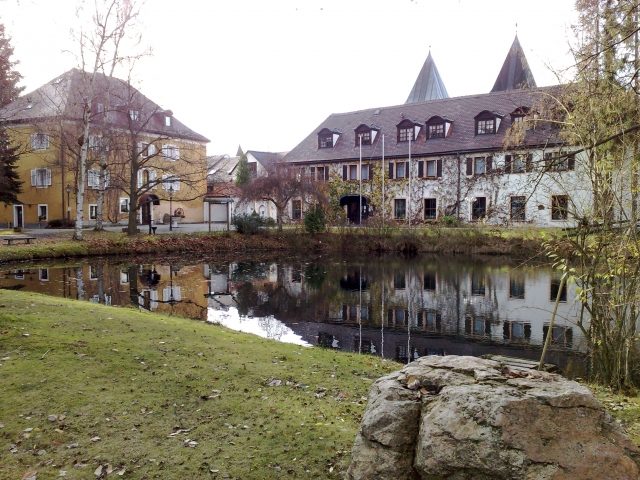
Fuchsmühl Castle is located in the municipality of Markt Fuchsmühl in the district of Tirschenreuth on the eastern edge of the Steinwald in the Upper Palatinate in Bavaria.
The castle grounds consist of the actual castle building, the manor house, and the castle chapel. To the west extends a farmyard with farm buildings and a brewery. To the east and south extends a landscape park with ponds and a gardener's house.
The history of the castle dates back to the 12th century. In 14th-century documents, the present Fuchsmühl Castle is mentioned as the knightly and feudal estate of Fossenmühl. The name is derived from the former owners, the Lords of Fossenhofen.
In 1363, Hans Heckel, a Leuchtenbergian vassal, is mentioned as the owner of the estate in a document. He sold it in 1394 to Landgrave Johann I of Leuchtenberg. Later, it passed as a feudal possession to the knight Konz von Wirsberg.
The Trautenberg Era
The Wirsbergs were followed by the Lords of Trautenberg. The pro-Swedish Trautenbergs abandoned their knightly estate of Fuchsmühl during the Thirty Years' War and fled. In 1587, the Lords of Trautenberg united the Fuchsmühl estate with the Bohemian Landtafel estate of Nacketsdörfel.
During the Thirty Years' War, Fuchsmühl Castle was owned by Johann Philipp Cratz von Scharffenstein, commander of the Upper Palatinate in Bavarian service, who, however, defected to the Swedes. After his capture in the Battle of Nördlingen in 1635, he was beheaded in Vienna. Subsequently, a Colonel Kaspar Snetter is named as the new owner of the castle. Until 1657, the Trautenbergs were again the owners of the castle.
The Froschheim Era (1657 to 1820)
In 1657, Daniel von Froschheim took possession of the castle, followed in 1685 by his son Franz Heinrich Daniel. At his father's request, in 1688 he built a pilgrimage chapel in honor of the Mother of God on the Hahnenberg near Fuchsmühl, which became the origin of the present pilgrimage church Maria Hilf.
In 1672, an electoral secondary toll station of the main toll Kemnath was established in Fuchsmühl, as trade traffic from Leipzig and the Vogtland to Regensburg and vice versa was to take place. Fuchsmühl thus gained access to an important long-distance trade route.
The Froschheim lineage died out with the Royal Bavarian Chamberlain, Government Councilor, and Court Councilor in Amberg, Josef Daniel von Froschheim. Elevated to the rank of Baron on May 1, 1786, he died childless in Fuchsmühl on October 16, 1820.
From 1820 to 1945
Shortly thereafter, King Max I of Bavaria granted Fuchsmühl Castle as a knight's fief to his Minister of Justice, State Minister Friedrich Freiherr von Zentner. In 1843, it was received by Lieutenant General Karl Freiherr von Zoller, then by his son Maximilian Freiherr von Zoller. With him, the line of the first enfeoffed Karl Freiherr von Zoller died out. In 1889, the estate came to Ludwig von Zoller from a collateral line. Under his aegis, the infamous Fuchsmühl Timber Battle took place on October 29 and 30, 1894.
His son Alexander von Zoller sold Fuchsmühl Castle and its lands in 1937 for 600,000 Reichsmark to the city of Augsburg.
From 1945 to Today
From 1946, the Sisters of the Holy Cross from Eger in the Sudetenland found a new home in Fuchsmühl Castle, where they established an orphanage. In 1949, the municipality of Fuchsmühl acquired the castle estate and had the farm buildings converted into apartments. From the 1950s, the main building was used as a guesthouse. Abandoned due to economic problems, it was used by the Seltmann Weiden porcelain factory as accommodation for employees. In 1968, the castle was sold and again operated as a hotel. The owners bequeathed it in 1987 to the Arbeiterwohlfahrt (AWO) Berlin; they used it from 1987 to 2010 as an educational and recreational facility.
Since December 2011, the castle has been back in private ownership.
Take Mobile History with you
You are reading this text for free. Premium adds what matters on the road: descriptions read aloud, sites found through your camera, whole regions taken offline.
- Every description, including the ~17,700 Premium sites
- Audio guide: have descriptions read to you on location
- AR finder: see sites through your camera, with distance and bearing
- Unlimited saved sites
14 days free, then from €2.99 a month. Cancel anytime.
Source: Wikipedia · Licence: CC BY-SA 4.0
This description draws on the facts documented in the linked Wikipedia article; Wikipedia content is licensed under CC BY-SA 4.0. Wording and editing: Mobile History.
Location: 49.9159, 12.1530