CastleSalzburg

Fürberg Castle

Fürberg Castle

To be privately owned

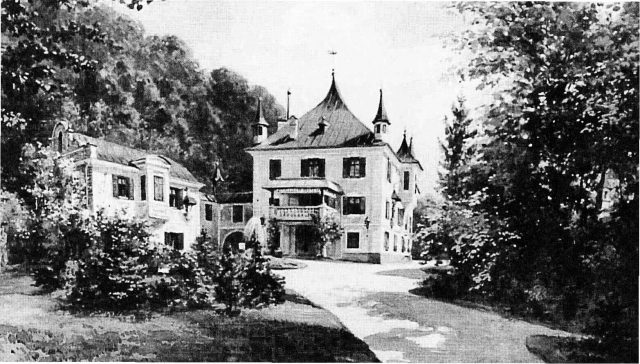
Fürberg Castle, one wing of which is also called Feyertagsstöckl after the Bavarian family Feyertag von Oberhausen, is located at the foot of the Kapuzinerberg in Salzburg at the end of Pausingerstraße (No. 11), formerly Fürbergstrasse. Even the earliest mentions speak of two buildings that for a long time belonged to different owners.

As early as 1316, a "Prädium Fürberg", which was granted to St. Peter's Abbey as an inheritance, is mentioned. In 1360, Abbot Otto I and the entire convent of St. Peter granted the Prädium (estate, property) to the Salzburg citizen Fritz Zchamlin (Zanklein, Zankl). In 1485, the councilor and later mayor Georg Waginger acquired the property. In 1500, his son Virgil (city councilor and mayor of Salzburg) followed him. In 1584, Canon Johann von Küenburg and in 1617, Canon Nikolaus Freiherr von Wolkenstein und Rodenegg, Bishop of Chiemsee, became owners. Wolfgang Feyertag took over the property from him in 1624. After this family, the "Prädium Fürberg", one wing of the present castle, was named Feyertagsstöckel.

Fürberg Castle is first mentioned in documents in 1323. It was built as a castle for a canon, i.e., a high-ranking official of the cathedral chapter and the Prince-Archbishop. In 1490, it was called "Neydeck in Pyrglan circa Imberg" because it was owned by Gregorius Neydeck. He was followed by the princely master of the hunt Ernst von Graben. In 1670, Franz Feyertag von Oberhausen, whose ancestor Wolfgang Feyertag had already acquired the "Prädium Fürberg" next to it in 1624, acquired the Neydeck estate and united the two properties. Franz Feyertag built the present castle on the previously existing farmhouse, exactly according to the plans of the Flederbach estate, which had become a fideicommissum of the Feyertag family through the foundation of his stepbrother and Salzburg mayor Paumann. The Feyertags extended their property to most of the southeast side of the Kapuzinerberg up to its summit, essentially as the property still stands today. They dominated and shaped Fürberg for 250 years. Due to excessive divisions of inheritance at the end of the 18th century, they finally lost the property. The last male descendant of the Feyertags, Kajetan von Feyertag, however, still kept the Feyertagsstöckl, whereby the property was divided anew. His unmarried daughter Anna, the last of her name, finally sold this in 1860.

In 1888, Katharina Wilhelmina von Plason de la Woestyne, née von Schmieterloew, acquired the property and restored all the buildings. She also had a connecting wing built between the Stöckl and the castle. Her husband, the court and ministerial councilor in the Imperial and Royal Foreign Ministry Adolf Ritter von Plason de la Woestyne, redesigned the buildings in Neo-Renaissance style. A landscape park with very rare trees was laid out around the castle according to the plans of the architect Lothar Abel and the head gardener Josef Franz. Under these new owners, Fürberg Castle experienced a new heyday.

However, it was severely damaged on February 29, 1945, by an air raid by the British. The heirs of the Plasons, daughter Mabel, married to Dr. Dusan Toncic Edler von Sorinj, and her son Dr. Lujo Toncic Edler von Sorinj rebuilt the severely damaged property in the 1950s.

The castle has well-preserved towers. The associated chapel is said to date from 1200 and originally represented the end of a Way of the Cross. It was rebuilt in 1648 after a fire three years earlier and renovated in 1893 and 1958. The chapel, like the castle, is equipped with high-quality medieval stained glass.

Fürberg Castle Today+

A semicircular gate in the surrounding wall leads into the landscaped park. A small wild stream with a waterfall flows through the park, which contains several outbuildings, a castle chapel, and a farm near the castle. The Fürberg farm is already shown in the Franziszeischer Cadastral Plan of 1830.

During the Second World War, Fürberg Castle was hit by a bomb and severely damaged. In 1955, a small plane crashed into the Kapuzinerberg and the park of Fürberg Castle. The pilot and three passengers died in the accident.

The castle is still privately owned and is currently not open to visitors.

Take Mobile History with you

You are reading this text for free. Premium adds what matters on the road: descriptions read aloud, sites found through your camera, whole regions taken offline.

  • Every description, including the ~17,700 Premium sites
  • Audio guide: have descriptions read to you on location
  • AR finder: see sites through your camera, with distance and bearing
  • Unlimited saved sites

14 days free, then from €2.99 a month. Cancel anytime.

Source: Wikipedia · Licence: CC BY-SA 4.0 · Image: http://commons.wikimedia.org/wiki/File:Fuerberg-neu.jpg

This description draws on the facts documented in the linked Wikipedia article; Wikipedia content is licensed under CC BY-SA 4.0. Wording and editing: Mobile History.

Location: 47.8035, 13.0626