CastleBad Rappenau-Fürfeld

Fürfeld Castle
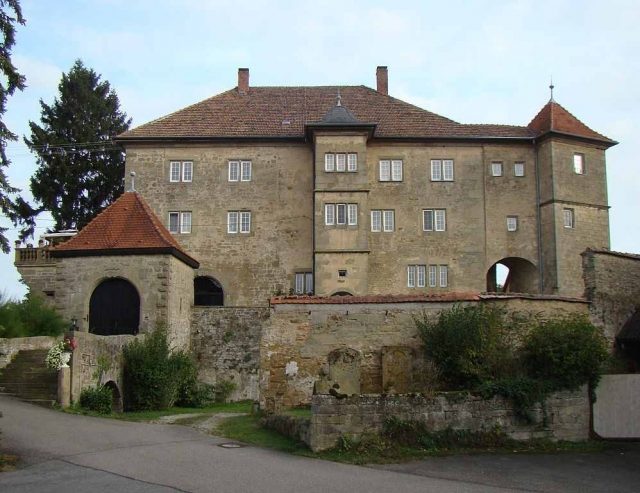
Fürfeld Castle

To be privately owned

Fürfeld Castle in Fürfeld, a district of Bad Rappenau in the Heilbronn district in northern Baden-Württemberg, dates back to a medieval castle and largely acquired its current form in the 16th and early 18th centuries.

In the oldest known mention of Fürfeld to date, the visitation report by Burkhard von Hall from 1288, only a farm in Fürfeld is mentioned. Nevertheless, a castle may have already existed there at that time. By 1380 at the latest, the place was referred to as a town with a castle. The establishment of the town and castle probably dates back to the time of the Staufer emperors in the 12th and 13th centuries. The oldest local lords and owners of the castle are the Lords of Fürfeld, first documented in 1302, who shared a coat of arms and were therefore probably related by lineage to the Lords of Neipperg. The oldest parts of the castle, especially the substructure of the terrace building on the south side, feature the bossed ashlar characteristic of the 12th and 13th centuries.

The Lords of Helmstatt, who were enfeoffed with the castle and town by the Diocese of Worms from 1427, further expanded the castle. The ribbed vault of the tower on the east side of the castle shows the four coats of arms of the families of Helmstatt, von Guttenberg, von Zaiskam, and von Holtzapfel.

After Fürfeld came into the possession of the Lords of Gemmingen in 1516, an expansion of the medieval castle took place under Philipp von Gemmingen († 1544), which is still evidenced today by several building inscriptions and alliance coats of arms of Philipp and his wife Agnes Marschalkin von Ostheim. The inner portal of the castle is dated 1519, the outer portal 1523, and the archway over the access bridge 1535. Pleikard von Gemmingen (1536–1594) had the castle's adjoining lake garden walled and fortified. His name and that of his wife Elisabeth von Nippenburg († 1581) were visible on a Renaissance portal from 1571, which no longer exists today; the initials of the couple are still on the fortification turret of the lake garden, called Schießhäusle, erected in 1577. A wooden pipeline ran through the lake garden, supplying the castle well with water.

There are only a few records from Fürfeld from the Thirty Years' War, but the place, like the entire surrounding area, suffered from the effects of the war. In 1622, in the vicinity of the Battle of Wimpfen, the castle library burned down.

During the War of the Palatine Succession, the castle was destroyed by French troops in 1693. Reconstruction began in 1706 under Johann Dietrich von Gemmingen (1676–1757) and was very costly despite corvée services approved by the Diocese of Worms for the subjects, as Johann Dietrich had already pledged various rights in Fürfeld, Bonfeld, and Wagenbach in 1707. Probably also due to a lavish lifestyle, further pledges occurred, which continued under Johann Dietrich's grandson and heir Johann Philipp Dietrich von Gemmingen (1729–1785), so that the castle and town of Fürfeld were finally under the forced administration of the Knightly Canton of Kraichgau from 1760 to 1786, before Johann Dietrich von Gemmingen (1744–1805) took over the leadership of the House of Fürfeld. The ownership of the castle was divided between his descendants (Stuttgart line) and those of his brother Johann Philipp Dietrich (1729–1785) (Fürfeld line).

In the last days of World War II, a first lieutenant and a company commander were initially quartered in the castle. The German troops withdrew without a fight, so that the town and the castle were spared destruction. From April 4 to 11, 1945, the castle was confiscated to accommodate American troops, after which Polish and Russian civilian workers were quartered there, while the lord of the castle, Dietrich von Gemmingen († 1955), stayed in the tenant's house. Numerous disputes arose, not only between the quartered individuals and the owners, but also between the different nationalities of civilian workers. The field barn and the stable of the castle estate, as well as the cellar of the tenant's house, were plundered multiple times. After most of the civilian workers had been relocated to camps in Weinsberg (Weinsberg camp) and Heilbronn by May 1, 1945, an American company again occupied the castle until May 22. After that, the owner was able to reoccupy the building, but had to provide accommodation for soldiers or displaced persons several times until at least May 1946.

Description+

Fürfeld Castle is located in the southeast of the historic village center of Fürfeld on a slight elevation. Access to the three-story rectangular building with two freestanding corner towers is through a bridge gatehouse from the northwest. The three portals leading into the castle date from 1519 (inner portal) to 1535 (bridge gate portal). Except for a corner in the south towards the former timber yard, the castle is surrounded by a massive wall. To the east, the still partially walled lake garden with the Schießhäusle from 1577 adjoins. North of the castle is the associated farmstead with tenant's apartment and stables. The residential building of the farmstead was erected in 1752.

Parts of the complex that no longer exist today include the Lower Castle of the Stuttgart line of the von Gemmingen family, once located north of the farmstead, the tithe barn at the timber yard south of the castle, demolished in 1979, another tower in the lake garden east of the castle, still present in 1829, and further stables located west of the castle.

In the castle moat, relics of the old Fürfeld church, converted into a barn in 1874 after the completion of the Protestant church, were placed, including the tomb of Anna von Helmstatt née von Neuenstein († 1448), the tomb of Anna von Vellberg († 1471), the heavily worn tombstone of Elisabeth von Nippenburg († 1581), the tomb of Heinrich Otto von Gemmingen (1771–1831) and his wife Elisabetha née Strauß (1777–1824), as well as the tomb of the postmaster Johannes Strauß († 1789). In the course of 2012, some of the tombs were removed.

Take Mobile History with you

You are reading this text for free. Premium adds what matters on the road: descriptions read aloud, sites found through your camera, whole regions taken offline.

  • Every description, including the ~17,700 Premium sites
  • Audio guide: have descriptions read to you on location
  • AR finder: see sites through your camera, with distance and bearing
  • Unlimited saved sites

14 days free, then from €2.99 a month. Cancel anytime.

Source: Wikipedia · Licence: CC BY-SA 4.0 · Image: https://commons.wikimedia.org/wiki/File:Fuerfeld-schloss-2012-3.JPG

This description draws on the facts documented in the linked Wikipedia article; Wikipedia content is licensed under CC BY-SA 4.0. Wording and editing: Mobile History.

Location: 49.2086, 9.0596