Cultural Events
Restaurant
Fürstenstein Castle
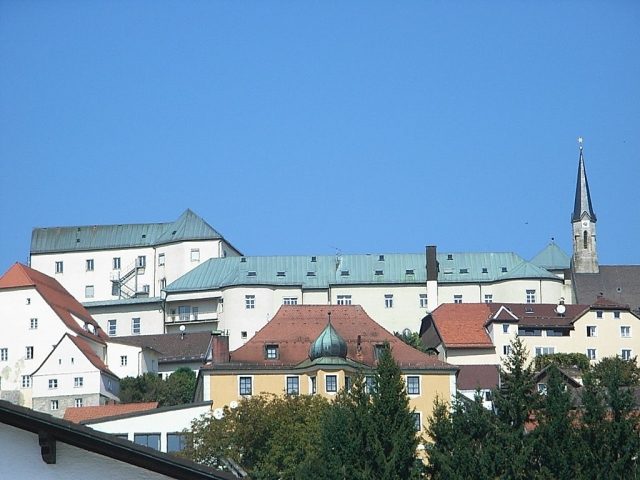
Fürstenstein Castle in Fürstenstein is, along with Saldenburg and Englburg, one of the three namesake structures of the Dreiburgenland in the Bavarian Forest.
The castle rises prominently on a hill about 70 meters above the crossroads at the foot of the village. The Counts of Hals are usually presumed to be the builders. The former castle was conquered in 1330 or 1332 during a feud by Heinrich the Natternberger and then administered by ducal stewards. Another tradition names the Prince-Bishops of Bamberg as owners, from whom Hetzmanstein received its current name and had already passed to the Duke of Bavaria in 1252.
Fürstenstein is first mentioned in a document in 1366. At that time, Albrecht der Puchberger was a steward in the service of the Bavarian Duke. In 1381, Duke Albrecht I ceded the castle to Landgrave Johann von Leuchtenberg as a life annuity, and in 1396 Wilhelm Puchberger received it. His son Wilhelm sold it after his father's death in 1416 to his nephews Georg and Asam zu Winzer. Asam, soon sole owner by contract, sold the castle in 1435 for 2800 ducats to Bishop Leonhard of Passau.
This sale was reversed in 1437, and one of Asam's sons named Hartlieb became lord of the castle. He died in 1460, and his daughter Elisabeth sold Fürstenstein in 1476 to the Schwarzensteiner zu Englburg. Artolf (Ortolf) Schwarzensteiner had the castle converted into a palace in 1570. After the extinction of the Schwarzensteiner family in 1617, it fell to the Counts of Taufkirchen; through marriage, it came into joint ownership of Wilhelm Notthafft von Wernberg and Christoph von Thürheim. Under Wilhelm's and Christoph's rule, a castle chaplaincy was founded in 1625, and in 1629 the castle church was built after the model of the Chapel of Grace in Altötting, which became a much-visited pilgrimage church and remained so until the 19th century.
Fürstenstein was plundered by Swedish troops during the Thirty Years' War. After 1680, through the marriage of the heiress, the castle passed to Ludwig Graf von Perusa. In 1742, the Pandurs reached the village and were repelled by a Bavarian free company, but in 1744 they were able to devastate the castle.
In 1803, through marriage, the Grand Ducal Hessian Lieutenant General Heinrich von Oyen received Fürstenstein Castle. In 1836, he sold the estate to the Bavarian state, but the castle to the postmaster Maier. The chaplaincy was elevated to a benefice in 1839.
The castle served as an inn with a brewery. In 1848, it was destroyed by fire and fell into disrepair. In 1860, the Bishop of Passau, Heinrich von Hofstätter, acquired the ruin for 22,000 guilders. He had Fürstenstein Castle rebuilt and handed it over to the English Ladies in 1861. They established a reformatory for neglected boys.
The church was extended to the west in 1867 and provided with a neo-Gothic tower; in 1877, the benefice was elevated to an expositure, and in 1894 to a parish. The reformatory was converted into a boarding school with a boys' elementary school in 1893. The boarding school was temporarily home to up to 200 students and about 30 nuns.
In 1952, a chapel was set up in the stable of the wing. The church was demolished in 1956, except for the octagon of the choir and the tower built in 1867. The spacious new building around the octagon was consecrated in 1957. In 2001, the English Ladies closed the boarding elementary school due to declining student numbers and a lack of new recruits among the nuns. The castle made headlines in 2005 when it appeared on the internet auction house eBay, along with Englburg, as "Jewels in the Bavarian Forest". In 2007, the approximately 5000 square meter complex was acquired by Annette Pinker, a German living in Spain, who intends to make parts of the building complex, which offers an excellent view, accessible to the public as a cultural, educational, and gastronomic project.
Buildings+
The current complex is divided into two parts. A clear distinction can be made between the lower and upper castles. The lower castle is grouped around an inner courtyard, on the eastern side of which three massive round towers rise. Medieval building fabric is still present in these towers.
A grand staircase leads from the castle courtyard to the upper castle. This is a two-winged building, on the south side of which remnants of the medieval fortifications are visible.
At some distance from the castle stands the church, which blends into the complex. Its interior is modern. The miraculous image, a copy of the Black Madonna of Altötting, was created around 1629 and placed at the southern choir entrance.
Take Mobile History with you
You are reading this text for free. Premium adds what matters on the road: descriptions read aloud, sites found through your camera, whole regions taken offline.
- Every description, including the ~17,700 Premium sites
- Audio guide: have descriptions read to you on location
- AR finder: see sites through your camera, with distance and bearing
- Unlimited saved sites
14 days free, then from €2.99 a month. Cancel anytime.
Source: Wikipedia · Licence: CC BY-SA 4.0
This description draws on the facts documented in the linked Wikipedia article; Wikipedia content is licensed under CC BY-SA 4.0. Wording and editing: Mobile History.
Location: 48.7208, 13.3286