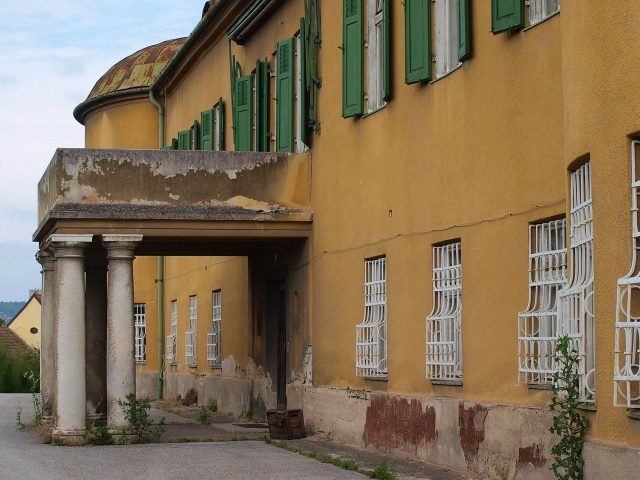
Music School
Gainfarn Castle

Gainfarn Castle is a castle in the Bad Vöslau cadastral community of Gainfarn. The castle, which today houses the Bad Vöslau music school, has a very similar development and ownership history to Merkenstein Castle in the neighboring village of Großau, as the Gainfarn and Großau estates belonged together for a long time.
Although a Rudwinus von Gainfarn was already mentioned in a document in the Salbuch of Klosterneuburg Abbey in 1206, the location of his seat, the so-called "Feste Haus" (fortified house), is not known. The Hohenbergers, who owned the Gainfarn estate, moved their seat to Merkenstein Castle as early as 1448. The castle that still exists today is, in any case, considerably younger.
When Merkenstein Castle was destroyed during the Second Turkish Siege, the seat of the lordship was moved back to Gainfarn. Both the village and Gainfarn Castle were owned by the Dietrichstein family from 1675, including during the Turkish Siege, until 1829. Even before the change of ownership, the castle was rebuilt into its current appearance by Joseph Carl von Dietrichstein, the first governor of the Privileged Austrian National Bank. In 1816, he had the main wing converted into its classical form.
In 1829, Joachim Eduard Graf Münch-Bellinghausen acquired the two estates of Gainfarn and Großau with Merkenstein. After his death, Adolph Freiherr von Brenner-Felsach inherited this castle in 1866. He, in turn, bequeathed it to his son Joachim von Brenner-Felsach, who became known for his world travels and the photographs taken during them, which are exhibited in today's Museum of Ethnology in Vienna. From 1897 to 1901, Hugo von Hofmannsthal was a frequent guest at the castle.
In 1911, Brenner-Felsach sold the castle and its possessions to the sawmill owner Leopold Kern, who owned it until 1917. From him, the industrialist Arthur Krupp from Berndorf bought it at the same time as the Merkenstein estate. He made it available as a military hospital in the last year of the First World War.
When, after the Second World War, all possessions of the Krupp family were confiscated by the Soviet occupation forces as German property, Gainfarn Castle and estate also fell under the administration of USIA. During this time, the castle visibly deteriorated. After the State Treaty, the property fell to the Republic of Austria and thus to the Federal Forests. In addition to the existing forestry schools in Bruck an der Mur and Gmunden, a forestry school was established by the Federal Forests in Waidhofen an der Ybbs in 1948 and now in Gainfarn. With the reorganization of the entire Austrian school system in 1972, a higher department with a Matura degree for forester training was established. An institute for apiculture was also rented for a time.
However, this school was closed at the turn of the millennium. Most of the forest property of 5,000 hectares had already been sold earlier.
In 2001, the municipality of Bad Vöslau acquired the castle. The renovated and adapted castle has since housed the Bad Vöslau music school.
Take Mobile History with you
You are reading this text for free. Premium adds what matters on the road: descriptions read aloud, sites found through your camera, whole regions taken offline.
- Every description, including the ~17,700 Premium sites
- Audio guide: have descriptions read to you on location
- AR finder: see sites through your camera, with distance and bearing
- Unlimited saved sites
14 days free, then from €2.99 a month. Cancel anytime.
Source: Wikipedia · Licence: CC BY-SA 4.0 · Image: http://commons.wikimedia.org/wiki/File:Castle_Gainfarn.jpg
This description draws on the facts documented in the linked Wikipedia article; Wikipedia content is licensed under CC BY-SA 4.0. Wording and editing: Mobile History.
Location: 47.9635, 16.2033