Restaurant
Hotel
Gehrden Castle

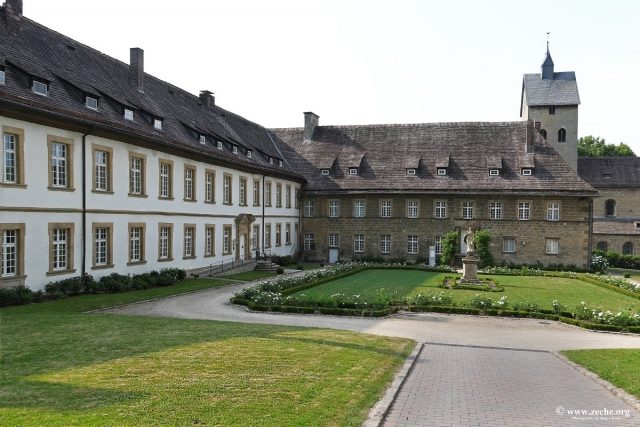
Gehrden Abbey is a former Benedictine nunnery in Brakel-Gehrden in the district of Höxter in present-day North Rhine-Westphalia. The former abbey church possesses the largest historic bell ensemble in Westphalia.
Foundation and First Golden Age+
In 1142, the Benedictine nuns, expelled from Iburg near Bad Driburg, founded a monastery on an estate donated by Heinrich von Gehrden, east of the villages of Nord- and Südgehrden near the Öse. Subsequently, the surrounding villages and farms were relocated under the protection of the mighty monastery walls. The door in the north portal of the church, with its rich iron fittings, dates from around 1200. The Romanesque abbey church, completed in 1180, is the only surviving building from this period, as the monastery buildings were replaced by more modern structures in the 17th century. In 1319, the settlement north of the monastery received town rights.
Secularization+
In the course of secularization, the Benedictine nuns left the monastery in 1810, which was converted into a secular castle with a baroque park. At the time of its dissolution, there were still eleven choir nuns and four lay sisters in the monastery.
Current Use+
Since the mid-1960s, the Family Education Center of the Archdiocese of Paderborn used the property as an educational institution. Today, the monastery houses a hotel.
In the garden, the Twelve Apostles Lime Tree can be found. The age of the lime tree is estimated to be between 400 and 800 years, according to various estimates. The circumference of the trunk is about 10 meters with a height of 20 meters.
Clock Tower+
A historic clockwork from the abbey church became the centerpiece of the artwork presented by jeweler Jens Lorenz in Berlin on November 9, 1989, with the inscription "Time breaks all walls". "It almost looks as if what I am unveiling here today before you will be overtaken by current events," Lorenz concluded his speech before 250 invited guests. On the same evening, the Berlin Wall fell.
Abbesses+
- Lutgardis n.d. (only in the necrology)
- Beatrix 1200 or shortly thereafter (widow of Werner de Brach)
- Wigmodis 1227
- Jutta 1245
- Jutta von Badenstene 1245 (magistra)
- M. 1252
- Alheidis de Schöneberg 1260/1268
- B. 1284
- Woldradis 1297
- Ida von Bonnichhusen 1305
- Gisle von Luthardessen 1420
- Elisabeth (?) Nagel before 1464/ 1474
- Gertrud von Bunstrup (Dumstorp) 1464/1474–1489
- Alveradis (de) Beghe(n) 1490/1529
- Anna van der Borch 1529–1574
- Dorothea von Offen 1574–1603
- Angela von Oeynhausen 1603–1634
- (Sedisvakanz 1635–1636)
- Ida von Bönninghausen 1636–1657
- Sophia Agnes de Wylstrop (Wilstorph) gen. Cölbe 1657–1678
- Clara Luberta von Westphalen 1678
- Anna Catharina von Oeynhausen 1679–1693
- Margaretha Josina Ursula von Schorlemer 1696–1705
- Johanna Wilhelma Elisabeth von Haxthausen 1705–1711
- Maria Anna Catharina de Groten or Groote 1711–1716
- Victoria Dorothea von Juden 1716–1741
- Henrietta Scholastica von Canstein 1741–1773
- Maria Victoria von Juden 1773–1798
- Maria Victoria (von) Burchard 1798–1810.
Take Mobile History with you
You are reading this text for free. Premium adds what matters on the road: descriptions read aloud, sites found through your camera, whole regions taken offline.
- Every description, including the ~17,700 Premium sites
- Audio guide: have descriptions read to you on location
- AR finder: see sites through your camera, with distance and bearing
- Unlimited saved sites
14 days free, then from €2.99 a month. Cancel anytime.
Source: Wikipedia · Licence: CC BY-SA 4.0 · Image: www.zeche.org
This description draws on the facts documented in the linked Wikipedia article; Wikipedia content is licensed under CC BY-SA 4.0. Wording and editing: Mobile History.
Location: 51.6537, 9.1191