CastleDobl

Gjaidhof Castle

Gjaidhof Castle

School

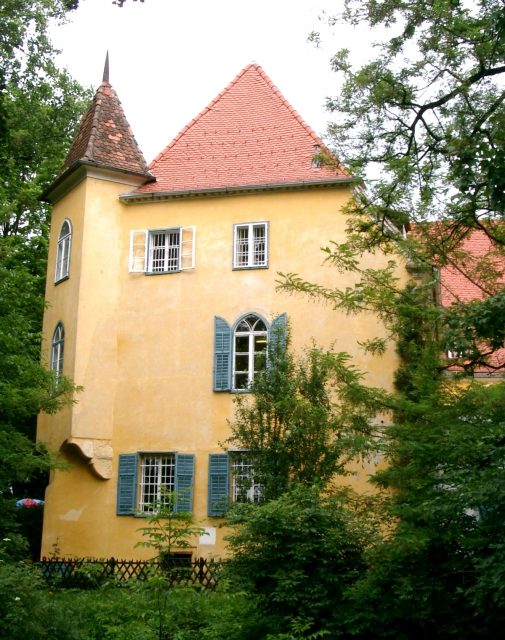
Gjaidhof Castle is a castle located in Dobl in Styria. Its history dates back to the 13th century. Since 1959, it has been owned by the Order of the Sisters of Mercy of St. Vincent de Paul, who run a private secondary school there.

The castle is located in the municipality of Dobl on the edge of a river terrace that slopes steeply down to the Kainach. On the mountain side, the complex is separated from the adjoining hills by a neck ditch. The Kaiserwald forest borders directly on the castle.

The castle was originally a fortified farm with a simple tower, built shortly after 1222 by Leopold VI. It served as a hunting lodge and for supervising the nearby Kaiserwald forest and the road connection from the Kainach Valley to Graz. Furthermore, around 1222, a chapel was added to the farm, from which the present-day Dobl parish church later emerged. From 1240 to 1242, the farm served as a starting point for Frederick II's hunting excursions. After Frederick II's death, the land passed to his niece Gertrud. Her daughter Agnes and her husband Ulrich, Count of Heunburg, sold the hunting lodge to King Rudolf I in 1279. During the uprising of the Styrian nobility in the Landsberger Bund against Duke Albrecht I in 1292, the property was occupied and devastated by his opponents. After the defeat of the rebels, the estate returned to the possession of the Duke and was rebuilt.

In the 14th century, the name "Gjaidhof", still in use today, became common for the estate, and it was managed by Habsburg servants who held the office of princely master of the hunt. Among the more famous masters of the hunt are Nycla Rogendorfer, mentioned in 1387, and Berchtold Krottendorfer, mentioned in 1433. In 1461, the castle guard passed to Andreas Rindscheit. During the Baumkircher Feud, the property was attacked, captured, and plundered in 1469 by mercenaries hired by Andreas Baumkircher. However, they could not defend themselves for long against Pankraz Rindscheit and the imperial troops supporting him. After being rebuilt again, the estate was first referred to as a castle in 1480. Emperor Frederick III had several fish ponds laid out.

After an invasion by passing Turks in 1532, the castle was dilapidated and had to be renovated. King Ferdinand I stayed at the castle during his visit to the Kainach Valley in 1536. From 1537, the princely forester resided at Gjaidhof. Between 1568 and 1570, Archduke Karl II commissioned the master builder Marco Dionysio with the reconstruction and expansion of the castle, in which his court foreman Dionissio Tade also participated. The current appearance of the castle dates from that time. In 1596, a beacon station was established on the castle grounds. Until 1804, the property served the Habsburgs primarily as a hunting lodge due to its proximity to the Kaiserwald forest. In 1804, the castle passed into the private ownership of Ludwig Graf Galler. He was followed in ownership by Karl Freiherr von Mandell and Ludwig Freiherr von Mandell. The majority of the adjacent Kaiserwald forest came into peasant ownership through a public auction in 1825. Until 1851, there was a frequent change of castle owners before it was acquired by the Barons von Bonar. Rosalia Freiin von Bonar had major renovations carried out in 1878. The neo-Gothic architectural details and the western corner tower date from this period. After the end of the Second World War, the property passed to Countess Villavicencio. Since her two sons joined the Jesuit Order, she sold Gjaidhof in 1959 to the Order of the Sisters of Mercy of St. Vincent de Paul. They restored the building and still maintain a private secondary school there today.

Design+

The castle is a single-story, two-winged building with a high hip roof and walled courtyard arcades, which was formerly surrounded by a defensive wall. The two wings stand at right angles to each other. To the east is a bay window with turrets, and at the southwestern corner of the building is a neo-Gothic corner tower. In the southeastern corner of the residential wing is a three-story bell tower. A simple gate with a coat of arms leads through the crenellated boundary wall into the small inner courtyard. The two wings and the outbuildings surround a small courtyard. The former stable building, located to the north of the castle, was converted for school purposes between 1960 and 1961.

Inside the castle is a chapel dedicated to the Virgin Mary, mostly modern in design. It features stained glass windows designed by Toni Hafner and an exterior relief created by Josef Pabst. The wooden figure of the resurrected Christ dates from around 1760 and is attributed to Balthasar Ferdinand Moll.

Take Mobile History with you

You are reading this text for free. Premium adds what matters on the road: descriptions read aloud, sites found through your camera, whole regions taken offline.

  • Every description, including the ~17,700 Premium sites
  • Audio guide: have descriptions read to you on location
  • AR finder: see sites through your camera, with distance and bearing
  • Unlimited saved sites

14 days free, then from €2.99 a month. Cancel anytime.

Source: Wikipedia · Licence: CC BY-SA 4.0 · Image: http://commons.wikimedia.org/wiki/File:Dobl_Gjaidhof_CIMG0689.jpg

This description draws on the facts documented in the linked Wikipedia article; Wikipedia content is licensed under CC BY-SA 4.0. Wording and editing: Mobile History.

Location: 46.9475, 15.3770