CastleGleusdorf

Gleusdorf Castle

Gleusdorf Castle

Nursing home

Gleusdorf Castle is located on the eastern edge of the Gleusdorf district of Untermerzbach in the Haßberge district (Lower Franconia). The early Classicist former noble residence, situated on the river Itz, now serves as a retirement home.

Gleusdorf Castle was first mentioned in a document in 1151, in which an Eribert de Chlubisdorf donated the hamlet of Liuzileber (Lützelebrn) to St. Peter in Bamberg, patron saint of Banz Abbey.

In the High Middle Ages, Gleusdorf itself belonged to Banz Abbey and was granted as a fief to monastic vassals. From the 14th to the 16th century, the Lords of Fulbach resided at the castle, which was damaged in the Peasants' War in 1525. In 1576, the widow of Sebastian von Fulbach died. In 1582, Georg and Valentin von Fulbach are still documented at Gleusdorf. After the extinction of the line, the fief reverted to the monastery and was converted into a vogtei office.

The current castle building was completed around 1770. In the course of secularization, the property fell to Bavaria in 1804. For a short time, it housed the seat of the newly founded Bavarian district court, which, however, was relocated to Baunach as early as 1808. Subsequently, private individuals acquired the castle buildings, which have changed owners several times since then. The current owner is "Seniorenresidenz Schloss Gleusdorf GmbH", which added some new buildings to the existing stock.

Description+

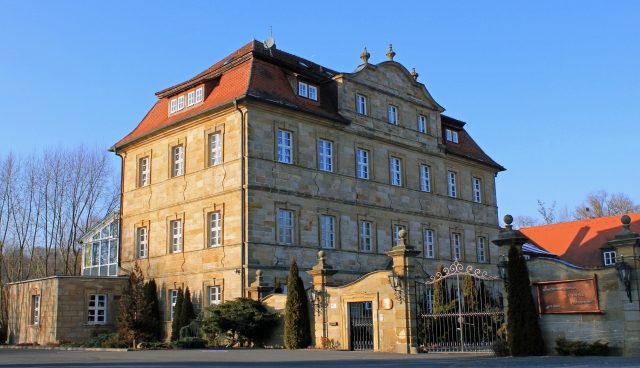
The three-story castle building stands stylistically at the transition from late Rococo to early Classicism. The unplastered sandstone building is structured by profiled window frames and string courses. Above the main portal on the east side is the coat of arms of Banz abbot Valerius Molitor. A three-axis attachment with a curved gable and spherical vases is placed in front of the low mansard roof on the portal side. Access to the castle grounds is provided by a brick gate system with sandstone pillars and iron grilles.

Inside, some simple stucco ceilings and the rich sandstone balustrade of the double-flight staircase still recall the former vogtei seat, which has otherwise been heavily altered by later repurposing.

Take Mobile History with you

You are reading this text for free. Premium adds what matters on the road: descriptions read aloud, sites found through your camera, whole regions taken offline.

  • Every description, including the ~17,700 Premium sites
  • Audio guide: have descriptions read to you on location
  • AR finder: see sites through your camera, with distance and bearing
  • Unlimited saved sites

14 days free, then from €2.99 a month. Cancel anytime.

Source: Wikipedia · Licence: CC BY-SA 4.0

This description draws on the facts documented in the linked Wikipedia article; Wikipedia content is licensed under CC BY-SA 4.0. Wording and editing: Mobile History.

Location: 50.0836, 10.8599