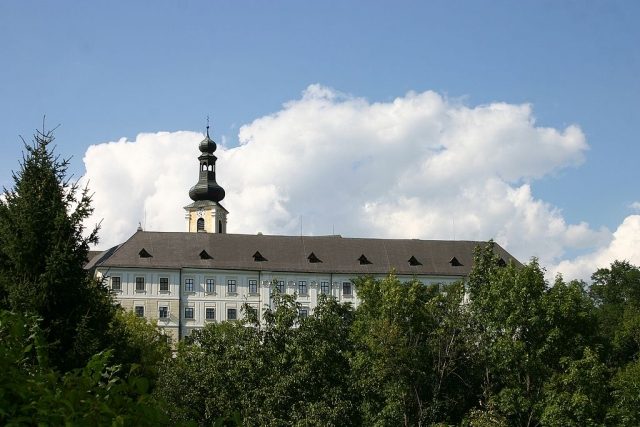
CastleGloggnitz

Gloggnitz Castle

Gloggnitz Castle

Cultural Events
Restaurant


Gloggnitz Castle, a former Benedictine monastery, is located in Gloggnitz in southern Lower Austria. The castle is best reached via the S6 highway, taking the Gloggnitz exit.

In 1094, the Benedictine monastery of Vornbach was elevated to an abbey. To the east, the donation of territories in the Neunkirchen-Pitten-Gloggnitz area to the Benedictines enabled the founding of a Vornbach filial monastery in Gloggnitz.

After the construction of the new parish church, the Christkönigskirche, near the city center, the old monastery church largely lost its significance.

Revitalization

From 1977 onwards, the castle church, St. Michael's Chapel, and the entire castle complex were renovated and revitalized with the support of the former Ministry of Construction, the Ministry of Science, the Federal Chancellery, the Province of Lower Austria, and many private donors. The municipality also contributed significant financial resources, and employees of the municipal building yard put in thousands of hours of work. In 1988, St. Michael's Chapel was reconsecrated. In 1991, a new café-restaurant was opened, and in 1992, the Lower Austrian State Exhibition with the theme "The Conquest of the Landscape" was held at the castle.

Following the Lower Austrian State Exhibition, the project "Weddings and Celebrations at the Castle" was established in 1992. The new event hall and the special exhibition rooms are available for various activities (concerts, exhibitions, festivals, etc.). Examples include the annual Castle Park Festival of the Eichberg Volunteer Fire Department or the Ö3-Disco in the castle park.

On weekends and public holidays, when most excursion tourism takes place, a restaurant is open at the castle.

Description+

This building, secularized in 1803 and now referred to as a castle, is a three-story Baroque structure, with the north side having a fortress-like character. Through two gatehouses from the late Gothic period, of which the second with its two-bay cross-ribbed vault is particularly interesting, one enters the polygonal courtyard (once a cemetery), in the center of which stands the church. Adjoining the second gatehouse is the 1.5-meter thick and 11.5-meter high medieval (15th, 16th century) curtain wall with rectangular loopholes. The early Gothic (14th century) two-bay abbot's chapel, dedicated to Saint Michael, has two entrances. Its lower part once housed an ossuary (charnel house). In the short west wing is the staircase leading to the living quarters, probably formerly guest rooms, and to the gallery of the abbot's chapel.

The elongated southern part (70 m) with building components from 1588 to 1735 was the former prelature; it contained the abbot's and provost's residences, the refectory (dining hall with stucco ceiling), and an aestuarium (sweat bath) each for the provost and the conventuals. The ascent to the prelature leads through a beautiful wrought-iron gate, and in the upper part, a large fresco (around 1730) depicting the apotheosis of St. Benedict adorns the ceiling.

The northeast wing (the convent house), also 70 meters long and dating from the Renaissance period, contained the kitchen with the pantry and a hand cellar in the lower part (the large cellar was in the manor farm), and in the upper part, accessible via a three-part stone staircase, the living quarters of the monks (cells) and the parish priest. In the courtyard, arcades on the ground floor and blind arcades on the upper floor are visible almost everywhere. Provost Franz Langpartner had the monastery baroqueized between 1730 and 1741.

Church of Maria Schnee

In the middle of the courtyard stands the Baroque monastery (castle) church, dedicated to Maria Schnee (Beate Mariae Virgini ad Nives) and Saint Oswald, with a Gothic core. In a document from 1485, it is also called the Provost's Church of St. Godehard (St. Gotthard) in Gloggnitz. The oldest part is the Lady Chapel (probably the original cell, 11th century) with a pointed arch rib from 1260, which was formerly independent and only connected to the church around 1760. It is also Gothic. The church underwent its greatest transformation under Provosts Perfaller and Wenckh. In 1692, the church was baroqueized, and the attached 36-meter high tower with an onion dome also dates from this period; it was to receive the first large bell (635 kg) a year later, and the second (1330 kg) in 1724. Provost Langpartner had the sacristy and oratory added in 1730.

The altarpiece of the church depicts Mary and Jesus alongside the crowned St. Oswald with the raven. Between the twisted columns are statues of Saints Gotthard and Benedict, and on the sides of the altar, statues of Saint Wolfgang and a guardian angel.

The right side altar in the nave shows St. Benedict with a poisoned chalice and snake in the altarpiece. A small detail depicts the upright death of the order's founder, with Saints Bernard and Benedict beside the altar.

On the left side altar, a Madonna of Mercy is depicted. On the left side of the altar is Saint Leonard with a donkey.

Beneath the choir, with an entrance covered by slabs in front of the steps to the presbytery, is a crypt where the provosts were buried.

The Marian Chapel

On the south side of the church is the Lady Chapel by Angelus Rumpler, also known as the Abbot's Chapel.

The Marian altar dates from the Baroque period. It has no altarpiece. The centerpiece was a Gothic wooden statue of Mary with the Child, which fell victim to church thieves in the sixties.

St. Michael's Chapel

Between the still-preserved high defensive wall of the monastery and the former refectory is St. Michael's Chapel, an early Gothic building, documented since 1322, which was only slightly altered during the Baroque period. The charnel house was located in the basement.

An exterior fresco of Saint Christopher is still present, albeit heavily damaged.

Take Mobile History with you

You are reading this text for free. Premium adds what matters on the road: descriptions read aloud, sites found through your camera, whole regions taken offline.

  • Every description, including the ~17,700 Premium sites
  • Audio guide: have descriptions read to you on location
  • AR finder: see sites through your camera, with distance and bearing
  • Unlimited saved sites

14 days free, then from €2.99 a month. Cancel anytime.

Source: Wikipedia · Licence: CC BY-SA 4.0 · Image: https://commons.wikimedia.org/wiki/File:Gloggnitz,_Schloss_%28Bild_1%29.jpg?uselang=de

This description draws on the facts documented in the linked Wikipedia article; Wikipedia content is licensed under CC BY-SA 4.0. Wording and editing: Mobile History.

Location: 47.6739, 15.9286