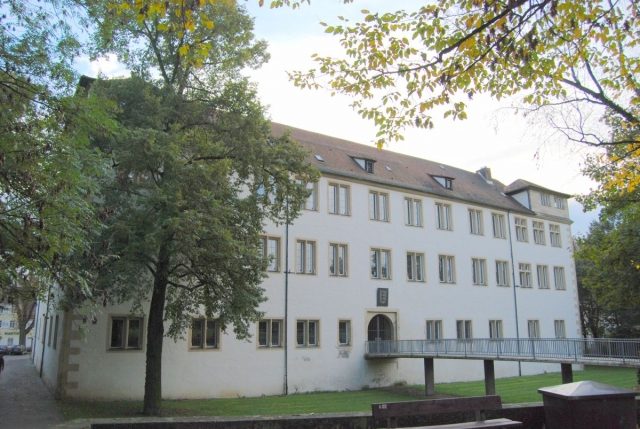
CastleGöppingen

Göppingen Castle

Göppingen Castle

District court and notaryship

Göppingen Castle is a four-winged Renaissance building, which today serves as a district court and notary's office.

Duke Christoph of Württemberg regularly came to Göppingen for a cure in the mid-16th century to use the Göppingen mineral water. It is said to have also helped him with poisoning suffered at the French court.

He commissioned the master builder Aberlin Tretsch to build a castle on the site of an already existing moated castle, first mentioned in 1455, which was to serve as his residence during his stays. It was built between 1550 and 1568 at the northwestern end of the city center as an almost regular four-winged Renaissance complex with low pavilions on the corners. The unadorned outer facade facing the city is only embellished by the elaborate decoration of the entrance gate to the city. The masonry of Hohenstaufen Castle, destroyed in the Peasants' War in 1525, is said to have served as building material.

The building was accessed by three (originally four) round stair towers in the corners of the inner courtyard. The first stair tower on the left with the Württemberg coat of arms above the door was reserved for the nobility and contains as a special ornament the so-called "Rebenstiege" (Vine Staircase), which was created by the Göppingen stonemason Hans Neu. 71 of the 79 steps of this spiral staircase, built in 1562, were decorated on the underside with a stone foliage and fruit intertwining of a grapevine, into whose tendrils a total of 13 different animals such as birds, a bear, and a wild boar were incorporated. The middle staircase was the servants' access. Because the table silver was carried upstairs there, it is called the "Silbertreppe" (Silver Staircase).

Even today, remnants of the original painting and decoration are still present in some official rooms. The wall painting in the inner courtyard indicates formerly open arcades on the first and second floors on three sides. The west side towards the stables, however, is lower and a half-timbered building. The stables are also preserved and today serve as a juvenile detention center.

Since 2002, investigations and restoration work have been carried out at Göppingen Castle.

To the north, a large park with several fountains and pleasure houses was connected, of which only a small remnant still exists.

Residents+

Göppingen Castle was initially used by Duke Christoph during his spa stays. Later, it repeatedly served as a widow's residence for the Duchesses of Württemberg. In particular, Duchess Maria Augusta was virtually under house arrest there from 1750 until her death in 1756 by order of her son Duke Carl Eugen. Later, the district court, which still exists today, and official residences for its judges were housed in the castle. Wilhelm August von Breitling (1835-1914), Prime Minister of Württemberg from 1901 to 1906, spent his first years of life at Göppingen Castle after his father Paul Breitling (1798-1867) became chief district judge in Göppingen in 1835 and moved into one of the official residences in the castle with his family.

Take Mobile History with you

You are reading this text for free. Premium adds what matters on the road: descriptions read aloud, sites found through your camera, whole regions taken offline.

  • Every description, including the ~17,700 Premium sites
  • Audio guide: have descriptions read to you on location
  • AR finder: see sites through your camera, with distance and bearing
  • Unlimited saved sites

14 days free, then from €2.99 a month. Cancel anytime.

Source: Wikipedia · Licence: CC BY-SA 4.0 · Image: http://schloesserrundschau.de/bawue/schloesser/goeppingen01.html

This description draws on the facts documented in the linked Wikipedia article; Wikipedia content is licensed under CC BY-SA 4.0. Wording and editing: Mobile History.

Location: 48.7050, 9.6516