Cultural center
Museum
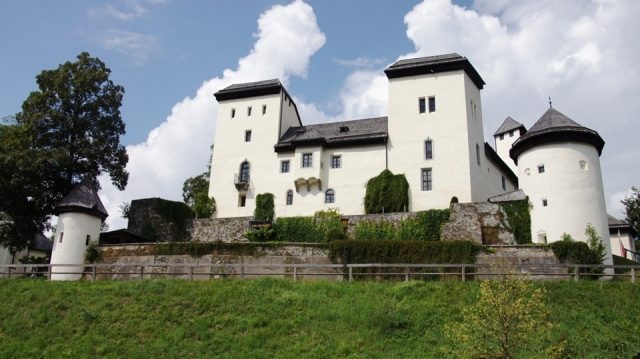
Goldegg Castle

Goldegg Castle is located on a rocky outcrop on the north bank of Lake Goldegg in the municipality of Goldegg in the district of St. Johann im Pongau in the state of Salzburg, Austria.
The exact time of the construction of the first castle is unclear. The Lords of Goldegg, a powerful ministerial family in and outside Salzburg, are considered to be the builders. They called themselves "von Pongau" since the 12th century and, since the end of the 12th century, after an early lost castle. In 1314, both Louis IV the Bavarian (1314–1347) and Frederick the Fair (1314–1330) were elected German King. In the subsequent disputes over the royal throne, Wulfing I of Goldegg fought on Louis's side. After the Battle of Mühldorf (1322), the Archbishop of Salzburg, Frederick III of Leibnitz (1315–1338), who fought on Frederick's side, had the castles in Altenhof and Taxenbach destroyed. However, due to Louis's victory, the Archbishop of Salzburg had to allow the Lords of Goldegg to rebuild the castle. Construction of the new castle began in 1323 and it was completed simultaneously with the church. Goldegg was the seat of a Hofmark and served as a fortification to protect the connecting road between Pongau and Pinzgau. The structures still existing today are essentially based on this castle.
On September 19, 1400, Haug von Goldegg died as the last of his family. Two years earlier, he had sold a large part of his property to Archbishop Gregor Schenk von Osterwitz. He bequeathed Goldegg Castle, the Hofmark Wagrain, and forests in Rauris to his daughter Dorothea. Through further inheritance, Dorothea died in 1438, the castle came to her only son Wolfgang von Freundsberg, who died childless in 1449. Due to inheritance disputes with the Archbishops of Salzburg, the castle was occupied by the troops of Archbishop Frederick IV. Wolfgang's Tyrolean relatives were too weak to resist. They ceded their claims to the favorites of Duke Siegmund of Tyrol, the notorious Gradner brothers, known for their excessive acquisition of property. The Archbishop then had to enfeoff the brothers with the Goldegg inheritance in 1450. However, he granted a right of first refusal. The enemies of the Gradners overthrew them in Tyrol in 1455, and Ulrich von Freundsberg, the father of the later notorious mercenary leader Georg von Freundsberg, regained the castle. Archbishop Sigismund I von Volkersdorf did not give in, however, and definitively acquired the castle by purchase in the same year. The castle was subsequently administered by Salzburg caretakers and captains. In 1463, Captain Ulrich Dienstl successfully defended the castle during a week-long siege by rebellious peasants, who had to retreat before an archiepiscopal army. Thereupon, the sovereign made his brother Balthasar von Weißpriach the caretaker of Goldegg. In 1481, the Archbishop of Salzburg Bernhard II von Rohr (1466–1482), during his war against Emperor Frederick III, sold the castle out of financial necessity to his caretaker in Radstadt, Wilhelm Graf, and his moneylender Konrad Strochner, but with a right of repurchase. At that time, some additions and alterations to the castle must have taken place, including enlarged windows, the defensive structures, and the corner turrets.
The Graf family had already acquired the noble predicate name of the extinct family of Schernberg in 1370. Christoph Graf von Schernberg, married to Elisabeth, a relative of Archbishop Leonhard von Keutschach, successfully defended the bishop-loyal city of Radstadt in the Peasants' War of 1526. The following year, he received Goldegg Castle with its caretaking and land registry office from Archbishop Matthäus Lang for his services – Graf had, among other things, advanced 3000 guilders to the bishop for the war chest. After that, the conversion into a habitable 16th-century castle began. A new wing was built between the towers, creating an enclosed inner courtyard. On the 2nd floor, the Knights' Hall was equipped with magnificently painted wall paneling. The previously medieval wall covering was replaced with a coffered paneling.
In 1612, after the death of the indebted Christoph Graf the Younger, the complex was confiscated as an escheated fief by Archbishop Wolf Dietrich von Raitenau (1587–1612). The armament was brought to the nearby Hohenwerfen Castle and the right of care was granted to Baron Dietrich Kuen von Belasy for life. At that time, the castle already began to decay. Dietrich Kuen died in 1635. The Hofmark Goldegg and the regional court of St. Veit were merged into the Goldegg caretaking court in 1640. Since 1859 in private ownership and from 1959 in the possession of the Archdiocese of Salzburg, the castle was acquired by the municipality of Goldegg in 1973 due to a citizens' initiative. After a fundamental renovation for the second Salzburg State Exhibition "Reformation, Emigration - Protestants in Salzburg" in 1981, it now houses the Pongau Local History Museum, a seminar and cultural center, whose core is the cultural association SCHLOSS GOLDEGG, founded in 1982, which organizes the Goldegg Dialogues, the painting academy, and a cafe.
Take Mobile History with you
You are reading this text for free. Premium adds what matters on the road: descriptions read aloud, sites found through your camera, whole regions taken offline.
- Every description, including the ~17,700 Premium sites
- Audio guide: have descriptions read to you on location
- AR finder: see sites through your camera, with distance and bearing
- Unlimited saved sites
14 days free, then from €2.99 a month. Cancel anytime.
Source: Wikipedia · Licence: CC BY-SA 4.0 · Image: http://www.wehrbauten.at
This description draws on the facts documented in the linked Wikipedia article; Wikipedia content is licensed under CC BY-SA 4.0. Wording and editing: Mobile History.
Location: 47.3192, 13.1003