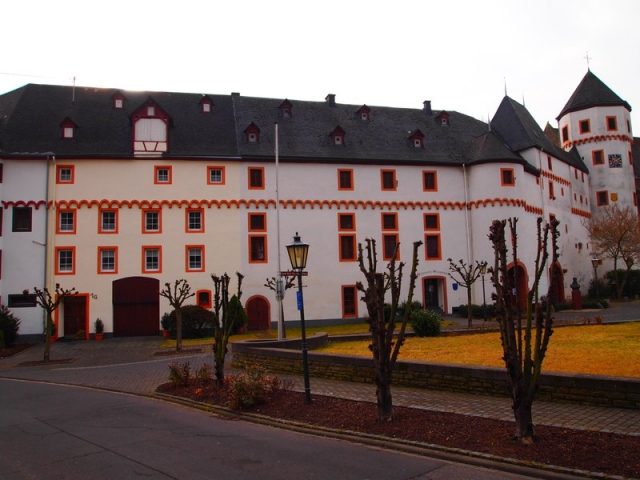
Branch of the provincial archives in Koblenz
Gondorf Castle

The Oberburg (in contrast to Schloss Liebieg, which is referred to as Niederburg), also known as Schloss von der Leyen, Schloss zur Leyen, Schloss Leyen, and Schloss Gondorf, is located in the Gondorf district of the municipality of Kobern-Gondorf on the Moselle. It is the ancestral seat of the Lords and later Princes von der Leyen. In 2002, a bronze bust of Imperial Prince Philipp von der Leyen, created by Karol Badyna and donated by the Gondorf Volunteer Fire Department, was unveiled in front of the outer bailey.
The castle is a protected cultural monument according to the Monument Protection Act (DSchG) and is registered in the monument list of the state of Rhineland-Palatinate. An external branch of the Koblenz State Main Archive is housed in some of the buildings.
The secluded location, like a headland protected on one side by the Moselle and on the back by the Nothbach (diverted and built over in the 1970s), presumably offered a site for a fortified and easily defensible settlement as early as the 5th/6th century.
The extensive complex from the 14th century consists of the outer bailey with a gatehouse added in 1527 and the core castle. The main builder around 1560 was the Trier Elector Johann VI. von der Leyen. The complex fell into disrepair in the following periods as the various family branches took up residence in Bliesgau, Bavaria, and Southwest Germany.
At the beginning of the 19th century, Imperial Count Philipp von der Leyen, who had meanwhile been elevated to Prince of Hohengeroldseck (Baden since 1819), had parts of his ancestors' castle restored. After the Prince's death, his son Erwein I sold the complex, lands, and the formerly significant winery, among other things, to the municipality of Gondorf.
During the expansion of the railway (the current Moselle line) in 1876, the castle complex, which extends to the banks of the Moselle, was cut into two parts, and the church, which stood southwest of the castle, was demolished. A replacement building was constructed elsewhere at the expense of the developer, the Prussian State Railway. Almost 100 years later, in 1971, Federal Highway 416 was built between the railway line and the Moselle. For this purpose, the ground-floor parts of the castle had to be opened or rebuilt. Thus, the federal highway now runs right through the castle over the former castle courtyard.
Take Mobile History with you
You are reading this text for free. Premium adds what matters on the road: descriptions read aloud, sites found through your camera, whole regions taken offline.
- Every description, including the ~17,700 Premium sites
- Audio guide: have descriptions read to you on location
- AR finder: see sites through your camera, with distance and bearing
- Unlimited saved sites
14 days free, then from €2.99 a month. Cancel anytime.
Source: Wikipedia · Licence: CC BY-SA 4.0 · Image: http://www.wehrbauten.de/thread.php?threadid=612
This description draws on the facts documented in the linked Wikipedia article; Wikipedia content is licensed under CC BY-SA 4.0. Wording and editing: Mobile History.
Location: 50.2913, 7.4586