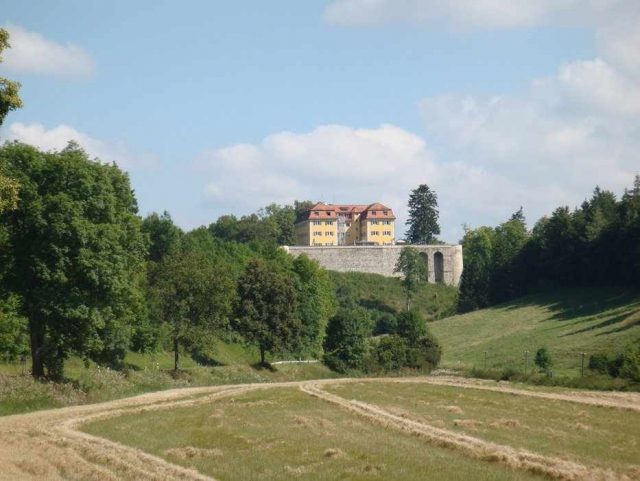
CastleGomadingen

Grafeneck Castle

Grafeneck Castle

The Castle can be visited

Grafeneck Castle is a castle near Gomadingen in the district of Reutlingen, Baden-Württemberg. The castle is located about 25 kilometers southeast of Tübingen between Engstingen and Münsingen, near the Marbach State Stud, a renowned horse breeding facility.

On the site of a high medieval castle, the Dukes of Württemberg built a hunting lodge around 1560. Duke Carl Eugen of Württemberg used the estate as a summer residence and expanded it between 1762 and 1772 into a baroque castle with an opera house and numerous pleasure buildings. The opera house was later moved to Ludwigsburg, and the castle was abandoned. In the 19th century, individual buildings were demolished, and the castle was used by the forestry office. In 1928, the Samariterstiftung (Samaritan Foundation) bought the castle, established a home for the disabled, and created its own cemetery in 1930.

Grafeneck during the National Socialist Era+

Beginnings

During the planning phase of Aktion T4, the Württemberg Ministry of Interior in Stuttgart, which worked closely with the Berlin "T4 office," proposed the Samariterstift Grafeneck, as it met most of the requirements for conversion. The choice of Grafeneck as the location for the first killing center in Germany had several reasons. The castle grounds are secluded in the forest and easy to cordon off, as there are only two driveways. Furthermore, the castle served as an administrative building for the staff, as it offered spatial work and accommodation possibilities. After Grafeneck Castle was confiscated "for purposes of the Reich" in October 1939, about 100 people were recruited from Stuttgart and Berlin. This staff consisted of doctors, police officers, office workers, nursing and transport personnel, economic and domestic staff, as well as guards and crematorium operators. The patients/residents at that time were relocated to Reute Monastery.

Conversion

From October 1939 to January 1940, the former Samariterstift Grafeneck was purposefully transformed into a killing institution. Living and administrative rooms, a registry office, and a police office were set up in the castle building. On the castle grounds, a wooden barracks with about 100 beds, a parking space for the gray buses, a crematorium oven, and a gassing shed were built.

Grafeneck also housed the central office of the Gemeinnützige Krankentransport GmbH (Gekrat), which was responsible for transports and headed by Reinhold Vorberg.

Murders

On January 18, 1940, the systematic murder of the first people began on the converted castle grounds. This also marked the beginning of the so-called euthanasia action in Germany. Grafeneck was one of the first facilities of this kind to have a gas chamber installed. The gassings took place in the so-called "garage," disguised as a shower room. The institutional doctor allowed carbon monoxide to flow into the gassing room by operating a valve equipped with a manometer. The necessary steel cylinders were supplied by Mannesmann, and the filling was carried out by IG Farbenindustrie at its Ludwigshafen plant (BASF). The first murdered patients came from the Eglfing-Haar sanatorium and nursing home. The victims came from 48 institutions for the disabled and mentally ill, 40 of them from Baden-Württemberg, six from Bavaria, and one each from Hesse and North Rhine-Westphalia.

The last murders took place on December 13, 1940.

Closure

The closure of the Grafeneck killing center in December 1940 had various reasons. The attempt to keep the murders secret failed, but increasingly frequent protests from the church and institutions were also reasons. After the closure, the staff was transferred to the Hessian killing center Hadamar near Limburg an der Lahn. There and in other killing centers, the murders of the sick continued unhindered until August 1941. In the following years, the castle building served for the so-called Kinderlandverschickung (evacuation of children). In 1945, the home was used by the French occupation authorities and returned to the Samariterstiftung in 1946/47. The disabled people who had been expelled from Grafeneck at the beginning of the war and survived it moved back into the castle.

Number of Victims+

There are various figures for the total number of victims in Grafeneck. According to the so-called "Hartheim Statistics," a total of 9,839 people were murdered in a gas chamber at the Grafeneck killing center in the twelve months between January and December 1940. The Württemberg Grafeneck trial in the summer of 1949 identified a total of 10,654 victims.

Killing Doctors+

The T4 organizers Viktor Brack and Karl Brandt ordered that the killing of the sick could only be carried out by medical personnel, as Hitler's authorization letter of September 1, 1939, referred only to doctors. Operating the gas tap was therefore the task of the gassing doctors in the killing centers. However, during the course of the action, it also happened that in the absence of doctors or for other reasons, the gas tap was operated by non-medical personnel. All doctors at Grafeneck exclusively used cover names in external correspondence.

Remembrance, Commemoration+

Since the 1950s and 1960s, two urn graves and a memorial site in the cemetery with an open chapel have commemorated the murders during the National Socialist era. In 1965, the "garage" was demolished. In 1982, a "Euthanasia Working Group" was formed to expand the memorial and enable a permanent exhibition. In 1995, the memorial and name book was presented for the first time. Since October 1998, this memorial book with over 8000 names of the victims has been housed near the memorial and is freely accessible to all visitors. Research for further unknown names is still ongoing. For these victims whose names are not yet known, an Alphabet Garden was created in August 1998. The idea came from the American artist Diane Samuels. Since October 2005, Grafeneck has housed a documentation center. Since then, the memorial, which includes the daily accessible permanent exhibition "Grafeneck 1940 – Murder of the Sick in National Socialism. History and Remembrance," is visited by between 15,000 and 20,000 people annually.

Take Mobile History with you

You are reading this text for free. Premium adds what matters on the road: descriptions read aloud, sites found through your camera, whole regions taken offline.

  • Every description, including the ~17,700 Premium sites
  • Audio guide: have descriptions read to you on location
  • AR finder: see sites through your camera, with distance and bearing
  • Unlimited saved sites

14 days free, then from €2.99 a month. Cancel anytime.

Source: Wikipedia · Licence: CC BY-SA 4.0

This description draws on the facts documented in the linked Wikipedia article; Wikipedia content is licensed under CC BY-SA 4.0. Wording and editing: Mobile History.

Location: 48.3927, 9.4295