Museum
Greillenstein Castle

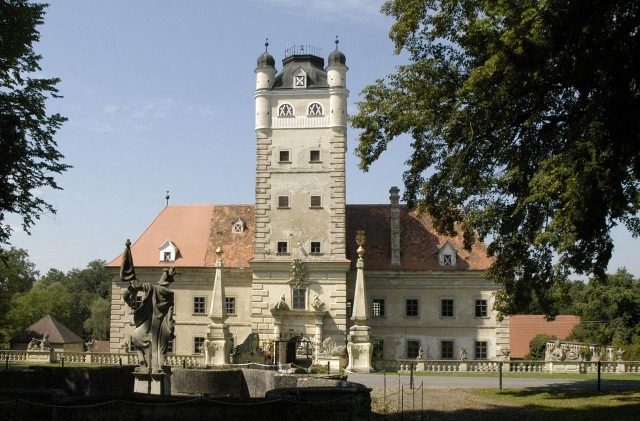
Greillenstein Castle is a Renaissance castle in the village of Greillenstein in the Lower Austrian municipality of Röhrenbach. The history of the castle is closely linked to the noble family of Kuefstein.
In 1313, a small fortified castle, owned by the Greillen (also Grello) family, was first reported. This is, incidentally, the last time the Greillen family can be traced. However, the first documentary mention of the castle dates only from 1371, when it came into the possession of the Lords of Dachbeckh.
Until 1499, the lordship was owned by the Lords of Dachbeckh, later it belonged to the Lords of Volkra. Since 1534, Greillenstein has been owned by the Barons (later Counts) of Kuefstein, whose most famous family member was the ambassador and later Vicedom (comparable to today's governor) of Upper Austria, Johann Ludwig von Kuefstein.
The Greillenstein lordship was purchased in 1534 by Baron Johann Lorenz von Kuefstein, and his son, Baron Hans Georg III. von Kuefstein, had the old fortified castle demolished between 1570 and 1590 and, according to tradition, commissioned an Italian master builder to erect the present Greillenstein Castle in its place, which was completed in 1604, including interior decoration and furnishings.
Greillenstein was built as an administrative seat for three large lordships (Feinfeld, Schauenstein, and Greillenstein) in the Waldviertel and as a representative and summer residence for the family. This was necessary because the Kuefsteins were Protestant at the time, and Hans Georg III, as Vicedom of Lower Austria, needed a place from which he could conduct his official business.
Despite the Protestant convictions of the Kuefstein family, they always remained loyal to the Emperor, but there were repeated armed conflicts with the neighboring Altenburg Abbey.
During the Thirty Years' War, Greillenstein was spared from devastation, but Hans Jacob Baron von Kuefstein had to leave the castle in 1620 when it was occupied by the leader of the Catholic League, Elector Maximilian of Bavaria. Greillenstein briefly served as a Catholic headquarters. Here, Elector Maximilian, Count Tilly, and Field Marshal Count Bucquoy met before the Battle of White Mountain to work out a strategy for the upcoming war for several days. Shortly before the end of the Thirty Years' War, small Swedish troop detachments passed by and occupied the castle without resistance, though without causing damage. In 1623, Hans Jacob von Kuefstein converted to the Catholic faith and thus saved the lordship for his family.
In 1634, the lordship was granted high jurisdiction by Emperor Ferdinand II. The district court, still existing today with a remarkable collection of medieval court records, dates from this period.
During the Fifth Coalition War in 1809, over 1000 French soldiers and 1400 horses were quartered. When they withdrew, the furnishings were so devastated and the financial basis of the lordship so shattered that Johann Ferdinand III. Count Kuefstein offered Greillenstein for sale to the Emperor, who, however, declined. By 1815, the debts could be repaid and the damages repaired.
After the dissolution of the manorial system in 1848, the castle lost its function as an administrative building. In the 19th century, artists such as Franz Grillparzer, whose cousin was married to the administrator there and who was inspired to write his play "Die Ahnfrau" here, and Anton Romako, who was discovered and promoted by Countess Maria Magda von Kuefstein, stayed in Greillenstein.
The castle survived both the First World War and the Russian occupation after the Second World War unscathed. After 1945, an educated Russian officer had the castle guarded, so there was no looting.
In 1945, after the end of the war, Count Johann Ferdinand V von Kuefstein moved to Greillenstein with his family. The family lived in the castle until 1960. His son, Count Karl II von Kuefstein, moved with his family to the outbuildings of the castle at that time.
Since then, the castle has been primarily used as a museum.
Take Mobile History with you
You are reading this text for free. Premium adds what matters on the road: descriptions read aloud, sites found through your camera, whole regions taken offline.
- Every description, including the ~17,700 Premium sites
- Audio guide: have descriptions read to you on location
- AR finder: see sites through your camera, with distance and bearing
- Unlimited saved sites
14 days free, then from €2.99 a month. Cancel anytime.
Source: Wikipedia · Licence: CC BY-SA 4.0 · Image: http://commons.wikimedia.org/wiki/File:Greillenstein_Schloss.jpg
This description draws on the facts documented in the linked Wikipedia article; Wikipedia content is licensed under CC BY-SA 4.0. Wording and editing: Mobile History.
Location: 48.6585, 15.5146