Museum
The Castle can be visited
Greinburg Castle

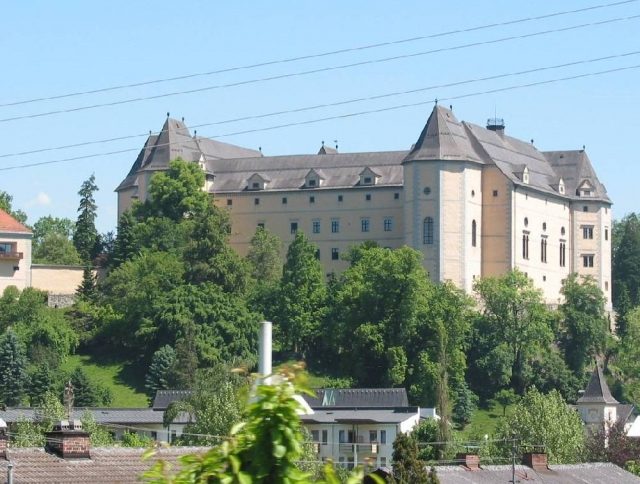
Greinburg Castle is located directly on the Danube in the Strudengau/Upper Austria. It belongs to the town of Grein in the Lower Mühlviertel. The castle is the landmark of the town and the oldest residential castle in Austria. Its current appearance is determined by the late medieval castle complex from 1488 to 1493 and the alterations from the 16th and 17th centuries.
To this day, the castle remains in private ownership and belongs to the family foundation of the ducal house of Saxe-Coburg and Gotha. Its historic state rooms such as the Great and Small Knight's Halls, the Diamond Vault, the Sala Terrena, and the arcaded courtyard, as well as the Upper Austrian Shipping Museum, can be visited daily from May to October. As part of a castle tour, visitors also gain access to the lavishly furnished Coburg Festival Rooms.
Greinburg Castle is one of the tourist attractions on the Danube Cycle Path and the Donausteig trail.
Documents about the castle date back to 1488. In that year, Emperor Frederick III granted the brothers Heinrich and Siegmund Prüschenk, Barons of Stettenberg, permission to build a castle. Around 1495, the Prüschenk brothers also acquired the County of Hardegg and named themselves after it, Counts of Hardegg and in Machland. The castle in Grein was intended to secure the Machland against Bohemian, Hungarian, and Turkish incursions. The first name was Stettenfels, from 1504 Heinrichsburg, and only since 1533 has the name Greinburg been recorded.
From 1485, the seat of the Machland regional court moved from Mitterberg Castle to the Grein dominion.
In 1534, the castle came into the possession of the imperial treasurer Johann Loeble. His daughter married Rudolf von Sprinzenstein, who sold the castle in 1621 to Count Leonhard Helfried von Meggau. Under Count Meggau, the castle was expanded in the Renaissance style. Through Count Meggau's daughter Anna, married to Sigmund Ludwig von Dietrichstein, Greinburg Castle came into the possession of the Dietrichstein family. In 1709, Franz Ferdinand Count von Salburg acquired the castle. Through inheritance, the castle passed to Josef Karl Prince von Dietrichstein in 1810, who sold it in 1817 to the army supplier Michael Fink.
From 1817, the originally Maria Theresian privilege of timber rafting on the Naarn belonged to the Greinburg dominion.
In 1823, Duke Ernst I of Saxe-Coburg and Gotha acquired Greinburg Castle and its dominion. He was succeeded by his sons Ernst II and Albert, Prince Consort of the British Queen Victoria, so that after the early death of her husband, Queen Victoria also became a co-owner of Greinburg Castle. Today, the estate is owned by the descendants of Victoria and Albert's fourth son - Prince Leopold, Duke of Albany. Its preservation is financed by the Foundation of the Duke of Saxe-Coburg and Gotha's Family. The current head of the house is Andreas Prince of Saxe-Coburg and Gotha.
After the Second World War, the castle was occupied by the Soviet army; in 1958, it was returned to the family foundation of the House of Saxe-Coburg and Gotha. In 1970, the foundation established the Upper Austrian Shipping Museum with loans from the Upper Austrian State Museums. From 1976–1987, a comprehensive renovation of the castle building and the adjacent outbuilding took place. Since then, the castle's significant state rooms have also been accessible to the public from May to October.
Description+
The castle stands on the granite rock Hohenstein above the town of Grein on the Danube. Greinburg Castle is considered the oldest residential castle in Austria and is a milestone in the development from castle to palace construction. It is the first castle complex north of the Alps that was built completely uniformly over a regularly planned floor plan. The castle was built as a four-tower complex with an additional gate tower, palas, and chapel. Worth seeing are the historic state rooms: the atmospheric arcaded courtyard, the late Gothic Diamond Vault, the impressive Great Knight's Hall (30 m long, 16 m wide, 14 m high), the castle chapel with the early Baroque Christmas altar, and the mysterious Sala Terrena, a festive hall completely decorated with pebble mosaic.
The so-called Coburg Festival Rooms on the second floor can be visited with a guided tour. They are richly furnished with antique furniture and a portrait gallery from the possession of the ducal family of Saxe-Coburg and Gotha.
Upper Austrian Shipping Museum
In 1969, the castle was renovated and the Upper Austrian Shipping Museum was established, which opened on June 13, 1970. It is the only shipping museum in Upper Austria. Detailed models represent the history of the transport use of inland navigation on the Danube and its tributaries Inn, Salzach, Enns, and Traun. In the Danube Hall (Small Knight's Hall), a 15-meter-long model of a so-called ship train can be seen. Furthermore, rafts are exhibited, testifying to the region's busy transport artery, as well as the model of the first Danube steamboat Maria Anna. The numerous objects are loans from the Upper Austrian State Museums.
In addition to shipping, models of old towns in Upper Austria are also exhibited.
Take Mobile History with you
You are reading this text for free. Premium adds what matters on the road: descriptions read aloud, sites found through your camera, whole regions taken offline.
- Every description, including the ~17,700 Premium sites
- Audio guide: have descriptions read to you on location
- AR finder: see sites through your camera, with distance and bearing
- Unlimited saved sites
14 days free, then from €2.99 a month. Cancel anytime.
Source: Wikipedia · Licence: CC BY-SA 4.0 · Image: http://commons.wikimedia.org/wiki/File:GreinBurg.jpg
This description draws on the facts documented in the linked Wikipedia article; Wikipedia content is licensed under CC BY-SA 4.0. Wording and editing: Mobile History.
Location: 48.2264, 14.8531