To be privately owned
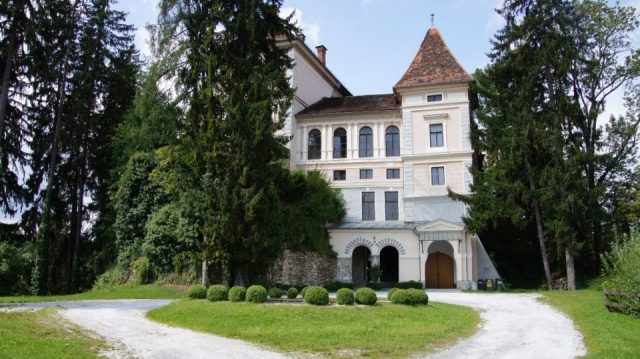
Greißenegg Castle

Construction of a castle probably began here in the first half of the 13th century. It could not be clarified whether the "castrum inferius Witsperch" mentioned in 1265 referred to today's Greißenegg or to a fortification in the city of Voitsberg that has since disappeared.
In 1396, there is mention of the "Niederhaus Voitsberg". In 1443, the building was called "veste Voitsperch" and in 1494, Schloss Voitsberg. The princely fortified building was managed by administrators. Hans Laun, who held this office around 1420, had major extensions carried out. Through the marriage of his niece Margaretha, the castle came into the possession of Andreas Greißenegger in 1459. He was executed in Graz in 1471 for conspiring with Andreas Baumkircher.
The name Greißenegg for the castle only became established after his death. Before that, it was called Hanstein. After Greißenegger's beheading, the emperor confiscated the dominion and first granted it to Andreas Teufenbach and then to Konrad von Hollenegg. In 1485, Hungarian troops of King Matthias Corvinus occupied the castle. They could only be driven out five years later. In 1578, Georg Freiherr von Herberstein took over the already dilapidated fortified building after an inheritance dispute with his cousin Dietrich Freiherr von Herberstein. In 1624, Hans Siegmund Graf Wagensperg received the dominion as a pledge. Nine years later, he succeeded in acquiring it through purchase. The Wagensperg family kept Greißenegg until the 19th century. Since 1774, it had been part of a family fideicommissum. Only from 1804 to 1818 was Karl August Fürst Isenburg the lord of the dominion.
In 1877, the industrialist August Zang bought the castle at auction, after the Wagensperg family's assets had been declared bankrupt the year before. Zang had it largely renovated in the historicist style, so that today it resembles a large Gründerzeit villa much more than a medieval fortified building. In 1903, the castle came to Count Ludwig von Ostrovski and in 1916 to Dr. Walter Rittler. In the second half of the 20th century, the building was in danger of becoming a ruin. Only when the Steirer family took over the castle in the 1980s and had it restored was its existence secured.
Take Mobile History with you
You are reading this text for free. Premium adds what matters on the road: descriptions read aloud, sites found through your camera, whole regions taken offline.
- Every description, including the ~17,700 Premium sites
- Audio guide: have descriptions read to you on location
- AR finder: see sites through your camera, with distance and bearing
- Unlimited saved sites
14 days free, then from €2.99 a month. Cancel anytime.
Source: Wikipedia · Licence: CC BY-SA 4.0 · Image: http://www.wehrbauten.at
This description draws on the facts documented in the linked Wikipedia article; Wikipedia content is licensed under CC BY-SA 4.0. Wording and editing: Mobile History.
Location: 47.0488, 15.1437