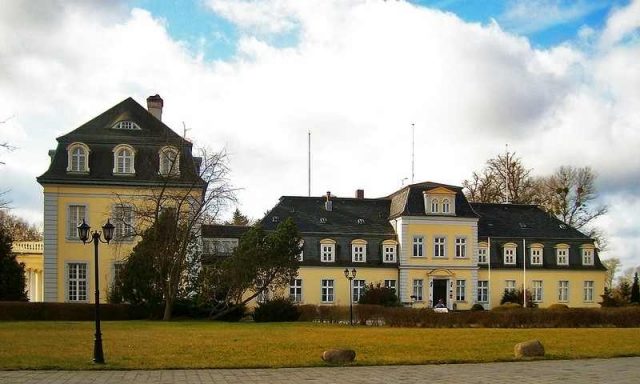
CastleGroß Plasten

Groß Plasten Castle

Groß Plasten Castle

Hotel

The first owner of Groß Plasten Castle mentioned in 1790 is Regierungsrat von Normann, who presumably built the main house in 1751 as a single-story manor house. Around 1800, the building became the property of Lieutenant von Saldern. In 1850, Amtshauptmann Friedrich Heinrich Christian von Michael, owner of Ihlenfeld Castle near Neubrandenburg, bought Groß Plasten Castle to leave it to his heir Dr. jur. Friedrich von Michael. He married Elsa Haniel, daughter of the industrial magnate Julius Haniel. He had thus chosen not only a wealthy but also a building-enthusiastic and socially committed wife. Thus, the manor house was completed in the Neo-Baroque style and social facilities were created. A school, a children's and women's home, apartments for the working class were built, and a doctor was also established.

Also particularly noteworthy is the nearby chapel, which was built in the Renaissance style over a period of two years.

The chapel was built due to a dispute between the families von Michael and von Blücher over the navigation rights on Lake Plasten - when the Klein Plasteners were no longer allowed to fish in the lake, they forbade the Groß Plasteners from using the common church. Since this situation was unbearable for the Christian family von Michael, they built their own and probably much more beautiful church for themselves and their loyal citizens. It was the first church in Mecklenburg to be built in the Renaissance style with a dome roof.

The von Michael family and the castle had survived the First World War unscathed. The Second World War claimed its victims - the heir to Groß Plasten Castle, Friedrich-August von Michael, became a soldier, was captured by the Russians, and was considered missing by his family.

His wife and children remained here in the castle together with his sister, her children, and the married-in Kirchbach family. They continued to care for the women, children, and those left behind during the war.

At the end of the war, the castle served as a German military hospital. In 1945, the owners were expropriated and expelled by the communists. Thereafter, the castle served as accommodation for the Russian occupation and a refugee home.

Major Friedrich-August von Michael returned from captivity in 1949 and stood before nothing. His property and his family were lost. He fled to Munich, where he spent the rest of his life. In 2007, he was buried in the cemetery in Groß Plasten with his family.

From 1951 to 1991, Groß Plasten Castle was used as an educational institution for agriculture. But not only a school and boarding school were housed here, it was also a community center with a doctor's station, library, and children's holiday camp in the summer months.

In April 1994, the couple Ernst and Marga Walloschke acquired Groß Plasten Castle from the municipality. The building was in a deplorable state. Lack of maintenance and three years of vacancy had taken their toll. With much love and great personal commitment, Groß Plasten Castle shone in new splendor after a one-year construction period. On July 1, 1995, Groß Plasten Castle was ceremoniously opened as one of the first castle hotels. In the spring of 2003, the castle hotel was renovated again and expanded with the coach house and the wellness area.

In 2010, the castle was further enhanced and beautified with the expansion of the park and a new herb garden.

Take Mobile History with you

You are reading this text for free. Premium adds what matters on the road: descriptions read aloud, sites found through your camera, whole regions taken offline.

  • Every description, including the ~17,700 Premium sites
  • Audio guide: have descriptions read to you on location
  • AR finder: see sites through your camera, with distance and bearing
  • Unlimited saved sites

14 days free, then from €2.99 a month. Cancel anytime.

Source: Wikipedia · Licence: CC BY-SA 4.0 · Image: http://www.werner-conrad.de/schloss-grosz-plasten.html

This description draws on the facts documented in the linked Wikipedia article; Wikipedia content is licensed under CC BY-SA 4.0. Wording and editing: Mobile History.

Location: 53.5434, 12.8486