Cultural center
CastleGroßenhain
Großenhain Castle
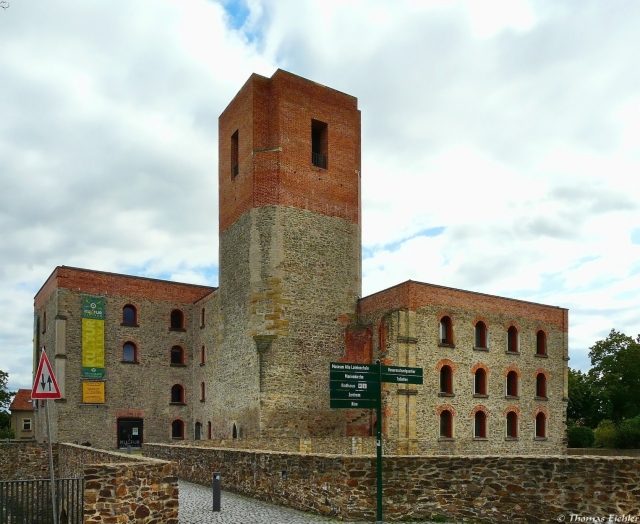
In Saxony, Großenhain Castle now serves as a cultural center. Originally a border fortress, it endured destruction and reconstruction before finding a new purpose in the 21st century.
History+
First mentioned in 1289 as a building in the Hayner Pflege region, the complex also served as a residence for Landgrave Albrecht the Degenerate's sons, Friedrich and Dietzmann. Due to its proximity to Brandenburg, the castle was fortified in 1291 and a freestanding keep was added in the 13th century. A city fire in 1547 led to the castle's destruction. Elector August ordered its reconstruction in 1557, but during the Thirty Years' War, the building was besieged and devastated again by Swedish troops in 1637 and 1642. Elector Johann Georg II had the ruin repaired in 1662. Later, Wolf Caspar von Klengel acquired the property, which was already referred to as a “Schloss” (castle/palace) in 17th-century records. Despite inspections by Elector Johann Georg II in 1663, the castle suffered further damage in 1704 during the Great Northern War and in 1744 during another city fire. Around 1745, it was surrounded by a moat, and its six-meter-thick walls were considered impregnable. Between 1780 and 1800, the powder bastion and gate were demolished.
Image: Thomas Eichler
Location: 51.2901, 13.5337