Cultural facilitie
The Castle can be visited
Großsedlitz Castle

The Baroque Garden Großsedlitz with the Friedrichschlösschen is located on a hill southeast of Dresden, in the city of Heidenau in the Free State of Saxony.
The garden is considered an outstanding example of French garden art in Saxony; it is one of Germany's most authentic Baroque complexes. Also noteworthy is the multitude of bitter oranges that emphasize the architecture of the terraced garden space.
The Baroque Garden in the Heidenau district of Großsedlitz was built between 1719 and 1723 by Imperial Count Christoph August von Wackerbarth as a country estate with an orangery. He had already acquired it in 1715. The creator of the concept for the intended three-winged castle in French Baroque style is unknown. Designs by Pöppelmann, Longuelune, and Knöffel for the complex are known. The shell was erected by 1720; however, a design plan by Johann Christoph Knöffel is not documented.
Already in 1723, the estate came into the possession of Elector August the Strong, who had it enlarged and redesigned horticulturally and architecturally until 1727, among others by Longuelune. An originally planned castle-like palace was never built.
While the palace in Pillnitz served for pleasure and the one in Moritzburg for hunting, Großsedlitz was intended to become the Order Palace for the foundation festivals of the Polish Order of the White Eagle. On August 3, 1727, its anniversary, August the Strong began this one-day festival for the first and only time in Großsedlitz. After August's death in 1733, his son, Elector Frederick August II, since 1734 King of Poland August III, continued this tradition. Between 1740 and 1756, these festivities took place here twelve more times. The highlight each time was the shooting competition in the Lower Orangery Parterre; painted boards on the back wall of the basin of the "Silent Music" served as targets.
The complex fell into disrepair after 1750. The Seven Years' War, in particular, caused severe damage; by the peace treaty of 1763, the garden was devastated. During the Napoleonic Wars (1792 to 1815), the park and especially the buildings were also severely damaged. Early preservation work extended over a long period from 1846 to 1878. The remaining dilapidated structure of the castle was demolished in 1871, and in the following years, a two-story New Castle, later called Friedrichschlösschen, was erected on the site of the original east wing.
Parts of the Baroque Garden complex are attributed to Johann Christoph Knöffel. Sculptures are by Johann Christian Kirchner; some others are attributed to Johann Benjamin Thomae. Many other figures can be identified by their
Due to the gentle slope, the Baroque park was laid out in terraces. Its structure follows the gardening principles of a French garden and is influenced by the peculiarities of Dresden Baroque during the time of August the Strong. As a pleasure garden, the complex was used for festivities of the Dresden court until 1763. The western part of the garden remained unfinished and was hardly changed in the following centuries.
The main entrance gate of the Baroque Garden is a relatively recent addition. It was moved here in 1960 from the forecourt of the old Landhaus in Dresden (now the City Museum). The gate complex was built between 1960 and 1963. The dolphin fountains in the entrance area are the work of Johann Christian Feige.
Buildings+
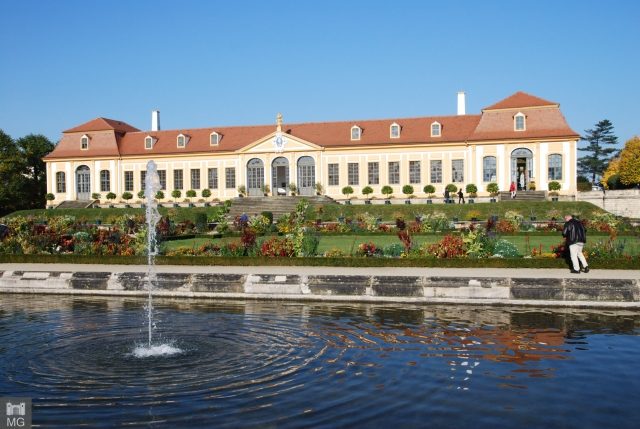
The buildings still preserved today, built in Baroque style, are the Friedrichschlösschen and the Upper and Lower Orangeries.
The Friedrichschlösschen, completed in 1847 according to plans by court architect Bernhard Krüger, embodies the former east wing of the castle built between 1719 and 1720 and demolished in 1871 due to dilapidation.
The Upper Orangery was built according to plans by Johann Christoph Knöffel from 1720 to 1721 as a functional building for housing orange trees in winter. It is single-story and has 23 window axes as well as corner pavilions with high mansard roofs on both sides. The triangular gable in the central axis is adorned with the Wackerbarth coat of arms.
The also single-story Lower Orangery was completed in 1727; it is characterized by 31 window axes and a successful integration into the terraced structure of the garden.
The Friedrichschlösschen today houses a historic restaurant, the Upper Orangery a registry office and a shop. The Upper and Lower Orangeries are used for concerts and exhibitions; the Lower Orangery also serves as winter quarters for the garden's potted plants.
Baroque Garden+
The park area, oriented along a northwest-southeast axis, today covers about 18 hectares. Although never fully completed, the complex is one of Germany's most authentic Baroque gardens. The garden is characterized by a sloping location with terracing, grand staircases, and cascades, completed by sightlines for landscape views.
The geometric network of paths is oriented along the three main axes of the complex.
The Lower Orangery Parterre, located on the eastern side of the park, formed the garden's ballroom; here, among other things, the shooting competition took place. The sunken, U-shaped complex is bordered on the north side by the Lower Orangery, and on the south, an unusual staircase adjoins it. This grand staircase, called "Silent Music" due to the musical putti adorning it, was designed by the master builder Matthäus Daniel Pöppelmann. Here, two curved flights of steps embrace a basin, which with its three fountains represented the target point of the shooting range.
In the western part of the garden, the Forest Cascade with an upper basin called "Stone Sea" embodies the intention to create a "water axis" as the most vibrant part of the garden. However, like the Parterre d'eau located at the lowest point and the two water steps enclosed by the retaining walls of the Upper Orangery Parterre, it remained unfinished.
Of the formerly numerous sandstone sculptures from Roman and Greek mythology, 64 still adorn the garden complex today, including 24 originals. Noteworthy are the figure groups "Four Seasons" (Winter, Spring, Summer, Autumn), "Four Continents" (Europe, Asia, Africa, America; Australia was still undiscovered at the time), and "Four Elements" (Fire, Water, Air, Earth), all of which still exist as originals, created by court sculptor Johann Christian Kirchner. In the latter, two opposing elements are combined in a single figure: Fire and Water, as well as Air and Earth, are united here.
Orangery+
Collections of southern plants, often referred to as "Orangeries," became fashionable in the 17th and 18th centuries. In addition to oranges, myrtles, pomegranates, laurels, and figs were cultivated in Großsedlitz.
Due to their connection to the Greek Hercules myth, oranges held special significance at that time. According to this myth, Hercules, as one of twelve tasks, was to retrieve golden apples from the Garden of the Hesperides. The obvious similarity of oranges to golden apples allowed for a flattering association of their owner with the virtuous characteristics of Hercules.
According to the inventory list of 1736, the Baroque Garden at that time possessed 1,250 orange trees, with the stock of bitter oranges being particularly valuable. Years of neglect and presumably a heating failure in the severe winter of 1928/29 destroyed the last remaining stocks.
In 1997, 150 orange trees were acquired from Tuscany for the first time; the current stock has grown to over 400 potted plants, including 140 bitter oranges. They are overwintered at temperatures of 5 to 8 degrees Celsius in the Lower Orangery.
Current Situation+
The Baroque Garden came into the possession of the re-established Free State of Saxony in 1992. At the same time, a comprehensive restoration and reconstruction of the garden and buildings began.
The publicly accessible complex today includes, in addition to the Friedrichschlösschen, the Old Gardener's House, the Upper and Lower Orangeries, the Upper Parterre, the Water Parterre (Parterre d'eau), the "Silent Music," the Lower Parterre, the Forest Cascade, and the Natural Theater.
From Easter to October each year, a variety of events take place in the garden. The highlight is the Garden Festival on the first weekend in August. It is intended to commemorate the first festival of the Polish Order of the White Eagle, which was celebrated for the first time in Großsedlitz under August the Strong.
Take Mobile History with you
You are reading this text for free. Premium adds what matters on the road: descriptions read aloud, sites found through your camera, whole regions taken offline.
- Every description, including the ~17,700 Premium sites
- Audio guide: have descriptions read to you on location
- AR finder: see sites through your camera, with distance and bearing
- Unlimited saved sites
14 days free, then from €2.99 a month. Cancel anytime.
Source: Wikipedia · Licence: CC BY-SA 4.0 · Image: Mobile Geschichte
This description draws on the facts documented in the linked Wikipedia article; Wikipedia content is licensed under CC BY-SA 4.0. Wording and editing: Mobile History.
Location: 50.9515, 13.8893