Museum
CastleRimpar
Grumbach Castle
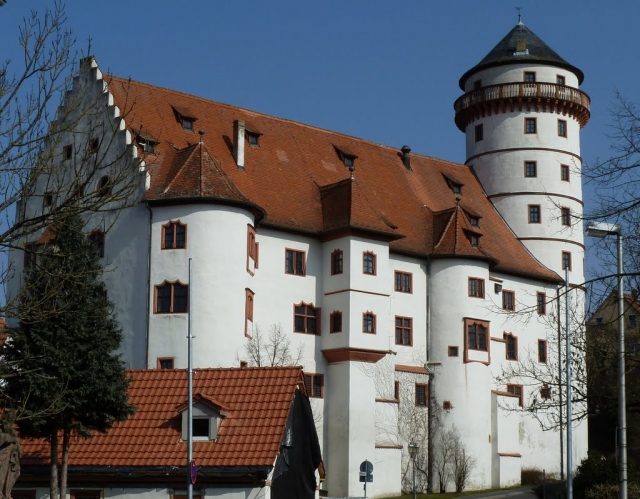
Grumbach Castle is located in Rimpar in the Lower Franconian district of Würzburg and is the town's main attraction. It was built in the 14th century by a line of the ancient Franconian noble family Wolfskeel, which in this line first called itself "Wolfskeel von Grumbach", later simply "von Grumbach". Well-known representatives of the Rimpar line of the (Wolfskeel) von Grumbach were Prince-Bishop Johann III von Grumbach and Wilhelm von Grumbach. In 1593, Grumbach Castle and the village of Rimpar were acquired by the Würzburg Prince-Bishop Julius Echter von Mespelbrunn and served from then until the 18th century as the summer residence of the Würzburg Prince-Bishops. The castle has been owned by the municipality of Rimpar since 1980, which bought it from the state of Bavaria. Between 1996 and 2010, the castle museums operated by the Freundeskreis Schloss Grumbach e.V. (Friends of Grumbach Castle Association) were established: Archaeological Museum, Bakery Museum, Traditional Costume Museum, Mason and Carpenter Museum, and Crime Museum.
History+
Originally, Rimpar belonged to the possessions of the noble free lords of Grumbach, who were first mentioned in documents in the 11th century and had their ancestral seat in Burggrumbach, a district of Unterpleichfeld, where they built Burggrumbach Castle from the 11th to the 12th century. The family died out in the male line in 1243 with Albert II. His daughter was married to a Count of Rieneck, who then received all the family's possessions.
In 1328, Count Ludwig von Rieneck sold two-thirds of his castle in Burggrumbach as well as all his possessions in Burggrumbach, Rimpar, Kürnach, and Bergtheim. The buyer was a knight Eberhard from the ancient Franconian noble family of Wolfskeel, who later named himself Wolfskeel von Grumbach after his possession, which his descendants adopted, later calling themselves only von Grumbach in this line. These Wolfskeel von Grumbach then had Grumbach Castle built in Rimpar. There are no documents whatsoever about the construction of a castle in Rimpar. Nevertheless, it can be concluded that it cannot have been built before about 1370, as the defensive wall is equipped with loopholes for firearms. It was not until 1371 that Horant von Grumbach was first mentioned as a von Grumbach living in Rimpar. The castle itself, however, is not mentioned in documents until 1469. This concerns a division agreement between Heinz and Eberhard von Grumbach. At this time, two family members from the Rimpar line became more famous: Prince-Bishop Johann III von Grumbach and Wilhelm von Grumbach. While the former left behind the Franconian ducal sword as an important relic, Wilhelm von Grumbach, born in the castle in 1503, served under numerous princes as court marshal, governor of the margravial landscape, colonel of the crown, and under numerous other titles. His rise came to an inglorious end with the beginning of the Grumbach Feud, when the Ansbach Margrave was outlawed by the Emperor and he was declared a disturber of the peace, although there was no reason for it. Nevertheless, at the instigation of Prince-Bishop Melchior Zobel von Giebelstadt, all his goods were confiscated. An attempt to sue for his rights before the Imperial Court of Justice also failed. Wilhelm von Grumbach states that he lost 17,000 guilders in one year at that time, which today corresponds to about three million euros. In 1558, Prince-Bishop Melchior Zobel von Giebelstadt was ambushed on his way to Marienberg Fortress by a group of armed men and shot dead by a servant of Wilhelm von Grumbach. Most likely, this was not the case, but rather a kidnapping had been planned – through which Wilhelm von Grumbach could have regained his property. Apart from his confession under torture in 1567, however, there is no longer any proof today of a kidnapping plan. In any case, the former court marshal wanted his goods back at all costs, as he even temporarily occupied the city of Würzburg with 1300 men. Thereupon he forced the cathedral chapter to return his property and was consequently outlawed by the Emperor. Von Grumbach had to flee to Gotha to Duke Johann Friedrich the Middle, who was well-disposed towards him and did not extradite him even after repeated requests. The situation escalated to the point that in 1567 an imperial army marched on Gotha and captured the city. The Duke was sentenced to life imprisonment, von Grumbach was tortured and then killed.
Wilhelm's son, Konrad von Grumbach, paid the sum of 50,000 guilders to the Prince-Bishopric of Würzburg in 1569 to regain his father's possessions. In the following period, however, he became increasingly indebted through costly investments and finally had to sell the castle along with the entire village of Rimpar to Würzburg in 1593, indebted with about 250,000 guilders. In 1593, the castle and village of Rimpar were acquired by the Würzburg Prince-Bishop Julius Echter von Mespelbrunn. Before Konrad's son Wilhelm saw the Rimpar line of the Grumbachs die out in 1603, the castle and town of Rimpar were rededicated as the summer residence of the Würzburg Prince-Bishops. Julius Echter had a town hall built, the church renovated, and a pleasure house erected below the castle. Inside the castle, numerous rooms were newly furnished, including the still preserved, stuccoed main hall. The frequent visits were sometimes accompanied by about 140 people from the court. Between 1698 and 1739, 36 stays of the bishop are verifiable; 26 of these were accompanied by a court of up to 69 people and 10 by a court of up to 160 people. In 1744, however, the castle was replaced by the Werneck country residence, which had just been completed, and the decay of the walls began.
Thus, between 1780 and 1793, the entire west wing was demolished – the resulting rubble was used to fill the basements of the towers, the present archaeological museum, and the moat – before the invasion of French troops in 1796 initially put further demolition plans on hold. It is probably thanks to this circumstance that the castle is still relatively well preserved today; for instead of further decay, a renovation even followed in 1800, during which the "Welsche" (Italianate) roofs were replaced by blunt hoods, thus adopting their present appearance. The Royal Bavarian Forestry Office Rimpar, founded in 1806, found its home from the beginning in the east wing. It was not until 1971 that this became free again when the forestry office was dissolved. Finally, on July 21, 1980, Rimpar, under Mayor Anton Kütt, bought the castle, which until then had been owned by the state of Bavaria. The Freundeskreis Schloss Grumbach (Friends of Grumbach Castle) was founded in the same year. From 1984, after renovation and refurbishment, the castle could be used as a town hall, and the inauguration took place on May 18, 1985. Between 1996 and 2010, the castle museums (Archaeological Museum, Bakery Museum, Traditional Costume Museum, Mason and Carpenter Museum, and Crime Museum) were established, which are operated by the Freundeskreis Schloss Grumbach e.V.
Interiors+
Knight's Halls (Large and Small Hall)+
According to the Freundeskreis Schloss Grumbach, the rooms are among the "most beautiful Renaissance halls in Germany." In the large …
Source: Wikipedia · Licence: CC BY-SA 4.0 · Image: Reinhold Schulz
This description is a machine translation of an excerpt from the linked Wikipedia article. The source text was written by its authors, the translation is by Mobile History; like the original it is licensed under CC BY-SA 4.0.
Location: 49.8572, 9.9586