CastleGroßpösna - Güldengossa

Güldengossa Castle
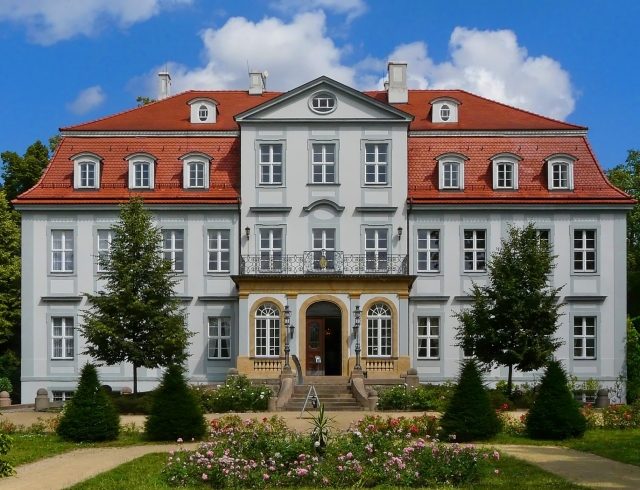
Güldengossa Castle

Cultural Events

For centuries, Güldengossa was shaped by its manor, whose owners in the 18th century had a representative Baroque-style castle built. The castle still dominates the village today.

The first mention of a manor house dates back to 1285, referring to a "Theodoricus de Ghzouuve". Then, in 1350, a knight Heinrich von Cossowe is mentioned. The enfeoffment of the Erdmannsdorf brothers in 1473 is only confirmed. In 1594, Friedrich von Burkersroda was the feudal lord of Güldengossa, followed by his heirs. In 1719, August the Strong is said to have offered Güldengossa to his chief master of horse and chamberlain Friedrich I. Vitzthum von Eckstädt, which is also the first time the name "Gülden Gossa" appeared (previously just Gossa, but often still so later). However, he apparently declined, because already in 1720, after a purchase for 28,000 guilders, Johann Ernst Kregel von Sternbach was the hereditary, feudal, and judicial lord of the manor. He was a wealthy Leipzig merchant and councilor, which enabled him to have the manor house rebuilt as a Baroque building, so that from then on it could be referred to as a castle. He also had a representative park laid out to the east. In 1731, his son of the same name inherited the estate.

The next owner from 1761 was Dr. jur. Carl Friedrich Brehme from Leipzig. In 1785, the Leipzig merchant Johann Heinrich Küstner acquired it. Küstner was a member of the Gewandhaus Directorate. In 1807, he drafted the "General Fire Regulations for Villages and Manors" and introduced them on his estate and in the municipality of Güldengossa. In 1814, the new owner of Güldengossa was district inspector Victor August Schoch. The Welter family of owners (1880–1943) undertook significant changes at the end of the 19th century. They enlarged the property by buying up farms and completely relocated the agricultural operations of the estate to the other side of the southern boundary road of the park. This, and a neoclassical extension with a balcony above the entrance in 1900, gave the castle an even more representative character.

The last private owner, Theodor Volkmar-Frenzel, a nephew of the Welter family, was dispossessed and expelled by the communists in 1945 as part of the land reform, and the KPD sub-district leadership Leipzig received the entire estate for use. Then the agricultural operation and the castle were separated. The property was divided among 27 new farmers and 28 small settlers, and some of the operational buildings were used for other purposes. In 1950, the castle became an FDGB recreation home and from 1951, a trade union school for IG Druck und Papier. In 1968, VEB Kombinat Espenhain took over the castle and used it as an apprentice dormitory until 1990. The park partly served as a sports field for the home.

In 1993, the Gesellschaft für Arbeitsförderung, Beschäftigung und Weiterbildung mbH. Leipzig (ABW) acquired the castle. After the ABW failed with its operating concept, it stood almost empty from 1997 and was only sporadically used for cultural events.

In 2006, a private investor from Baden-Württemberg bought the castle and park, renovated both exemplarily within two years, and moved the headquarters of his trading business here. In the park, which is publicly accessible, the historical network of paths was restored. The castle also serves for cultural events and can be visited during guided tours.

Take Mobile History with you

You are reading this text for free. Premium adds what matters on the road: descriptions read aloud, sites found through your camera, whole regions taken offline.

  • Every description, including the ~17,700 Premium sites
  • Audio guide: have descriptions read to you on location
  • AR finder: see sites through your camera, with distance and bearing
  • Unlimited saved sites

14 days free, then from €2.99 a month. Cancel anytime.

Location: 51.2560, 12.4473