Museum
CastleGüstrow
Güstrow Castle
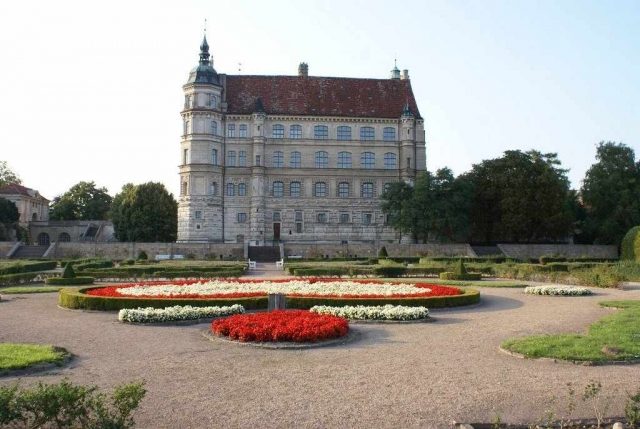
Güstrow Castle, a Renaissance building in Northern Germany, rises in the city of the same name. It stands as a testament to a time when princely courts became centers of culture and Italian architecture shaped the North.
History+
Originally, a Slavic fortified settlement existed on the site of the present castle, first mentioned around 1307 as a castle of the Princes of Werle. After the extinction of this line in 1436, the castle came into the possession of the Dukes of Mecklenburg and served as their second residence. Duke Ulrich of Mecklenburg developed Güstrow into a center of Renaissance culture after the divisions of the duchy in 1547 and 1552. A fire in the south wing of the old castle in 1557 provided the opportunity for a new building. Under the direction of the Italian-born architect Franz Parr, the entrance wing and the western part of the south wing were built from 1558, with the shell completed around 1565. After another fire in 1586, which destroyed the north wing, it was rebuilt from 1587 to 1591 according to designs by the Dutchman Philipp Brandin. The east wing followed in 1594 according to plans by Claus Midow. Between 1628 and 1630, Wallenstein resided here. The completion of the castle construction took place in 1671 with the gatehouse and the castle bridge by Charles Philipp Dieussart.
Source: Wikipedia · Licence: CC BY-SA 4.0 · Image: Roland Neubert, Halle (Saale)
This description draws on the facts documented in the linked Wikipedia article; Wikipedia content is licensed under CC BY-SA 4.0. Wording and editing: Mobile History.
Location: 53.7907, 12.1772