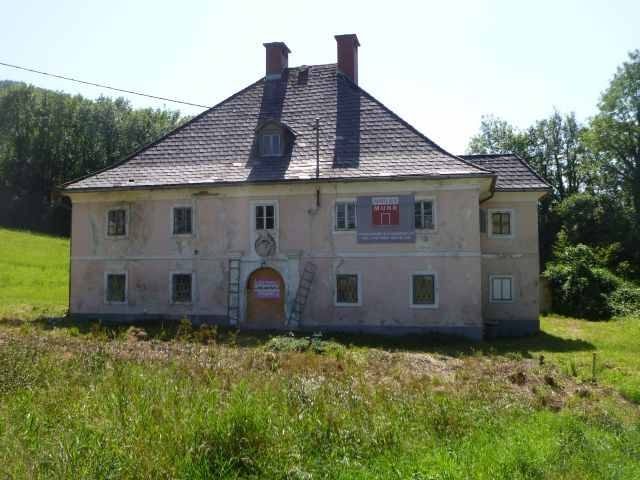
To be privately owned
Guggenthal Castle

Guggenthal Castle (also manor, hunting lodge) is located in Guggenthal in the Salzburg municipality of Koppl at the foot of the Gaisberg, directly on the Wolfgangseestraße, approx. 5 km as the crow flies east of Salzburg city center.
As early as 1272, the hamlet and the place name "guck ins thal" (look into the valley) appeared in documents. The next historical evidence refers to Andre and Maximilian Stainhauser, who owned the Guggenthal estate in 1588. After the bankruptcy of their trading house, Sebastian Stainperger, a Salzburg merchant, acquired the property in 1627. His widow Magdalena Taxin followed him in 1630, but sold it as early as 1633 to Catharina Countess Lodron, née Spaur. On July 14, 1640, the estate was freed from all taxes. On December 20, 1642, Archbishop Paris Lodron had the estate purchased by the court chamber from his sister-in-law as administrator of the Lodron primogeniture (today Lindenbichlhof, Guggenthal No. 9). Paris Lodron gave the "newly built manor house", presumably by Santino Solari, to Bishop Johann Christoph von Chiemsee with the condition that the Chiemsee "small castle above the Gmain" (the Weiherhof in Morzg) be left to the Salzburg canons for use - the Bishops of Chiemsee were the auxiliary bishops of the Archdiocese of Salzburg, and resided in Salzburg. His successor Johann Graf Preysing sold the estate including the mill on June 1, 1670, to the princely steward Franz Carl Polito and his wife Maria Ursula Catharina von Grimming. With his assumption of ownership, fierce disputes with the surrounding farmers began. After Polito's death in 1683, a jurisdictional dispute broke out in 1691 between the Neuhaus district court and the Chiemsee Hofmark Koppl. It was then determined that the entire Guggenthal estate belonged to the Neuhaus court. The estate was subsequently leased to farmers by the Bishops of Chiemsee. On December 4, 1875, after many intermediate stages, the Lindenbichlhof and the small castle were acquired by Siegmund Hatschek, whose family still owns the property today.
Architectural Description+
Guggenthal Castle (or small castle) has an almost square floor plan with two stories and a high, almost pyramidal hip roof over a wide cove cornice. A central corridor runs through the castle, from which one can reach the first floor via a steep wooden staircase. Above the eastern entrance door is the coat of arms of the Chiemsee Bishop Franz Virgil Graf Spaur. The western coat of arms has not yet been assigned. On the street side, a wooden crucifix is mounted behind a grate, and on the mountain side, there is a Madonna figure.
Take Mobile History with you
You are reading this text for free. Premium adds what matters on the road: descriptions read aloud, sites found through your camera, whole regions taken offline.
- Every description, including the ~17,700 Premium sites
- Audio guide: have descriptions read to you on location
- AR finder: see sites through your camera, with distance and bearing
- Unlimited saved sites
14 days free, then from €2.99 a month. Cancel anytime.
Source: Wikipedia · Licence: CC BY-SA 4.0 · Image: http://commons.wikimedia.org/wiki/File:Schloss_Guggenthal.jpg
This description draws on the facts documented in the linked Wikipedia article; Wikipedia content is licensed under CC BY-SA 4.0. Wording and editing: Mobile History.
Location: 47.8187, 13.0986