CastleGymnich

Gymnich Castle

Gymnich Castle

To be privately owned

Gymnich Castle is a moated castle in the Erftaue in Gymnich, a district of Erftstadt, in North Rhine-Westphalia. For centuries it was the seat of the Rhenish knightly family of Gymnich.

The castle, which is surrounded by a large park, has a total plot area of 21 hectares and is located on the Rhenish Saga Trail.

A first castle was built in 1354 on the western edge of the village by Heinrich I von Gymnich. He offered it to Archbishop Wilhelm von Gennep as an open house of the Cologne Church and received it back as a fief from him. After raids and damage to other vassals of the Archbishop by Heinrich II, the castle was demolished in 1399 on the orders of Archbishop Friedrich von Saarwerden. Heinrich pledged – also for his descendants – never again to build a fortified house in Gymnich without the Archbishop's permission.

The successor building was erected at a different location, east of the first castle. In 1419, Johann von Gymnich, son of Heinrich II, was enfeoffed with Haus Gymnich. His son Arnold inherited Haus Gymnich in 1467, which remained in family ownership until the extinction of the line of von und zu Gymnich in 1824 with the death of Baroness Johanna von Gymnich, canoness in Neuss, daughter of Karl Otto Ludwig Theodat von und zu Gymnich. Afterwards, the castle came as a gift to her great-nephew Max Felix Reichsgraf Wolff Metternich and his heirs. Vilma Reichsgräfin Wolff Metternich, who was the last member of the family and thus heir, brought it to this line through her marriage to Franz Vicomte de Maistre. In the further line of succession, after the death of the childless son Rudolf Vicomte de Maistre, the castle fell to the testamentary successor designated by Vilma, the countess's grandson and son of her daughter, Jörg Freiherr von Holzschuher.

Miranda de Maistre (1912–2009), Rudolf's wife, who could not inherit according to house law, moved into the chaplaincy next to the church after her husband's death (1968). After a modest life, she died there on July 22, 2009. She remained connected to Gymnich as patroness of the Sebastianus Brotherhood until shortly before her death.

The Gymnich Mill was connected to the castle and later the palace as a ban mill.

Description of the complex+

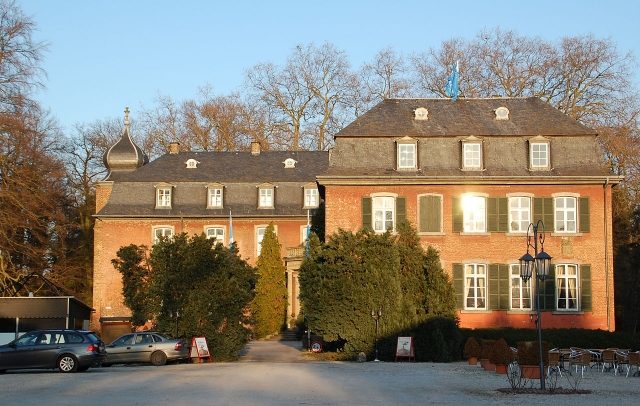
A side street, branching off the main road, leads to the castle's entrance gate, from which an avenue leads to the castle. Of the former farmyard, the outer bailey, the north wing was demolished. The outer bailey is connected to the main castle by a bridge, which lies on a rectangular island surrounded by moats. The two-winged complex consists of a west wing with two towers and a northern tract adjoining at a right angle. In the corner of the two wings, the entrance, accessible via a staircase, is located in an antechamber.

The two wings were built at different times. After the castle was burned down in the Hessian War in 1642, the west wing, built in 1547, with the southern chapel tower, was rebuilt in Baroque style from 1655 to 1659 by Sofia Margarethe Wolff, also known as Metternich, the widow of Adolf von Gymnich, and the altar in the castle tower was reconsecrated. Remains of an earlier castle complex can still be seen in the plinth foundation of the chapel tower.

The north wing was built in 1722. Karl Otto Ludwig Theodat von und zu Gymnich had the rooms furnished in Rococo style in 1738. The opulent interiors with magnificent stucco decorations are particularly characterized by the portraits of the electors of the time embedded in the wall surfaces in the "Electors' Hall", a portrait of Empress Maria Theresia in the "Marble Cabinet", and paintings of personalities from the family of the Lords of Gymnich, as well as by the unique supraports depicting all the castles of Elector Clemens August.

During the alterations and fundamental renovations carried out between 1903 and 1930, the main entrance was relocated in 1907 and the current entrance was built as a small antechamber in Neo-Baroque style.

According to Henriette Meynen, the significance of the Baroque castle lies not only in its artistic interior design but also in its large park with an abundance of native tree species, as well as botanically striking exotic plants.

Today, the building is a protected monument.

The property, including the park, covers an area of 212,667 square meters.

Modernization of the complex+

Jörg Freiherr von Holzschuher, who, according to media reports, unexpectedly inherited the castle from his grandmother Vilma Reichsgräfin Wolff-Metternich, found a complex that had been vacant for years and was in great need of renovation.

During World War II, it had been used militarily. The Luftwaffe had set up its telephone exchange there for the Luftwaffe squadron stationed at the Gymnich airfield. The couple Vicomte de Maistre had given up their apartment in the castle and had buildings in the northwest wing of the outer bailey demolished and a new residence built for themselves in 1956.

Jörg von Holzschuher modernized and renovated the castle to meet the increased demands for living comfort by installing central heating, renewing electrical wiring, installing bathrooms and toilets, and fundamentally restoring the reception rooms.

Use by the Federal Government+

In 1971, he leased it to the Federal Government for 750,000 DM per year, which used the castle as a guesthouse until July 1990. It was thus the predecessor and successor to the Federal Guesthouse on the Petersberg. Gymnich Castle hosted 262 state guests. Most state guests landed at Nörvenich Air Base, which is within sight, and were then driven by car to the nearby guesthouse.

The term Gymnich meeting refers to a meeting within the framework of European Political Cooperation in April 1974 at the guesthouse Schloss Gymnich of the German Federal Government, hosted by Hans-Dietrich Genscher. Since this meeting, so-called Gymnich meetings have taken place once per Council Presidency, i.e., once every six months.

On August 25, 1989, a secret meeting of Hungarian and German heads of state took place at the castle, which then led to the opening of the Hungarian-Austrian border on the night of September 10-11, 1989, for the embassy refugees from Hungary.

New Owners+

When the end of the Schloss Gymnich guesthouse became foreseeable after the Federal Government's guesthouse was moved back to Petersberg, Freiherr von Holzschuher sought a buyer. In June 1987, the Japanese entrepreneur Masao Nangaku acquired the castle for 28 million DM. He intended to convert Schloss Gymnich into a luxury hotel with an adjoining golf course that was to extend towards the Gymnich Mill. However, his plans were not realized due to financial difficulties. After the conclusion of the purchase negotiations, he could no longer withdraw from the purchase without presenting a new buyer. He found him in 1993 in Joachim (Joe) Wander (Wander Group). The new owner also wanted to build a golf course on the property, but had to realize that the building permit for this had already been withdrawn in 1992. Wander therefore set up an upscale hotel there, which proved unprofitable as the expected guests stayed away without the golf course. Due to major financial difficulties, he too had to give up.

In July 1998, Dan Kelly, father of the music group Kelly Family, acquired the castle at a forced auction for 13.1 million DM. The Kelly Family lived there until the father's death in 2002. Due to the busloads of fans, who sometimes camped in the residents' front gardens, a special security service was required. Over time, the children had moved out, and father Dan often remained alone in the castle. Thus, since 2000, several attempts were made to sell the castle, but without success. With the death of father Dan in August 2002, the 9 siblings and three half-siblings – one of whom was in the USA with a trustee – finally inherited the castle jointly. The many co-owners could not agree on a subsequent use or sale for a long time.

Therefore, the castle was leased in the interim. In 2005, the entrepreneurs Wilfried Vogt and Manfred Diel, together with Joey Kelly, founded "Schloss Gymnich GmbH", which operated the castle as a restaurant and event venue. After Manfred Diel's arrest in the course of the insolvency of the Heros corporate group, the GmbH filed for insolvency in spring 2006. From May 1, 2006, the rescue company "Schloss Gymnich Erleben und Genießen GmbH" took over, with Wilfried Vogt remaining as managing director; Joey Kelly remained involved as a shareholder. Until 2009, it was run as an upscale hotel and restaurant and served as an event venue. From September 2010 to April 2011, the castle served as an outdoor set for the ZDF telenovela Lena – Liebe meines Lebens.

Due to the disagreement of the many co-owners, Joey Kelly initiated the forced auction, with the market value set at 5.3 million Euros. Based on this market value, the minimum bid was set ex officio at 2.65 million Euros. Bids had to be submitted to the competent district court in Brühl by January 31, 2012. However, at that time, only a bid from Joey Kelly himself of 1.7 million Euros was available. Since it fell below the set minimum bid, the sale did not proceed for the time being.

Legend and Coat of Arms+

The legend of the Gymnich Ride is associated with the castle and the family, which is still celebrated today on Ascension Day by the Sebastianus Brotherhood as a mounted procession. The legend also became a design element in the coat of arms of the von Gymnich family.

Take Mobile History with you

You are reading this text for free. Premium adds what matters on the road: descriptions read aloud, sites found through your camera, whole regions taken offline.

  • Every description, including the ~17,700 Premium sites
  • Audio guide: have descriptions read to you on location
  • AR finder: see sites through your camera, with distance and bearing
  • Unlimited saved sites

14 days free, then from €2.99 a month. Cancel anytime.

Source: Wikipedia · Licence: CC BY-SA 4.0

This description draws on the facts documented in the linked Wikipedia article; Wikipedia content is licensed under CC BY-SA 4.0. Wording and editing: Mobile History.

Location: 50.8426, 6.7442