To be privately owned
Restaurant
Haag Castle

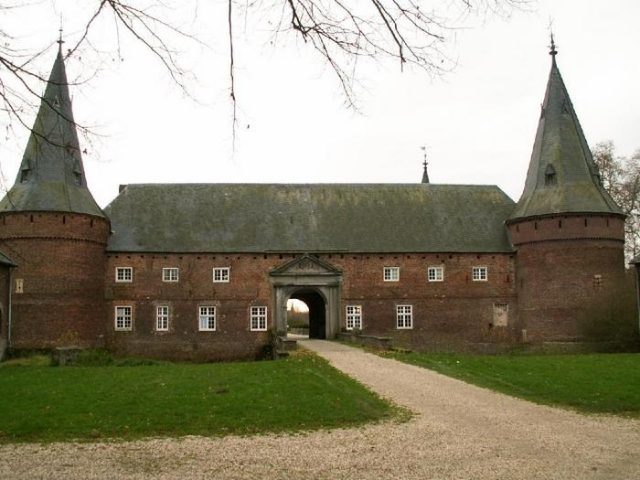
Haag Castle is located north of the town of Geldern in the Kleve district. Its name derives from the Old German word "haeg", which referred to a copse. Despite extensive destruction in the Second World War, it is still recognizable today as a once heavily fortified castle complex from the late Middle Ages.
Residents and Owners+
In 1337, a farm in "ghen Haege" was first mentioned in documents, which at that time was owned by Konrad von Issum. 26 years later, two farms of the same name were even reported, belonging to a Johann von Boedberg.
After Haag came under the County of Geldern in 1382, the complex belonged as a sub-fief to the House of Hoenselaer. At that time, Johann's grandson, also named Johann, was the owner of Haag. He belonged to the influential Gelderland knighthood and acquired the hereditary marshal's office in 1431.
In direct succession, Haag Castle then passed to Adrian, Cornelius, Adria, and again a Cornelius von Boedberg.
When that Cornelius died unmarried in 1585, his brother Arnold succeeded him. But he too died in 1613 without leaving male descendants, and so the castle passed to Ulrich, Lord of Hoensbroek, who was married to Johanna von Boedberg, Arnold's and Cornelius' sister.
Ulrich's son Adrian took over the property, including the associated hereditary marshal's office, in 1618. His son, Arnold Adrian, was an envoy of the Spanish King Charles II, who elevated him to the rank of Marquis in 1675 for his services.
After Arnold Adrian, eleven more generations of the Hoensbroech family ruled over Haag Castle. At the end of the 18th century, it replaced Hoensbroek Castle as the family's ancestral seat. It is still owned by the Imperial Counts of and zu Hoensbroech today.
Throughout its long history, the buildings have seen many prominent visitors. Frederick the Great was among them, as was Emperor Napoleon Bonaparte, who visited the complex on September 12, 1804. In 1814, Tsar Alexander I was a guest, and in 1863, King Wilhelm I stayed there on the occasion of Geldern's 150-year affiliation with Prussia.
The Buildings+
In the 14th century, the farms were surrounded by forests and swamps. They were gradually expanded by their owners into a defensible knight's seat. Today, Haag Castle consists of the former outer bailey and a forecourt located to the north. The former manor house is no longer preserved.
During the Spanish-Dutch War, the then heavily fortified complex suffered from troops quartered there, who plundered it in 1584, partially demolished it, and burned down the forecourt. To avoid further occupations, the magistrate of the city of Geldern, at the request of Baron Arnold von Boedberg, turned to the stadtholder of the Habsburg Netherlands, Alessandro Farnese, with the request to have the fortifications of Haag Castle razed; with success, as the ramparts were leveled and defensive walls demolished.
Although the castle was marked with Red Cross flags as a hospital, Allied bombing raids severely damaged it on February 28, 1945. Its west wing and the manor house, including its valuable art collection, were completely destroyed.
In 1967, a reconstruction of the still preserved curtain wall, including the battlement and loopholes, was carried out on the west side, but the manor house was not rebuilt.
The park-like surroundings of the castle date back to 17th and 19th-century garden designs.
Outer Bailey and Forecourt
The outer bailey, with its round corner towers and the square gate tower in the southwest, probably originates in its basic substance from a single large construction phase in the second half of the 15th century. The gate tower was the former entrance to the castle complex. Above a pointed arch portal, it has an eight-part broken spire. The outer walls of the west and north wings show late medieval loopholes on the ground floor and in the roof truss area. The pointed arch arcades on the inner sides still bear witness to their former battlement.
The eastern wing of the outer bailey was rebuilt on old foundations in 1680 during a restoration. The north portal from 1686 is made of Liège bluestone and has a flat gable in classical style resting on two columns. It shows the coat of arms of Arnold Adrian von Hoensbroech and his third wife Katharina von Bocholtz and was originally the entrance portal of the manor house. In 1688, the horseshoe-shaped forecourt was built, which, like the outer bailey, consists of a central section and two wings joining at right angles.
Manor House
From 1662 to 1664, Arnold Adrian von Hoensbroech had the old two-story manor house extensively rebuilt in the Baroque style, thus transforming Haag Castle into a representative country estate. In the course of this renovation, a square tower on the southwest side of the house was demolished, whose counterpart on the southeast side was already no longer present at that time. Two risalits were added to the courtyard-facing front.
In 1876/77, the main house was restored under the direction of the Cologne master builder Vinzenz von Statz and extensively altered in the Neo-Gothic style. Statz added an additional floor and replaced the old driveway with an open staircase. The old main portal was installed in its current place in the outer bailey and replaced by a new one, above which the alliance coat of arms of Arnold Adrian von Hoensbroech and his wife Dorothea Elisabeth von Cottereau was displayed.
The interior of the manor house housed, among other things, a ballroom that was used as a dining room, and several state rooms. As late as 1891, the walls of the dining room were decorated with Flemish tapestries from an Antwerp manufactory. A large hallway on the second floor also served as a chapel. Only in 1902 was a separate, single-nave chapel building erected between the manor house and the outer bailey on the east side of the complex.
Current Use+
The outer bailey is currently used by the comital family for residential purposes and is therefore private. The inner bailey houses a restaurant and offices, while the outdoor area serves as a golf course.
The courtyard of the outer bailey is open to visitors.
Take Mobile History with you
You are reading this text for free. Premium adds what matters on the road: descriptions read aloud, sites found through your camera, whole regions taken offline.
- Every description, including the ~17,700 Premium sites
- Audio guide: have descriptions read to you on location
- AR finder: see sites through your camera, with distance and bearing
- Unlimited saved sites
14 days free, then from €2.99 a month. Cancel anytime.
Source: Wikipedia · Licence: CC BY-SA 4.0 · Image: http://www.wehrbauten.de/thread.php?threadid=566&hilight=Borghees
This description draws on the facts documented in the linked Wikipedia article; Wikipedia content is licensed under CC BY-SA 4.0. Wording and editing: Mobile History.
Location: 51.5351, 6.3197