CastleOhrenbach - Habelsee

Habelsee Castle
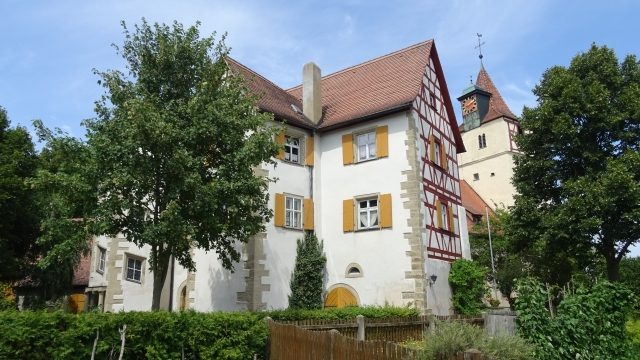
Habelsee Castle

To be privately owned

The first mention of Habelsheim is found in a manuscript volume of the Lorsch Monastery near Worms on the Rhine (Bavarian Main State Archive Munich). The record was made between 1167 and 1195. It was based on documents and registers from around 900. It records donations from a free Frankish lord who presumably inhabited the manor that stood on the site of the present-day castle. From the sources on the former Rothenburg area, the designation "the old burgk Hebalzhym" can be found in 1128, and in documents since 1300, men of knightly status are mentioned who held the castle as a fief from the Counts of Hohenlohe-Entsee. They therefore called themselves "von Habelsheim". The Knights Hübschmann bore the honorary title "Truchsess" (Seneschal). In the retinue of their counts, they always took the first place and always fought alongside their lords. In the Minster of Heilsbronn, a very well-preserved tombstone of a Hübschmann von Habelsheim shows a heron's head in a triangular shield as a coat of arms.

Initially inhabited by other knights of the Hohenlohe dominion (e.g., Lösch), in 1392 Mayor Heinrich Toppler acquired the castle for Rothenburg and made it the northeastern border fortress of the imperial city territory, the so-called Landwehr. From 1418 to 1607, the Öfffner family, their relatives von Bernheim, von Rinckenberg, and von Hessberg, became owners of the castle. Then the city came into possession for the second time, until 1649, immediately after the Thirty Years' War, the imperial Generalwachtmeister Johann Schaff von Habelsee acquired the castle, after it was no longer called Habelsheim due to the lakes that now surrounded it.

The new owner was an important man as a cavalry general of the Emperor in Vienna in the fight against the Turks, and in Habelsee a brilliant economist who had the castle - a fortified castle was no longer needed - built in its present form, with the art-historically significant staircase having survived the long war unscathed.

In 1666, Johann Schaff von Habelsee had to cede all his property to Rothenburg due to a murder, in exchange for the purchase price and improvement costs. The imperial city then had the castle administered by district magistrates until 1695 when the former imperial council and mayor Daniel Rückert bought it, and in 1709 Senator Daniel von Staudt bought it and remained the owner until 1741. Meanwhile, there were numerous changes of ownership.

However, the castle was often left uninhabited until its purchase in 1856 by the Prehmus family. In 1979, Reinhold Wiedenmann and his wife Gisela acquired the castle, which had been alienated for agricultural use, renovated it to look very much as it probably did under Johann Schaff von Habelsee, and have since filled it with life through high-ranking culture.

Source: Wilhelm Dannheimer, Die Chronik von Habelsee Schneidersche Buchdruckerei, Gebr. Schneider, Rothenburg o.d.T., 1949

Take Mobile History with you

You are reading this text for free. Premium adds what matters on the road: descriptions read aloud, sites found through your camera, whole regions taken offline.

  • Every description, including the ~17,700 Premium sites
  • Audio guide: have descriptions read to you on location
  • AR finder: see sites through your camera, with distance and bearing
  • Unlimited saved sites

14 days free, then from €2.99 a month. Cancel anytime.

Location: 49.4658, 10.2509