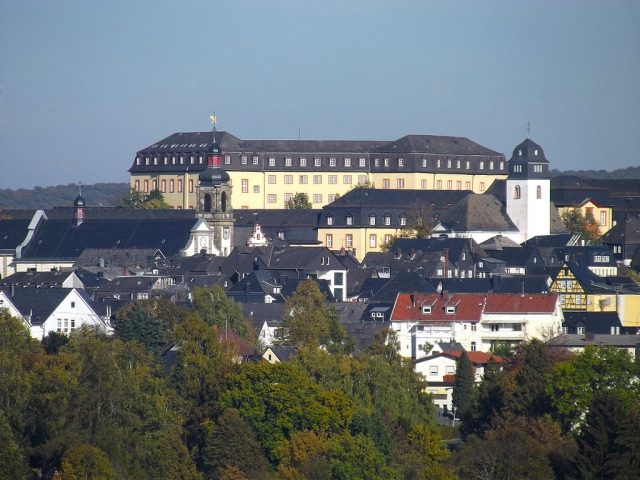
University of the German Bundesbank
Hachenburg Castle
Today's Hachenburg Castle was founded as a castle around 1180 by Count Heinrich II of Sayn and subsequently served as the seat of the Counts of Sayn.
The construction was completed in 1212 under his son Heinrich III of Sayn. He is also mentioned as the first owner of the town and castle of Hachenburg. At the same time, the neighboring Cistercian monastery of Marienstatt was built under him.
Hachenburg, whose name derives from a castle hill protected by a thorn bush, received its town charter in 1314 from Emperor Ludwig the Bavarian. The original settlement was not on the castle hill, which lies at 390 m above sea level, but in the Rothbach valley, about 1.5 km away and 100 meters lower, at the site of today's district of Altstadt, which was first mentioned in a document in 1343 (to distinguish it from the younger Hachenburg). The Romanesque St. Bartholomew's Church (today an evangelical church), built there around 1200, is the oldest surviving building in Hachenburg, followed by the Stone House (Zur Krone) on the Old Market in the city center, from the 15th century. The castle church was only built in the late 15th century and underwent several renovations until the 18th century. The Catholic Church of Maria Himmelfahrt was initially the church of the Franciscan monastery of Hachenburg from the first half of the 18th century, which became a parish church in 1813. In the Middle Ages, Hachenburg's population was probably not more than 500-1000. In the 17th and 18th centuries, it was between 1000 and 1500. After the Second World War, the population rose to 3000, and today the small town has almost 6000 inhabitants.
A large town fire on October 13, 1654, destroyed large parts of the city center and the castle. Count Salentin von Manderscheid and Count Georg Friedrich von Sayn-Hachenburg had the town and castle (now as a Baroque palace) rebuilt. The city center still has the shape they ordered, as most of the half-timbered houses on Friedrichstrasse, Herrnstrasse, Alter Markt, Perlgasse, Mittelstrasse, Judengasse, and Wilhelmstrasse date from the 17th and 18th centuries. The extensive castle, built by the Nassau-Weilburg architect Julius Ludwig Rothweil between 1715 and 1746 on the site of the old castle, features a horseshoe-shaped inner courtyard with a view of the castle garden. It changed owners several times in the 20th century and is now the seat of the University of Applied Sciences of the Deutsche Bundesbank.
Largely spared from damage in the Second World War, Hachenburg had, however, suffered greatly in earlier centuries, for example, from several large fires (1400, 1439, 1484, 1541, 1594, and 1654) and from the effects of war, especially in the Thirty Years' War (1618–1648), the Seven Years' War (1756–1763), and the two so-called Coalition Wars (1792–1797 and 1799–1802).
In 1799, after the death of the last Count, Johann August von Sayn-Hachenburg, the county fell to Nassau-Weilburg, and Hachenburg lost its status as a residential town.
Take Mobile History with you
You are reading this text for free. Premium adds what matters on the road: descriptions read aloud, sites found through your camera, whole regions taken offline.
- Every description, including the ~17,700 Premium sites
- Audio guide: have descriptions read to you on location
- AR finder: see sites through your camera, with distance and bearing
- Unlimited saved sites
14 days free, then from €2.99 a month. Cancel anytime.
Source: Wikipedia · Licence: CC BY-SA 4.0 · Image: http://commons.wikimedia.org/wiki/File:Hachenburg_Schloss.JPG
This description draws on the facts documented in the linked Wikipedia article; Wikipedia content is licensed under CC BY-SA 4.0. Wording and editing: Mobile History.
Location: 50.6614, 7.8257