To be privately owned
CastlePassau
Hacklberg Castle
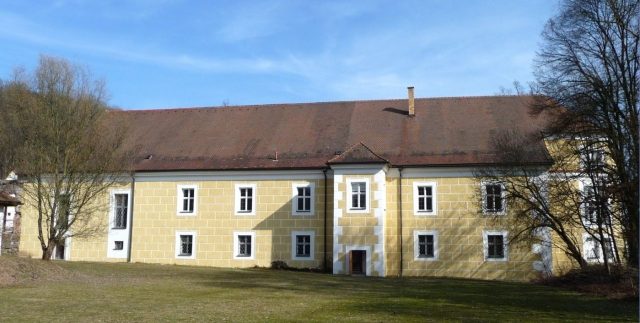
In the Hacklberg district of Passau, on the left bank of the Danube, is Hacklberg Castle. Originally a bishop's feudal court, it evolved into a summer residence and is now privately owned.
History+
The origins of Hacklberg Castle date back to 1307, when a small bishop's feudal court with a bathhouse was established here. By 1358, the property featured two towers and was the site of a knight's tournament celebrating the marriage of Meinhard III to a daughter of Duke Albrecht II of Austria. In 1410, the citizens of Passau prevented its expansion into a fortified complex, ensuring Hacklberg remained solely a summer castle. Bishop Wolfgang von Salm had it transformed in 1544 by Bernardino into a villa with gardens and colonnades. In 1675, Prince-Bishop Sebastian von Pötting relocated the Princely Brewery here. Under Prince-Bishop Johann Philipp von Lamberg, an expansion took place over nearly two decades, making Hacklberg one of the summer castles in Southern Germany, surrounded by an orangery, various greenhouses, cavalier and servant wings, and garden layouts. After 1786, Prince-Bishop Joseph Franz Anton von Auersperg converted the French garden into an English one. His successor, Thomas Johann von Thun und Hohenstein, used the estate as a beer storage cellar from 1796. After secularization, the castle wings and gardens fell into disrepair, while the brewery evolved into the Hacklberg Brewery. The surviving banquet hall was extensively restored in 2003.
Source: Wikipedia · Licence: CC BY-SA 4.0
This description draws on the facts documented in the linked Wikipedia article; Wikipedia content is licensed under CC BY-SA 4.0. Wording and editing: Mobile History.
Location: 48.5763, 13.4435