Offices
Hagenberg Castle

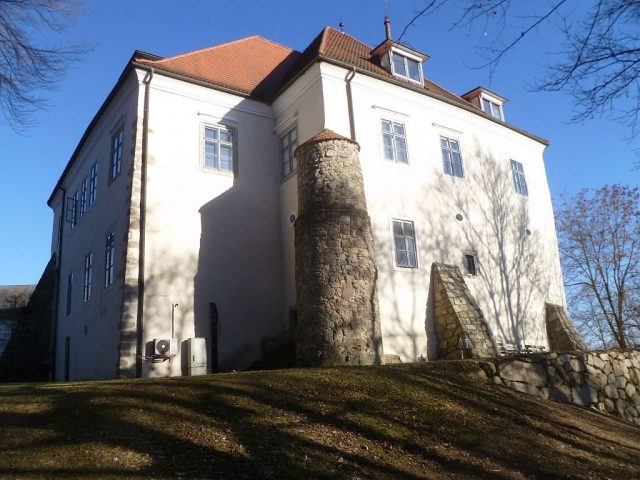
Hagenberg Castle is a listed castle complex in Upper Austria and is located in the town of Hagenberg im Mühlkreis in the Mühlviertel region. The castle was first mentioned around 1370 and changed owners several times. Its decay began in 1928, and by the 1960s, it had become uninhabitable. From 1983, the castle was renovated by the municipality with the help of the state of Upper Austria and has housed the Research Institute for Symbolic Computation (RISC) of Johannes Kepler University Linz, founded by Professor Bruno Buchberger, since 1989. Subsequently, the Softwarepark Hagenberg developed around RISC, which also includes the University of Applied Sciences Upper Austria, Faculty of Computer Science, Communication and Media. The entire town benefited from the Softwarepark and the University of Applied Sciences through additional jobs.
In 1370, what is now Hagenberg Castle was mentioned as a small castle, then owned by Lord von Wartberg ob der Aist, Eberhard Stadler. In that year, he transferred the castle to the brothers Eberhard, Hans, and Ulrich von Kapellen as a free property and took it back as a fief. Albrecht Stadler's daughter married Georg von Zwingenstein around 1406, bringing Hagenberg into the possession of this family. Their daughter, Beatrix, married Georg Schießenberger in 1432. This family kept the castle until 1514 and expanded it into a palace. Around 1514, Hans Schießenberger sold the estate to his cousins Hans, Mert, and Leo von Hoheneck (also: Hohenegg). They built a crypt chapel next to the castle in 1610. Eva von Hoheneck married Georg Christoph von Schallenberg in 1615, and the castle passed into his possession.
In 1672, the castle was sold to Egon Gotthard Maurer von Hohenberg, who had the castle chapel built. When he died 20 years later, the castle passed to Johann Adam von Wöber. His daughter Regina married Hofrat Wolf Wilhelm von Blumental. Their son handed over the castle to Augustin Thomas von Wöber in 1754. Augustin had the castle church completed in 1770, which was elevated to a parish church under Emperor Joseph II. In 1750, the Hagenberg dominion comprised 238 subjects. In 1775, the Counts Thürheim, who also owned Weinberg Castle, bought the castle. Through marriage, it changed owners again: Countess Maria Franziska Thürheim married Count Michael Max Althan in 1801. Their daughter Franziska married Major Friedrich Wilhelm von Dürkheim-Montmartin in 1862, who took over the castle in 1867. Under the Dürkheims, it received its current appearance: the characteristic tower was added to the former keep in 1892, and the crypt chapel was demolished in 1900. In 1928, the last owning Count Dürkheim died, and the castle began to decay.
In November 1938, Friedrich Lösch took over the castle. After World War II, the Soviet occupation forces occupied the complex and severely damaged it. Estate owner Lösch, virtually penniless, retreated to the nearby Meierhof at that time. In the following years, the castle served as emergency accommodation for various tenants. The building became increasingly dilapidated, an earthquake caused further damage in 1972, and in the mid-1970s, the owner applied for a demolition order. This was followed by the protection of the castle ruin by the Federal Monuments Office, and the building was preserved.
In 1983, the Hagenberg municipal council passed a resolution to save the castle and set a corresponding sign with the renewal of the tower roof. In 1985, the castle association was founded and supported the municipality in the renovation and revitalization. The state of Upper Austria provided monetary aid. As a result, in 1985, the municipality was able to lease the castle, which was more of a ruin, for 99 years. An institute of Johannes Kepler University in Linz was found as a user. The ruin was renovated and adapted as a technology center, even though numerous historical alterations were removed. In 1988, the executing architectural team Riepl/Moser was awarded the Architecture Prize of the State of Upper Austria for their work. In 1989, the Research Institute for Symbolic Computation (RISC) was opened in the castle, and the first University of Applied Sciences in Upper Austria was opened in the nearby Meierhof. Part of the castle serves as a community center.
Description+
Main Castle and Outer Bailey
The castle is situated on a ridge steeply sloping towards the Visnitz and is a mighty, elongated two-story building. The medieval castle is still recognizable in the third courtyard. Today, this courtyard is covered with a glass roof and serves as a lobby. The castle's character is now defined by the gate tower and the stump of a round tower. The first-mentioned tower was built at the end of the 19th century and has a wedge roof, flanked at its four corners by a small turret with an onion dome. Due to its unmistakable construction, the municipality of Hagenberg today features the castle tower as a landmark in its municipal coat of arms. The interior of the castle has been completely modernized; nothing remains of the former furnishings.
To the east, the outer bailey was separated from the main castle by a moat, which is now filled in. The four corners were fortified with a round tower each. On the first floor of the outer bailey, there is an arcade from the 16th century. Due to the demolition of the crypt chapel, the foremost courtyard is open at the front. The parish church, as the former castle church, is connected to the south wing. It was built in 1610 as a Protestant prayer house and expanded in 1672 and 1728.
The Software Competence Center Hagenberg is now housed in the former Meierhof.
Castle Chapel
The castle chapel was built around 1672. After the fire of 1728, it was expanded and baroque-styled. The furnishings date from the first half of the 18th century. The baldachin high altar with four columns and a group of the Holy Family is by Johann Mähl from Linz, and the side altars feature paintings by Bartolomeo Altomonte.
Castle Garden
The landscape garden west of the castle was laid out before 1826 and enlarged around 1862. The castle garden is located on a south-facing slope, which allows for the cultivation of exotic species. Therefore, one can find, for example, a 130-year-old small-leaved lime tree, blood and copper beeches, English oaks, Norway and sycamore maples, black locusts, ginkgo trees, katsura trees, hemlock firs, and tulip trees. Furthermore, the park includes meadows and small ponds.
Take Mobile History with you
You are reading this text for free. Premium adds what matters on the road: descriptions read aloud, sites found through your camera, whole regions taken offline.
- Every description, including the ~17,700 Premium sites
- Audio guide: have descriptions read to you on location
- AR finder: see sites through your camera, with distance and bearing
- Unlimited saved sites
14 days free, then from €2.99 a month. Cancel anytime.
Source: Wikipedia · Licence: CC BY-SA 4.0 · Image: http://commons.wikimedia.org/wiki/File:Schloss_Hagenberg.jpg
This description draws on the facts documented in the linked Wikipedia article; Wikipedia content is licensed under CC BY-SA 4.0. Wording and editing: Mobile History.
Location: 48.3662, 14.5138